

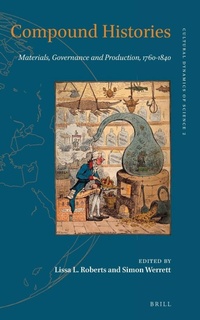
Compound Histories
Materials, Governance and Production, 1760-1840
Published on 1. December 2017
Book
Hardback
402 pages
978-90-04-32549-4 (ISBN)
Description
Compound Histories: Materials, Governance and Production, 1760-1840 offers a new view of the period during which Europe took on its modern character and globally dominant position. By exploring the intertwined realms of production, governance and materials, it places chemists and chemistry at the center of processes most closely identified with the construction of the modern world. This includes the interactive intensification of material and knowledge production; the growth and management of consumption; environmental changes, regulation of materials, markets, landscapes and societies; and practices embodied in political economy. Rather than emphasize revolutionary breaks and the primacy of innovation-driven change, the volume highlights the continuities and accumulation of incremental changes that framed historical development.
Contributors are: Robert G.W. Anderson, Bernadette Bensaude Vincent, Jose Ramon Bertomeu Sanchez, John R.R. Christie, Joppe van Driel, Frank A.J.L. James, Christine Lehman, Lissa L. Roberts, Thomas le Roux, Elena Serrano, Anna Simmons, Marie Thebaud-Sorger, Sacha Tomic, Andreas Weber, Simon Werrett.
Contributors are: Robert G.W. Anderson, Bernadette Bensaude Vincent, Jose Ramon Bertomeu Sanchez, John R.R. Christie, Joppe van Driel, Frank A.J.L. James, Christine Lehman, Lissa L. Roberts, Thomas le Roux, Elena Serrano, Anna Simmons, Marie Thebaud-Sorger, Sacha Tomic, Andreas Weber, Simon Werrett.
Reviews / Votes
"In this collection, Lissa L. Roberts and Simon Werrett propose an ambitious new agenda for examining relations between science and early industrial production, in which the centrality of chemistry is reasserted. [...] With fourteen chapters in total, the editors faced an obvious challenge of organisation, which they have met with a good measure of success. Each chapter has a well-developed introduction and conclusion, engaging with the common agenda for the volume. By articulating this agenda at length, the editors have also given a significant impulse to future research, and their comprehensive bibliography of secondary sources provides a handy resource for those investigations.- Jan Golinski (University of New Hampshire), Ambix|, 2018, 1-2, DOI 10.1080/00026980.2018.1488125.
Mobilized by the environmental crisis, these historians of science are tackling a
political and economic history of nitrogen,
aluminum, cobalt or uranium
unveiling the social, economic networks
and complex policies in connection with
agriculture, industry or even the
consumption, and revealing geographies
unpublished: in the case of aluminum,
Europe in the Antilles in the nineteenth century and then to
Postcolonial Ghana.
More details
Series
Language
English
Place of publication
Leiden
Netherlands
Target group
Professional and scholarly
Product notice
sewn/stitched
Cloth over boards
Dimensions
Height: 239 mm
Width: 160 mm
Thickness: 28 mm
Weight
680 gr
ISBN-13
978-90-04-32549-4 (9789004325494)
Copyright in bibliographic data and cover images is held by Nielsen Book Services Limited or by the publishers or by their respective licensors: all rights reserved.
Schweitzer Classification
Persons
Lissa L. Roberts, PhD. (1985), UCLA, is Professor of Long Term Development of Science and Technology at University of Twente. She serves also as editor-in-chief of the journal History of Science and co-edits the Brill Series "Cultural Dynamics of Science."
Simon Werrett, PhD. (2000), Cambridge, is Senior Lecturer in History and Philosophy of Science, University College, London. Author of Fireworks: Pyrotechnic Arts and Sciences in European History (2010), he is completing a new history of experimental philosophy entitled Thrifty Science.
Simon Werrett, PhD. (2000), Cambridge, is Senior Lecturer in History and Philosophy of Science, University College, London. Author of Fireworks: Pyrotechnic Arts and Sciences in European History (2010), he is completing a new history of experimental philosophy entitled Thrifty Science.
Content
Acknowledgments
List of Illustrations
Notes on Contributors
Introduction: "A More Intimate Acquaintance"
?Lissa Roberts and Simon Werrett
Part 1: Materials and Material Objects
1 Household Oeconomy and Chemical Inquiry
?Simon Werrett
2 The Case of Coal
?Lissa Roberts and Joppe van Driel
3 Capturing the Invisible: Heat, Steam and Gases in France and Great Britain, 1750-1800
?Marie Thebaud-Sorger
4 Spreading the Revolution: Guyton's Fumigating Machine in Spain. Politics, Technology, and Material Culture (1796-1808)
?Elena Serrano
5 Arsenic in France. The Cultures of Poison During the First Half of the Nineteenth Century
?Jose Ramon Bertomeu Sanchez
Part 2: Chemical Governance and the Governance of Chemistry
6 Relations between the State and the Chemical Industry in France, 1760-1800: The Case of Ceruse
?Christine Lehman
7 Between Industry and the Environment: Chemical Governance in France, 1770-1830
?Thomas Le Roux
8 Renegotiating Debt: Chemical Governance and Money in the Early Nineteenth-Century Dutch Empire
?Andreas Weber
9 How to Govern Chemical Courses. The Case of the Paris Ecole de pharmacie During Vauquelin's Direction, 1803-1829
?Sacha Tomic
Part 3: Revisiting the History of Production
10 Teaching Chemistry in the French Revolution: Pedagogy, Materials and Politics
?Bernadette Bensaude Vincent
11 The Subversive Humphry Davy: Aristocracy and Establishing Chemical Research Laboratories in Late Eighteenth- and Early Nineteenth-Century England
?Frank A.J.L. James
12 Wholesale Pharmaceutical Manufacturing in London, c.1760 - c.1840: Sites, Production and Networks
?Anna Simmons
13 Chemical Glasgow and its Entrepreneurs, 1760-1860
?John R.R. Christie
14 Relations between Industry and Academe in Scotland, and the Case of Dyeing: 1760 to 1840
?Robert G.W. Anderson
Bibliography of Secondary Sources
List of Illustrations
Notes on Contributors
Introduction: "A More Intimate Acquaintance"
?Lissa Roberts and Simon Werrett
Part 1: Materials and Material Objects
1 Household Oeconomy and Chemical Inquiry
?Simon Werrett
2 The Case of Coal
?Lissa Roberts and Joppe van Driel
3 Capturing the Invisible: Heat, Steam and Gases in France and Great Britain, 1750-1800
?Marie Thebaud-Sorger
4 Spreading the Revolution: Guyton's Fumigating Machine in Spain. Politics, Technology, and Material Culture (1796-1808)
?Elena Serrano
5 Arsenic in France. The Cultures of Poison During the First Half of the Nineteenth Century
?Jose Ramon Bertomeu Sanchez
Part 2: Chemical Governance and the Governance of Chemistry
6 Relations between the State and the Chemical Industry in France, 1760-1800: The Case of Ceruse
?Christine Lehman
7 Between Industry and the Environment: Chemical Governance in France, 1770-1830
?Thomas Le Roux
8 Renegotiating Debt: Chemical Governance and Money in the Early Nineteenth-Century Dutch Empire
?Andreas Weber
9 How to Govern Chemical Courses. The Case of the Paris Ecole de pharmacie During Vauquelin's Direction, 1803-1829
?Sacha Tomic
Part 3: Revisiting the History of Production
10 Teaching Chemistry in the French Revolution: Pedagogy, Materials and Politics
?Bernadette Bensaude Vincent
11 The Subversive Humphry Davy: Aristocracy and Establishing Chemical Research Laboratories in Late Eighteenth- and Early Nineteenth-Century England
?Frank A.J.L. James
12 Wholesale Pharmaceutical Manufacturing in London, c.1760 - c.1840: Sites, Production and Networks
?Anna Simmons
13 Chemical Glasgow and its Entrepreneurs, 1760-1860
?John R.R. Christie
14 Relations between Industry and Academe in Scotland, and the Case of Dyeing: 1760 to 1840
?Robert G.W. Anderson
Bibliography of Secondary Sources