

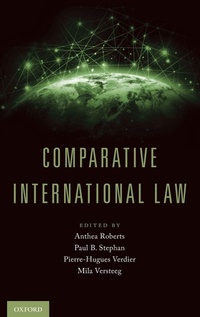
Comparative International Law
Published on 22. February 2018
Book
Hardback
636 pages
978-0-19-069757-0 (ISBN)
Description
By definition, international law, once agreed upon and consented to, applies to all parties equally. It is perhaps the one area of law where cross-country comparison seems inappropriate, because all parties are governed by the same rules. However, as this book explains, states sometimes adhere to similar, and at other times, adopt different interpretations of the same international norms and standards. International legal rules are not a monolithic whole, but are the basis for ongoing contestation in which states set forth competing interpretations. International norms are interpreted and redefined by national executives, legislatures, and judiciaries. These varying and evolving interpretations can, in turn, change and impact the international rules themselves. These similarities and differences make for an important, but thus far, largely unexamined object of comparison. This is the premise for this book, and for what the editors call "comparative international law."
This book achieves three objectives. The first is to show that international law is not a monolith. The second is to map the cross-country similarities and differences in international legal norms in different fields of international law, as well as their application and interpretation with regards to geographic differences. The third is to make a first and preliminary attempt to explain these differences. It is organized into three broad thematic sections, exploring: conceptual matters, domestic institutions and comparative international law, and comparing approaches across issue-areas. The chapters are authored by contributors who include leading international law and comparative law scholars with diverse backgrounds, experience, and perspectives.
This book achieves three objectives. The first is to show that international law is not a monolith. The second is to map the cross-country similarities and differences in international legal norms in different fields of international law, as well as their application and interpretation with regards to geographic differences. The third is to make a first and preliminary attempt to explain these differences. It is organized into three broad thematic sections, exploring: conceptual matters, domestic institutions and comparative international law, and comparing approaches across issue-areas. The chapters are authored by contributors who include leading international law and comparative law scholars with diverse backgrounds, experience, and perspectives.
Reviews / Votes
This well-structured volume assembles an impressive roster of contributions to the intriguing new field of comparative international law. * Judge Joan Donoghue, International Court of Justice * To meet the challenge of a universally recognized rule of law, one needs to understand how and why nations and regions approach international law in different ways. This refreshing collection of essays on comparative international law examines what is vaguely perceived to be true but not acknowledged: that there are major variations in state practice when giving effect to international obligations. * Gillian Triggs, Emeritus Professor, Sydney Law School, and former President, Australian Human Rights Commission * This publication is an important step in the development of comparative international law and it is likely to be highly influential in both the study and the practice of the law. * Lord Lloyd Jones, Supreme Court of the United Kingdom * This volume is indispensable to anyone interested in studying why approaches to international law often vary around the world. * Curtis A. Bradley, William Van Alstyne Professor, Duke Law School * This wide-ranging volume firmly establishes comparative international law as a rich field of study... A refreshing and sophisticated response to theories that advocate hierachy in the name of an international rule of law. * Eyal Benvenisti, Whewell Professor of International Law, University of Cambridge * The book ... is produced to the excellent and attractive standard of OUP at, these days, a favorable price. * William E. Butler, Journal of Comparative Law *More details
Language
English
Place of publication
New York
United States
Target group
Professional and scholarly
Dimensions
Height: 240 mm
Width: 161 mm
Thickness: 38 mm
Weight
1109 gr
ISBN-13
978-0-19-069757-0 (9780190697570)
Copyright in bibliographic data and cover images is held by Nielsen Book Services Limited or by the publishers or by their respective licensors: all rights reserved.
Schweitzer Classification
Other editions
Additional editions
Anthea Roberts | Paul B. Stephan | Pierre-Hugues Verdier
Comparative International Law
E-Book
12/2017
1st Edition
OUP eBook
€76.49
Available for download
Anthea Roberts | Paul B. Stephan | Pierre-Hugues Verdier
Comparative International Law
E-Book
12/2017
1st Edition
OUP eBook
€59.99
Available for download
Persons
Anthea Roberts is Associate Professor at the RegNet School of Regulation and Global Governance, Australian National University, College of Asia and the Pacific. She won ASIL's Frances Deak Prize in 2002 and 2011, and currently serves as a Reporter for the American Law Institute's--Restatement (Fourth) of the Foreign Relations Law of the United States (for jurisdiction). She authored Is International Law International? (Oxford 2017).
Paul B. Stephan is John C. Jeffries, Jr., Distinguished Professor of Law, and John V. Ray Research Professor at the University of Virginia School of Law. He specializes in international business, international dispute resolution, and comparative law, with special focus on Soviet and post-Soviet legal systems. He is presently a coordinating reporter for the American Law Institute's--Restatement (Fourth) of the Foreign Relations Law of the United States.
Pierre-Hugues Verdier is Professor of Law at the University of Virginia School of Law. He specializes in the areas of public international law, banking and financial regulation, and international economic relations. He is currently working on a book-length project focusing on U.S. and foreign prosecutions targeting global banks.
Mila Versteeg is Class of 1941 Research Professor of Law and Director of the Human Rights Program at the University of Virginia School of Law. She specializes in comparative constitutional law, public international law, and empirical legal studies. She also focuses on the origins, evolution, and effectiveness of provisions in the world's constitutions. Her writings have been published in the California Law Review, the New York University Law Review, the University of Chicago Law Review, the American Political Science Review, the American Journal of Political Science, the Journal of Legal Studies, the American Journal of International Law, and the Journal of Law, Economics and Organizations.
Paul B. Stephan is John C. Jeffries, Jr., Distinguished Professor of Law, and John V. Ray Research Professor at the University of Virginia School of Law. He specializes in international business, international dispute resolution, and comparative law, with special focus on Soviet and post-Soviet legal systems. He is presently a coordinating reporter for the American Law Institute's--Restatement (Fourth) of the Foreign Relations Law of the United States.
Pierre-Hugues Verdier is Professor of Law at the University of Virginia School of Law. He specializes in the areas of public international law, banking and financial regulation, and international economic relations. He is currently working on a book-length project focusing on U.S. and foreign prosecutions targeting global banks.
Mila Versteeg is Class of 1941 Research Professor of Law and Director of the Human Rights Program at the University of Virginia School of Law. She specializes in comparative constitutional law, public international law, and empirical legal studies. She also focuses on the origins, evolution, and effectiveness of provisions in the world's constitutions. Her writings have been published in the California Law Review, the New York University Law Review, the University of Chicago Law Review, the American Political Science Review, the American Journal of Political Science, the Journal of Legal Studies, the American Journal of International Law, and the Journal of Law, Economics and Organizations.
Editor
Associate ProfessorAssociate Professor, RegNet School of Regulation and Global Governance, Australian National University.
John C. Jeffries, Jr., Distinguished Professor of Law, and John V. Ray Research ProfessorJohn C. Jeffries, Jr., Distinguished Professor of Law, and John V. Ray Research Professor, University of Virginia School of Law
Professor of LawProfessor of Law, University of Virginia School of Law
Professor of Law, and Director, Human Rights ProgramProfessor of Law, and Director, Human Rights Program, University of Virginia School of Law
Content
Contributors
Introduction
1. Conceptualizing Comparative International Law
Anthea Roberts, Paul Stephan, Pierre-Hugues Verdier & Mila Versteeg
Part 1: Comparative International Law and Related Fields: Comparative Politics, Foreign Relations Law, and International Relations
2. Methodological Guidance: How to Select and Develop Comparative International Law Case Studies
Katerina Linos
3. Comparative International Law, Foreign Relations Law and Fragmentation: Can the Center Hold?
Paul B. Stephan
4. Why Comparative International Law Needs International Relations Theory
Daniel Abebe
Part 2: International Lawyers, the Academy, and Competing Conceptions of International Law
5. The Many Fields of (German) International Law
Nico Krisch
6. Crimea and the South China Sea: Connections and Disconnects Among Chinese, Russian, and Western International Lawyers
Anthea Roberts
7. "Shioki (Control)" "Fuyo (Dependency)," and Sovereignty: The Status of the Ryukyu Kingdom in Early-Modern and Modern Times
Masaharu Yanagihara
Part 3: Comparative International Law and International Institutions
8. Comparative International Law Within, Not Against, International Law: Lessons from the International Law Commission
Mathias Forteau
9. The Continuing Impact of French Legal Culture on the International Court of Justice
Mathilde Cohen
Part 4: Comparative International Law and Domestic Institutions: Legislatures and Executives
10. International Law in National Legal Systems: An Empirical Investigation
Pierre-Hugues Verdier & Mila Versteeg
11. Objections to Treaty Reservations: A Comparative Approach to Decentralized Interpretation
Tom Ginsburg
12. Intelligence Communities and International Law: A Comparative Approach
Ashley S. Deeks
13. National Legislatures: The Foundations of Comparative International Law
Kevin L. Cope & Hooman Movassagh
Part 5: Comparative International Law and Domestic Institutions: National Courts
14. International Law in Chinese Courts During the Rise of China
Congyan Cai
15. The Democratizing Force of International Law: Human Rights Adjudication by the Indian Supreme Court Neha Jain
16. Case Law in Russian Approaches to International Law: Sovereign Cautiousness of a Semi-Peripheral Great Power
Lauri Maelksoo
17. Doing Away with Capital Punishment in Russia: International Law and the Pursuit of Domestic Constitutional Goals
Bakhtiyar Tuzmukhamedov
Part 6: Comparative International Law and Human Rights
18. Comparative Views on the Right to Vote in International Law: the Case of Prisoners' Disenfranchisement Shai Dothan
19. When Law Migrates: Refugees in Comparative International Law
Jill I. Goldenziel
20. An Asymmetric Comparative International Law Approach to Treaty Interpretation: The CEDAW Committee's Tolerance of the Scandinavian States' Progressive Deviation
Alec Knight
21. Comparative International Law and Human Rights: A Value-Added Approach
Christopher McCrudden
22. CEDAW in National Courts: A Case Study in Operationalizing Comparative International Law Analysis in a Human Rights Context
Christopher McCrudden
23. The Great Promise of Comparative Public Law for Latin America: Towards ius commune americanum? Alejandro Rodiles
Part 7: Comparative International Law, Investment, and Law of the Sea
24. Who Cares about Regulatory Space in BITs? A Comparative International Approach
Tomer Broude, Yoram Z. Haftel & Alexander Thompson
25. Africa and the Rethinking of International Investment Law: About the Elaboration of the Pan-African Investment Code
Makane Moise Mbengue & Stefanie Schacherer
26. Not So Treacherous Waters of International Maritime Law: Islamic Law States and the UN Convention on the Law of the Sea
Emilia Justyna Powell
Index
Introduction
1. Conceptualizing Comparative International Law
Anthea Roberts, Paul Stephan, Pierre-Hugues Verdier & Mila Versteeg
Part 1: Comparative International Law and Related Fields: Comparative Politics, Foreign Relations Law, and International Relations
2. Methodological Guidance: How to Select and Develop Comparative International Law Case Studies
Katerina Linos
3. Comparative International Law, Foreign Relations Law and Fragmentation: Can the Center Hold?
Paul B. Stephan
4. Why Comparative International Law Needs International Relations Theory
Daniel Abebe
Part 2: International Lawyers, the Academy, and Competing Conceptions of International Law
5. The Many Fields of (German) International Law
Nico Krisch
6. Crimea and the South China Sea: Connections and Disconnects Among Chinese, Russian, and Western International Lawyers
Anthea Roberts
7. "Shioki (Control)" "Fuyo (Dependency)," and Sovereignty: The Status of the Ryukyu Kingdom in Early-Modern and Modern Times
Masaharu Yanagihara
Part 3: Comparative International Law and International Institutions
8. Comparative International Law Within, Not Against, International Law: Lessons from the International Law Commission
Mathias Forteau
9. The Continuing Impact of French Legal Culture on the International Court of Justice
Mathilde Cohen
Part 4: Comparative International Law and Domestic Institutions: Legislatures and Executives
10. International Law in National Legal Systems: An Empirical Investigation
Pierre-Hugues Verdier & Mila Versteeg
11. Objections to Treaty Reservations: A Comparative Approach to Decentralized Interpretation
Tom Ginsburg
12. Intelligence Communities and International Law: A Comparative Approach
Ashley S. Deeks
13. National Legislatures: The Foundations of Comparative International Law
Kevin L. Cope & Hooman Movassagh
Part 5: Comparative International Law and Domestic Institutions: National Courts
14. International Law in Chinese Courts During the Rise of China
Congyan Cai
15. The Democratizing Force of International Law: Human Rights Adjudication by the Indian Supreme Court Neha Jain
16. Case Law in Russian Approaches to International Law: Sovereign Cautiousness of a Semi-Peripheral Great Power
Lauri Maelksoo
17. Doing Away with Capital Punishment in Russia: International Law and the Pursuit of Domestic Constitutional Goals
Bakhtiyar Tuzmukhamedov
Part 6: Comparative International Law and Human Rights
18. Comparative Views on the Right to Vote in International Law: the Case of Prisoners' Disenfranchisement Shai Dothan
19. When Law Migrates: Refugees in Comparative International Law
Jill I. Goldenziel
20. An Asymmetric Comparative International Law Approach to Treaty Interpretation: The CEDAW Committee's Tolerance of the Scandinavian States' Progressive Deviation
Alec Knight
21. Comparative International Law and Human Rights: A Value-Added Approach
Christopher McCrudden
22. CEDAW in National Courts: A Case Study in Operationalizing Comparative International Law Analysis in a Human Rights Context
Christopher McCrudden
23. The Great Promise of Comparative Public Law for Latin America: Towards ius commune americanum? Alejandro Rodiles
Part 7: Comparative International Law, Investment, and Law of the Sea
24. Who Cares about Regulatory Space in BITs? A Comparative International Approach
Tomer Broude, Yoram Z. Haftel & Alexander Thompson
25. Africa and the Rethinking of International Investment Law: About the Elaboration of the Pan-African Investment Code
Makane Moise Mbengue & Stefanie Schacherer
26. Not So Treacherous Waters of International Maritime Law: Islamic Law States and the UN Convention on the Law of the Sea
Emilia Justyna Powell
Index