

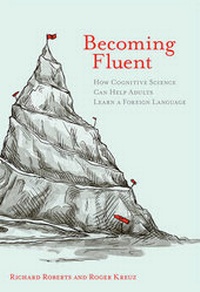
Becoming Fluent
How Cognitive Science Can Help Adults Learn a Foreign Language
Published on 7. August 2015
Book
Hardback
248 pages
978-0-262-02923-0 (ISBN)
Description
How adult learners can draw upon skills and knowledge honed over a lifetime to master a foreign language.
Adults who want to learn a foreign language are often discouraged because they believe they cannot acquire a language as easily as children. Once they begin to learn a language, adults may be further discouraged when they find the methods used to teach children don't seem to work for them. What is an adult language learner to do? In this book, Richard Roberts and Roger Kreuz draw on insights from psychology and cognitive science to show that adults can master a foreign language if they bring to bear the skills and knowledge they have honed over a lifetime. Adults shouldn't try to learn as children do; they should learn like adults.
Roberts and Kreuz report evidence that adults can learn new languages even more easily than children. Children appear to have only two advantages over adults in learning a language: they acquire a native accent more easily, and they do not suffer from self-defeating anxiety about learning a language. Adults, on the other hand, have the greater advantages -- gained from experience -- of an understanding of their own mental processes and knowing how to use language to do things. Adults have an especially advantageous grasp of pragmatics, the social use of language, and Roberts and Kreuz show how to leverage this metalinguistic ability in learning a new language.
Learning a language takes effort. But if adult learners apply the tools acquired over a lifetime, it can be enjoyable and rewarding.
Adults who want to learn a foreign language are often discouraged because they believe they cannot acquire a language as easily as children. Once they begin to learn a language, adults may be further discouraged when they find the methods used to teach children don't seem to work for them. What is an adult language learner to do? In this book, Richard Roberts and Roger Kreuz draw on insights from psychology and cognitive science to show that adults can master a foreign language if they bring to bear the skills and knowledge they have honed over a lifetime. Adults shouldn't try to learn as children do; they should learn like adults.
Roberts and Kreuz report evidence that adults can learn new languages even more easily than children. Children appear to have only two advantages over adults in learning a language: they acquire a native accent more easily, and they do not suffer from self-defeating anxiety about learning a language. Adults, on the other hand, have the greater advantages -- gained from experience -- of an understanding of their own mental processes and knowing how to use language to do things. Adults have an especially advantageous grasp of pragmatics, the social use of language, and Roberts and Kreuz show how to leverage this metalinguistic ability in learning a new language.
Learning a language takes effort. But if adult learners apply the tools acquired over a lifetime, it can be enjoyable and rewarding.
More details
Series
Language
English
Place of publication
Cambridge, Mass.
United States
Publishing group
MIT Press Ltd
Target group
US School Grade: College Graduate Student and over
Illustrations
4 Zeichnungen
4 line drawings
Dimensions
Height: 203 mm
Width: 137 mm
Thickness: 16 mm
ISBN-13
978-0-262-02923-0 (9780262029230)
Copyright in bibliographic data and cover images is held by Nielsen Book Services Limited or by the publishers or by their respective licensors: all rights reserved.
Schweitzer Classification
Other editions
Additional editions
Richard Roberts | Roger Kreuz
Becoming Fluent
How Cognitive Science Can Help Adults Learn a Foreign Language
Book
02/2017
MIT Press
€26.50
Article not available at the moment
Richard Roberts | Roger Kreuz
Becoming Fluent
How Cognitive Science Can Help Adults Learn a Foreign Language
E-Book
08/2015
MIT Press
€22.49
Available for download
Persons
Richard Roberts, currently a Foreign Service Officer in the US Department of State, taught psychology in Europe and Asia with the University of Maryland University College. Roger Kreuz is Professor of Psychology and Associate Dean of the College of Arts and Sciences at the University of Memphis.