

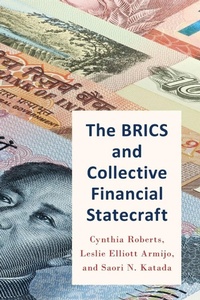
The BRICS and Collective Financial Statecraft
Published on 7. December 2017
Book
Paperback/Softback
288 pages
978-0-19-069752-5 (ISBN)
Description
In the first decade of the 21st century, five rising powers (Brazil, Russia, India, China, and South Africa) formed an exclusive and informal international club, the BRICS. Although neither revolutionaries nor extreme revisionists, the BRICS perceive an ongoing global power shift and contest the West's pretensions to permanent stewardship of the existing economic order. Together they have exercised collective financial statecraft, employing their expanding financial and monetary capabilities for the purpose of achieving larger foreign policy goals. This volume examines the forms and strategies of such collective financial statecraft, and the motivations of each individual government for collaborating through the BRICS club. Their cooperative financial statecraft takes various forms, ranging from pressure for "inside reforms" of either multilateral institutions or global markets, to "outside options" exercised through creating new multilateral institutions or jointly pushing for new realities in international financial markets. To the surprise of many observers, the joint actions of the BRICS are largely successful. Although each member has its unique rationale for collaboration, the largest member, China, controls resources that permit it the greatest influence in intra-club decision-making. The BRICS cooperate due to both common aversions (for example, resentment over being perennial junior partners in global economic and financial governance and resistance to infringements on their autonomy due to U.S. dollar dominance and financial power) and common interests (such as obtaining greater voice in international institutions, as the IMF). The group seeks reforms, influence, and enhanced leadership roles within the liberal capitalist global system. Where blocked, they experiment with parallel multilateral institutions in which they are the dominant rule-makers. The future of the BRICS depends not only on their bargaining power and adjustment to market players, but also on their ability to overcome domestic impediments to sustainable economic growth, the basis for their international influence.
Reviews / Votes
This book provides an authoritative, comprehensive, and lucid account of the rise of the BRICS. A compelling narrative about how a group of economies, which have some congruent interests but are simultaneously competitors in many other areas, have set aside their differences and come together as a force to reckon with in global finance. * Eswar Prasad, Tolani Senior Professor of Trade Policy, Cornell University, and Senior Fellow at the Brookings Institution * Here is a book that sceptics of the BRICS must read. Through careful and nuanced analysis, the authors show why no serious analyst of global financial governance can ignore this grouping any longer. * Eric Helleiner, Professor of Political Science, University of Waterloo * Daniel McDowell's book, Bucking the Buck: US Financial Sanctions and the International Backlash against the Dollar, makes a revelatory contribution from the US' perspective built upon meticulous case assessments and empirical analyses. * China International Strategy Review *More details
Language
English
Place of publication
New York
United States
Target group
College/higher education
Dimensions
Height: 234 mm
Width: 156 mm
Thickness: 17 mm
Weight
488 gr
ISBN-13
978-0-19-069752-5 (9780190697525)
Copyright in bibliographic data and cover images is held by Nielsen Book Services Limited or by the publishers or by their respective licensors: all rights reserved.
Schweitzer Classification
Other editions
Additional editions
Cynthia Roberts | Leslie Elliott Armijo | Saori Katada
The BRICS and Collective Financial Statecraft
Book
12/2017
Oxford University Press Inc
€195.60
Shipment within 15-20 days
Cynthia Roberts | Leslie Armijo | Saori Katada
The BRICS and Collective Financial Statecraft
E-Book
10/2017
OUP eBook
€18.99
Available for download
Cynthia Roberts | Leslie Armijo | Saori Katada
The BRICS and Collective Financial Statecraft
E-Book
10/2017
OUP eBook
€24.99
Available for download
Persons
Cynthia Roberts is Associate Professor of Political Science at Hunter College, CUNY; Senior Associate at the Saltzman Institute of War and Peace Studies and Adjunct Associate Professor of International Affairs at Columbia University. Her research focuses on the BRICS, international power shifts, and the liberal world order, and the strategies of major powers. She received her M.A., M.Phil. and Ph.D. from Columbia University and Certificate from the Harriman Institute.
Leslie Elliott Armijo teaches Political Economy and Development at the School for International Studies, Simon Fraser University, and has held Visiting Professorships in Brazil (2015) and Germany (2011). She investigates the politics of national and international economic policymaking, and their relationship to democratic consolidation, especially in Brazil, India, and large emerging economies. She holds degrees from Cornell University (B.A.) and the University of California, Berkeley (Ph.D).
Saori N. Katada is Associate Professor at School of International Relations at University of Southern California. Katada is the author of several books and numerous articles on trade, financial and monetary cooperation in East Asia and foreign aid. She has her Ph.D. from the University of North Carolina at Chapel Hill (Political Science) and B.A. from Hitotsubashi University (Tokyo). Before joining USC, she worked at the World Bank (Washington D.C.), and the UNDP (Mexico City).
Leslie Elliott Armijo teaches Political Economy and Development at the School for International Studies, Simon Fraser University, and has held Visiting Professorships in Brazil (2015) and Germany (2011). She investigates the politics of national and international economic policymaking, and their relationship to democratic consolidation, especially in Brazil, India, and large emerging economies. She holds degrees from Cornell University (B.A.) and the University of California, Berkeley (Ph.D).
Saori N. Katada is Associate Professor at School of International Relations at University of Southern California. Katada is the author of several books and numerous articles on trade, financial and monetary cooperation in East Asia and foreign aid. She has her Ph.D. from the University of North Carolina at Chapel Hill (Political Science) and B.A. from Hitotsubashi University (Tokyo). Before joining USC, she worked at the World Bank (Washington D.C.), and the UNDP (Mexico City).
Author
Associate Professor of Political ScienceAssociate Professor of Political Science, Hunter College
Visiting Scholar and Non-Resident FellowVisiting Scholar and Non-Resident Fellow, Portland State U and American Univ.
Associate Professor of International RelationsAssociate Professor of International Relations, USC
Content
1. Introduction: The BRICS as a Club
BRICS in the Aftermath of the Global Financial Crisis
Strategic Incentives in Unipolarity and Common Aversions
The BRICS and the Global Governance System
Formal Institutions and Informal Powers: The Emergence of Clubs
The BRICS as a Club
Clubs with Power Asymmetries and Dominant Powers with Outside Options
Plan of the Book
2. Global Power Shift: The BRICS, Building Capabilities for Influence
Conceptualizing Power
Measuring the Shift in Economic Capabilities
A New, Multipolar World?
The Global Financial and Monetary Capabilities of the BRICS
Redback Rising
Conclusions
3. BRICS Collective Financial Statecraft: Four Cases
Defining Collective Financial Statecraft
Four Categories of Collective Financial Statecraft
Inside Reforms: The BRICS Quest for Greater Influence Within the IMF and World Bank (Case 1)
Inside Reforms: Resist Manipulation of Financial Market Power for U.S./Western Political Aims (Case 2)
Outside Options: Create Parallel Financial Institutions Controlled by the BRICS (Case 3)
Outside Options: Diminish Dollar Dominance and Build the Financial Market
Power of the RMB (Case 4)
Future Directions and Cooperative Opportunities Not Taken
Conclusion: Mostly Successful BRICS Collective Financial Statecraft
4. Motives for BRICS Collaboration: Views from the Five Capitals
Six Propositions
The View from Beijing: In Search of Legitimacy and Unthreatening Leadership
The View from Moscow: Russia's Struggle for Autonomy and International Influence
The View from New Delhi: Amplifying Voice and Anticipating Multipolarity
The View from Brasilia: Enhancing Status and Inviting Investment
The View from Pretoria: Support for Growth and Regional Leadership
Conclusions: Explaining BRICS Collaboration
5. Conclusion: Whither the BRICS?
BRICS and World Order: Too Much Pessimism Is Unwarranted
Growth: The Essential Need to Return to the BRICS' Roots
The Tension Between Formal and Informal Rules
Summing up: The BRICS, Collective Financial Statecraft, and the Multipolar Future
Notes
Index
BRICS in the Aftermath of the Global Financial Crisis
Strategic Incentives in Unipolarity and Common Aversions
The BRICS and the Global Governance System
Formal Institutions and Informal Powers: The Emergence of Clubs
The BRICS as a Club
Clubs with Power Asymmetries and Dominant Powers with Outside Options
Plan of the Book
2. Global Power Shift: The BRICS, Building Capabilities for Influence
Conceptualizing Power
Measuring the Shift in Economic Capabilities
A New, Multipolar World?
The Global Financial and Monetary Capabilities of the BRICS
Redback Rising
Conclusions
3. BRICS Collective Financial Statecraft: Four Cases
Defining Collective Financial Statecraft
Four Categories of Collective Financial Statecraft
Inside Reforms: The BRICS Quest for Greater Influence Within the IMF and World Bank (Case 1)
Inside Reforms: Resist Manipulation of Financial Market Power for U.S./Western Political Aims (Case 2)
Outside Options: Create Parallel Financial Institutions Controlled by the BRICS (Case 3)
Outside Options: Diminish Dollar Dominance and Build the Financial Market
Power of the RMB (Case 4)
Future Directions and Cooperative Opportunities Not Taken
Conclusion: Mostly Successful BRICS Collective Financial Statecraft
4. Motives for BRICS Collaboration: Views from the Five Capitals
Six Propositions
The View from Beijing: In Search of Legitimacy and Unthreatening Leadership
The View from Moscow: Russia's Struggle for Autonomy and International Influence
The View from New Delhi: Amplifying Voice and Anticipating Multipolarity
The View from Brasilia: Enhancing Status and Inviting Investment
The View from Pretoria: Support for Growth and Regional Leadership
Conclusions: Explaining BRICS Collaboration
5. Conclusion: Whither the BRICS?
BRICS and World Order: Too Much Pessimism Is Unwarranted
Growth: The Essential Need to Return to the BRICS' Roots
The Tension Between Formal and Informal Rules
Summing up: The BRICS, Collective Financial Statecraft, and the Multipolar Future
Notes
Index