

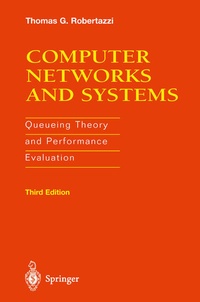
Computer Networks and Systems
Queueing Theory and Performance Evaluation
3rd Edition
Published on 22. June 2000
Book
Hardback
XIII, 409 pages
978-0-387-95037-2 (ISBN)
Description
Statistical performance evaluation has assumed an increasing amount of importance as we seek to design more and more sophisticated communication and information processing systems. The ability to predict a proposed system's per formance before one constructs it is an extremely cost effective design tool. This book is meant to be a first-year graduate level introduction to the field of statistical performance evaluation. It is intended for people who work with sta tistical performance evaluation including engineers, computer scientists and applied mathematicians. As such, it covers continuous time queueing theory (chapters 1-4), stochastic Petri networks (chapter 5), discrete time queueing theory (chapter 6) and recent network traffic modeling work (chapter 7). There is a short appendix at the end of the book that reviews basic probability theory. This material can be taught as a complete semester long course in performance evalua tion or queueing theory. Alternatively, one may teach only chapters 2 and 6 in the first half of an introductory computer networking course, as is done at Stony Brook. The second half of the course could use a more protocol oriented text such as ones by Saadawi [SAAD] or Stallings [STALl What is new in the third edition of this book? In addition to the well received material of the second edition, this edition has three major new features.
More details
Edition
Third Edition 2000
Language
English
Place of publication
New York
United States
Target group
Primary & secondary/elementary & high school
Graduate
Edition type
New edition
Illustrations
XIII, 409 p.
Dimensions
Height: 241 mm
Width: 160 mm
Thickness: 28 mm
Weight
805 gr
ISBN-13
978-0-387-95037-2 (9780387950372)
DOI
10.1007/978-1-4612-1164-8
Schweitzer Classification
Other editions
Additional editions
Book
10/2012
3rd Edition
Springer
€53.49
Shipment within 15-20 days
Previous edition
Thomas G. Robertazzi
Computer Networks and Systems
Book
07/2012
2nd Edition
Springer
€109.13
Article exhausted; check for reprint
Content
1: The Queueing Paradigm.- 1.1 Introduction.- 1.2 Queueing Theory.- 1.3 Queueing Models.- 1.4 Case Study I: Performance Model of a Distributed File Service By W.G. Nichols and J.S. Emer.- 1.5 Case Study II: Single-bus Multiprocessor Modeling By B.L. Bodnar and A.C. Liu.- 1.6 Case Study III: TeraNet, A Lightwave Network.- 1.7 Case Study IV: Performance Model of a Shared Medium Packet Switch By R. Guerin.- 2: Single Queueing Systems.- 2.1 Introduction.- 2.2 The M/M/1 Queueing System.- 2.3 Little's Law.- 2.4 Reversibility and Burke's Theorem.- 2.5 The State Dependent M/M/1 Queueing System.- 2.6 The M/M/1/N Queueing System: The Finite Buffer Case.- 2.7 The M/M/? Queueing System: Infinite Number of Servers.- 2.8 The M/M/m Queueing System: m Parallel Servers with a Queue.- 2.9 The M/M/m/m Queue: A Loss System.- 2.10 Central Server CPU Model.- 2.11 Transient Solution of the M/M/1/? Queueing System.- 2.12 The M/G/1 Queueing System.- 2.13 Priority Systems for Multiclass Traffic.- To Look Further.- Problems.- 3: Networks of Queues.- 3.1 Introduction.- 3.2 The Product Form Solution.- 3.3 Algebraic Topological Interpretation of the Product Form Solution.- 3.4 Recursive Solution of Nonproduct Form Networks.- 3.5 Queueing Networks with Negative Customers.- To Look Further.- Problems.- 4: Numerical Solution of Models.- 4.1 Introduction.- 4.2 Closed Queueing Networks: Convolution Algorithm.- 4.3 Mean Value Analysis.- 4.4 PANACEA: Approach for Large Markovian Queueing Networks.- 4.5 Norton's Equivalent for Queueing Networks.- 4.6 Simulation of Communication Networks By J.F. Kurose and H.T. Mouftah.- To Look Further.- Problems.- 5: Stochastic Petri Nets.- 5.1 Introduction.- 5.2 Bus-oriented Multiprocessor Model.- 5.3 Toroidal MPN Lattices.- 5.4 The Dining Philosophers Problem.-5.5 A Station-oriented CSMA/CD Protocol Model.- 5.6 The Alternating Bit Protocol.- 5.7 SPN's without Product Form Solutions.- 5.8 Conclusion.- To Look Further.- Problems.- 6: Discrete Time Queueing Systems.- 6.1 Introduction.- 6.2 Discrete Time Queueing Systems.- 6.3 Discrete Time Arrival Processes.- 6.4 The Geom/Geom/m/N Queueing System.- 6.5 The Geom/Geom/1/N and Geom/Geom/1 Queueing Systems.- 6.6 Case Study I: Queueing on a Space Division Packet Switch.- 6.7 Case Study II: Queueing on a Single-buffered Banyan Network.- 6.8 Case Study III: DQDB Erasure Station Location.- To Look Further.- Problems.- 7: Network Traffic Modeling.- 7.1 Introduction.- 7.2 Continuous Time Models.- 7.3 Discrete Time Models.- 7.4 Solution Methods.- 7.5 Burstiness.- 7.6 Self-Similar Traffic.- To Look Further.- Appendix: Probability Theory Review.- A.1 Probability.- A.2 Densities and Distribution Functions.- A.3 Joint Densities and Distributions.- A.4 Expectations.- A.5 Convolution.- A.6 Combinatorics.- A.7 Some Useful Summations.- A.8 Useful Moment-generating Function Identities.- References.