

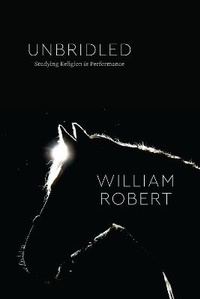
Unbridled
Studying Religion in Performance
Published on 27. July 2022
Book
Hardback
144 pages
978-0-226-81658-6 (ISBN)
Description
A study of religion through the lens of Peter Shaffer's play Equus.
In Unbridled, William Robert uses Equus, Peter Shaffer's enigmatic play about a boy passionately devoted to horses, to think differently about religion. For several years, Robert has used Equus to introduce students to the study of religion, provoking them to conceive of religion in unfamiliar, even uncomfortable ways. In Unbridled, he is inviting readers to do the same.
A play like Equus tangles together text, performance, practice, embodiment, and reception. Studying a play involves us in playing different roles, as ourselves and others, and those roles, as well as the imaginative work they require, are critical to the study of religion. By approaching Equus with the reader, turning the play around and upside-down, Unbridled transforms standard approaches to the study of religion, engaging with themes including ritual, sacrifice, worship, power, desire, violence, and sexuality, as well as thinkers including Judith Butler, Sigmund Freud, Karl Marx, Friedrich Nietzsche, and Jonathan Z. Smith. As Unbridled shows, the way themes and theories play out in Equus challenges us to reimagine the study of religion through open questions, contrasting perspectives, and alternative modes of interpretation and appreciation.
In Unbridled, William Robert uses Equus, Peter Shaffer's enigmatic play about a boy passionately devoted to horses, to think differently about religion. For several years, Robert has used Equus to introduce students to the study of religion, provoking them to conceive of religion in unfamiliar, even uncomfortable ways. In Unbridled, he is inviting readers to do the same.
A play like Equus tangles together text, performance, practice, embodiment, and reception. Studying a play involves us in playing different roles, as ourselves and others, and those roles, as well as the imaginative work they require, are critical to the study of religion. By approaching Equus with the reader, turning the play around and upside-down, Unbridled transforms standard approaches to the study of religion, engaging with themes including ritual, sacrifice, worship, power, desire, violence, and sexuality, as well as thinkers including Judith Butler, Sigmund Freud, Karl Marx, Friedrich Nietzsche, and Jonathan Z. Smith. As Unbridled shows, the way themes and theories play out in Equus challenges us to reimagine the study of religion through open questions, contrasting perspectives, and alternative modes of interpretation and appreciation.
Reviews / Votes
"Unbridled is a kaleidoscopic book that poses questions and gets one's theoretical imagination working." * History of Religions * "William Robert?s Unbridled: Studying Religion in Performance is both an interdisciplinary work and a novel return to basics. Examining the methodology of studying religions through the lens of dramaturgy, performance studies, and other relational disciplines, the novelty of Robert?s book lies in using the performance of a single play-Peter Schaffer?s Equus-to help shed light on how religions could be studied." * Reading Religion * "Unbridled treats Equus as a prism through which to reimagine the study of religion, asking urgent questions and inviting us to critically rethink methods as openings. With an inviting mix of confidence and humility, Robert reinvigorates pedagogical discussions, delivering insights about the difference between reverence and devotion, the meaning of critique, and the nature of literature. Every page provokes thoughts about how we teach and think about religion, and how we might do it otherwise." -- Constance M. Furey, coauthor of Devotion: Three Inquiries in Religion, Literature, and Political Imagination "Unbridled is a compelling, engaging, sophisticated provocation for how the study of religion might be done differently. Keeping his eyes fixed on Equus, Robert touches on themes central to the study of religion-performance, ritual, embodiment, sacrifice, image, worship, sexuality, violence-while also defamiliarizing the operation of these terms by following what Equus prompts us to think about them." -- Kent Brintnall, author of Ecce Homo: The Male-Body-in-Pain as Redemptive FigureMore details
Series
Language
English
Place of publication
Chicago
United States
Publishing group
The University of Chicago Press
Target group
Professional and scholarly
Dimensions
Height: 229 mm
Width: 152 mm
Thickness: 28 mm
Weight
340 gr
ISBN-13
978-0-226-81658-6 (9780226816586)
Copyright in bibliographic data and cover images is held by Nielsen Book Services Limited or by the publishers or by their respective licensors: all rights reserved.
Schweitzer Classification
Other editions
Additional editions
E-Book
02/2022
University of Chicago Press
€26.99
Available for download
Person
William Robert is associate professor of religion and director of LGBTQ studies at Syracuse University. He is the author of Revivals: Of Antigone and Trials: Of Antigone and Jesus.
Content
Playbill
Program Notes
Cast
Prologue
Act 1
1.1 Mise-en-scene
1.2 Imagination
1.3 Literature
1.4 Performance
1.5 Case
1.6 Terms
1.7 Problems
1.8 Question
Act 2
2.1 Staging
2.2 Performance-Text
2.3 Inter-
2.4 Mask
2.5 Play
2.6 Acting
2.7 Make-Believe
2.8 Play-in-Play
Act 3
3.1 Casting
3.2 Relations
3.3 Image
3.4 Human-Horse-Divinity
3.5 Devotion
3.6 Sexuality
3.7 Queer
3.8 Nude
Act 4
4.1 Directing
4.2 Passion
4.3 Pain
4.4 Normal
4.5 Tragedy
4.6 Sacrifice
4.7 Ending
4.8 Value
Epilogue
Encore
Credits
Notes
References
Index
Program Notes
Cast
Prologue
Act 1
1.1 Mise-en-scene
1.2 Imagination
1.3 Literature
1.4 Performance
1.5 Case
1.6 Terms
1.7 Problems
1.8 Question
Act 2
2.1 Staging
2.2 Performance-Text
2.3 Inter-
2.4 Mask
2.5 Play
2.6 Acting
2.7 Make-Believe
2.8 Play-in-Play
Act 3
3.1 Casting
3.2 Relations
3.3 Image
3.4 Human-Horse-Divinity
3.5 Devotion
3.6 Sexuality
3.7 Queer
3.8 Nude
Act 4
4.1 Directing
4.2 Passion
4.3 Pain
4.4 Normal
4.5 Tragedy
4.6 Sacrifice
4.7 Ending
4.8 Value
Epilogue
Encore
Credits
Notes
References
Index