

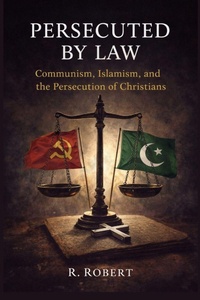
Persecuted by Law
Description
Persecuted by Law examines one of the most overlooked realities of religious persecution: that it is often carried out not through violence, but through legal systems.
Across the twentieth and twenty-first centuries, Christians have faced sustained repression under ideologically opposed regimes-from communist states in Eastern Europe and China to Islamist systems in the Middle East and Africa. While these ideologies differ radically in worldview, this book demonstrates how they repeatedly converge in practice when translated into law. Registration regimes, apostasy and blasphemy laws, security statutes, administrative licensing, and judicial discretion become tools through which conscience is regulated and faith is subordinated to power.
Rather than treating persecution as isolated incidents or cultural hostility, Persecuted by Law approaches the subject as a legal and institutional phenomenon. It shows how repression becomes normalised when embedded in statutes and procedures, enforced by courts rather than mobs, and justified as order, security, or morality. Law, not chaos, emerges as the most durable mechanism of control.
Drawing on comparative analysis and regional case studies, the book examines:
Communist systems in Eastern Europe and China
Islamist legal frameworks in the Middle East
Hybrid and plural legal regimes in Africa
The shared legal logic that underpins ideological repression
Throughout, the focus remains on mechanism rather than rhetoric-how law functions when ideology claims absolute authority, and why Christianity's insistence on independent moral allegiance places it in structural conflict with totalising power.
Written in clear, accessible language while maintaining scholarly rigour, Persecuted by Law is intended for students, researchers, policymakers, and general readers interested in law, religion, political ideology, and human freedom. It does not seek to inflame or persuade, but to explain. The analysis is academic in intent, comparative in method, and grounded in historical and legal evidence.
This book offers a sober warning for the present world: wherever law ceases to protect conscience and instead seeks to govern it, persecution follows-regardless of whether the ideology is secular or religious.