

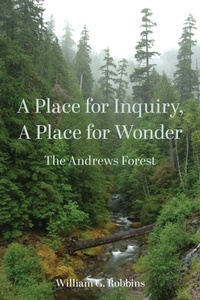
A Place for Inquiry, a Place for Wonder
The Andrews Forest
Will be published approx. on 31. August 2020
Book
Paperback/Softback
242 pages
978-0-87071-019-3 (ISBN)
Description
The H.J. Andrews Experimental Forest is a slice of classic Oregon: due east of Eugene in the Cascade Mountains, the Andrews Forest comprises almost 16,000 acres of the Lookout Creek watershed. The landscape is steep, with hills and deep valleys and cold, fast-running streams. The densely forested landscape includes cedar, hemlock, and moss-draped ancient Douglas fir trees. One of eighty-one USDA experimental forests, the Andrews is administered cooperatively by USFS, OSU, and the Willamette National Forest. While many Oregonians may think of the Andrews simply as a good place for a hike, research conducted there has profoundly reshaped Forest Service management policies and contributed to our understanding of healthy forests.
In A Place for Inquiry, A Place for Wonder, William Robbins turns his attention to the long-overlooked Andrews Forest and argues for its importance to environmental science and policy. From its founding in 1948, the experimental forest has been the site of wide-ranging research. Beginning with postwar studies on the conversion of old-growth timber to fast-growing young stands, research at the Andrews shifted in the next few decades to long-term ecosystem investigations that focus on climate, streamflow, water quality, vegetation succession, biogeochemical cycling, and effects of forest management. The Andrews has thus been at the center of a dramatic shift in federal timber practices from industrial, intensive forest management policies to strategies emphasizing biodiversity and healthy ecosystems.
In A Place for Inquiry, A Place for Wonder, William Robbins turns his attention to the long-overlooked Andrews Forest and argues for its importance to environmental science and policy. From its founding in 1948, the experimental forest has been the site of wide-ranging research. Beginning with postwar studies on the conversion of old-growth timber to fast-growing young stands, research at the Andrews shifted in the next few decades to long-term ecosystem investigations that focus on climate, streamflow, water quality, vegetation succession, biogeochemical cycling, and effects of forest management. The Andrews has thus been at the center of a dramatic shift in federal timber practices from industrial, intensive forest management policies to strategies emphasizing biodiversity and healthy ecosystems.
More details
Edition
1
Language
English
Place of publication
Corvallis, OR
United States
Target group
Professional and scholarly
Illustrations
22 black & white photos, 1 map, 1 chart, 1 table
Dimensions
Height: 226 mm
Width: 152 mm
Thickness: 23 mm
Weight
363 gr
ISBN-13
978-0-87071-019-3 (9780870710193)
Copyright in bibliographic data and cover images is held by Nielsen Book Services Limited or by the publishers or by their respective licensors: all rights reserved.
Schweitzer Classification
Persons
William G. Robbins, a native of Connecticut, served four years in the US Navy before attending college. He holds graduate degrees in history from the University of Oregon and taught at Oregon State University from 1971 to 2002. He retired as Emeritus Distinguished Professor of History. He has authored and edited many books, including A Man for all Seasons: Monroe Sweetland and the Liberal Paradox and The People's School: A History of Oregon State University.