

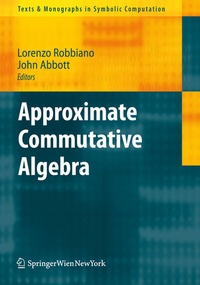
Approximate Commutative Algebra
Published on 1. October 2009
Book
Paperback/Softback
XIV, 227 pages
978-3-211-99313-2 (ISBN)
Description
Approximate Commutative Algebra is an emerging field of research which endeavours to bridge the gap between traditional exact Computational Commutative Algebra and approximate numerical computation. The last 50 years have seen enormous progress in the realm of exact Computational Commutative Algebra, and given the importance of polynomials in scientific modelling, it is very natural to want to extend these ideas to handle approximate, empirical data deriving from physical measurements of phenomena in the real world. In this volume nine contributions from established researchers describe various approaches to tackling a variety of problems arising in Approximate Commutative Algebra.
More details
Series
Edition
2010 ed.
Language
English
Place of publication
Vienna
Austria
Publishing group
Springer Wien
Target group
Professional and scholarly
Research
Illustrations
11 s/w Abbildungen, 4 farbige Abbildungen
XIV, 227 p. 15 illus., 4 illus. in color.
Dimensions
Height: 235 mm
Width: 155 mm
Thickness: 13 mm
Weight
421 gr
ISBN-13
978-3-211-99313-2 (9783211993132)
DOI
10.1007/978-3-211-99314-9
Schweitzer Classification
Other editions
Additional editions
Lorenzo Robbiano | John Abbott
Approximate Commutative Algebra
E-Book
09/2009
1st Edition
Springer
€96.29
Available for download
Content
From Oil Fields to Hilbert Schemes.- Numerical Decomposition of the Rank-Deficiency Set of a Matrix of Multivariate Polynomials.- Towards Geometric Completion of Differential Systems by Points.- Geometric Involutive Bases and Applications to Approximate Commutative Algebra.- Regularization and Matrix Computation in Numerical Polynomial Algebra.- Ideal Interpolation: Translations to and from Algebraic Geometry.- An Introduction to Regression and Errors in Variables from an Algebraic Viewpoint.- ApCoA = Embedding Commutative Algebra into Analysis.- Exact Certification in Global Polynomial Optimization Via Rationalizing Sums-Of-Squares.