

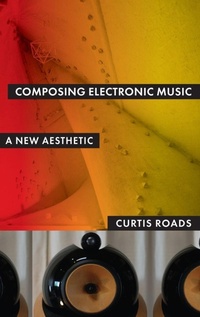
Composing Electronic Music
A New Aesthetic
Published on 20. August 2015
Book
Hardback
510 pages
978-0-19-537323-3 (ISBN)
Description
Electronic music evokes new sensations, feelings, and thoughts in both composers and listeners. Opening the door to an unlimited universe of sound, it engages spatialization as an integral aspect of composition and focuses on sound transformation as a core structural strategy. In this new domain, pitch occurs as a flowing and ephemeral substance that can be bent, modulated, or dissolved into noise. Similarly, time occurs not merely as a fixed duration subdivided by ratios, but as a plastic medium that can be generated, modulated, reversed, warped, scrambled, and granulated. Envelope and waveform undulations on all time scales interweave to generate form. The power of algorithmic methods amplify the capabilities of music technology. Taken together, these constitute game-changing possibilities.
This convergence of technical and aesthetic trends prompts the need for a new text focused on the opportunities of a sound oriented, multiscale approach to composition of electronic music. Sound oriented means a practice that takes place in the presence of sound. Multiscale means an approach that takes into account the perceptual and physical reality of multiple, interacting time scales-each of which can be composed. After more than a century of research and development, now is an appropriate moment to step back and reevaluate all that has changed under the ground of artistic practice.
Composing Electronic Music outlines a new theory of composition based on the toolkit of electronic music techniques. The theory consists of a framework of concepts and a vocabulary of terms describing musical materials, their transformation, and their organization. Central to this discourse is the notion of narrative structure in composition-how sounds are born, interact, transform, and die. It presents a guidebook: a tour of facts, history, commentary, opinions, and pointers to interesting ideas and new possibilities to consider and explore.
This convergence of technical and aesthetic trends prompts the need for a new text focused on the opportunities of a sound oriented, multiscale approach to composition of electronic music. Sound oriented means a practice that takes place in the presence of sound. Multiscale means an approach that takes into account the perceptual and physical reality of multiple, interacting time scales-each of which can be composed. After more than a century of research and development, now is an appropriate moment to step back and reevaluate all that has changed under the ground of artistic practice.
Composing Electronic Music outlines a new theory of composition based on the toolkit of electronic music techniques. The theory consists of a framework of concepts and a vocabulary of terms describing musical materials, their transformation, and their organization. Central to this discourse is the notion of narrative structure in composition-how sounds are born, interact, transform, and die. It presents a guidebook: a tour of facts, history, commentary, opinions, and pointers to interesting ideas and new possibilities to consider and explore.
Reviews / Votes
a worthwhile addition to electronic music literature. * Richard Barrett, Journal of Sonic Studies * What a pleasure to read a book which explains to us all the foundations of electronic music ... [which] has been opening a new full area on the history of music, and putting a clear separation between the area of "acoustic" music, and the area of "electronic" music. * Jean-Claude Eloy * Clearly formulated starting points engage the reader in more challenging concepts and interesting lines of enquiry, contextualising the many perspectives surrounding each topic. This well researched treasure chest of quotes, references, and examples illustrates an insightful text which the author, himself with decades of experience as a transcontinental practitioner, has enriched with personal reflections that in turn allow the reader to do the same. * Natasha Barrett * Curtis Roads' book is a kind of prism that reevaluates the field of music composition in the light of the new technologies of the 21st century. He builds a thousand bridges between different approaches to attributes like pitch, rhythm, time scales, and even sonic narratives in order to help us to understand present music practices. * Horacio Vaggione, composer, Professor Emeritus, the University of Paris VIII * A rich and enjoyable survey for the computer musician, ranging from the objects of compositional manipulation to the performative aspects of the shaping of sensory experience. This book will be of interest not only to the electronic music composer, but also to the performing musician, and the general reader interested in the process and principles of musical design. * Elaine Chew, Professor of Digital Media, Queen Mary University of London *More details
Other editions
Additional editions
Book
08/2015
Oxford University Press Inc
€68.50
Shipment within 15-20 days
E-Book
06/2015
1st Edition
OUP eBook
€34.99
Available for download
E-Book
01/2015
1st Edition
Oxford University Press, USA
€34.99
Available for download
Person
Curtis Roads is a composer and researcher who teaches electronic music composition at the University of California, Santa Barbara. He co-founded the International Computer Music Association and served as an editor/associate editor of Computer Music Journal for 23 years. The author of numerous books, his electronic music set POINT LINE CLOUD won the Award of Distinction at the 2002 Ars Electronica.
Content
00 Preface ; 01 The electronic medium ; 02 Aesthetic foundations ; 03 The nature of sound ; 04 Creating sound materials ; 05 Sound transformation ; 06 Processes of rhythm ; 07 Pitch in electronic music ; 08 Articulating space ; 09 Multiscale organization ; 10 Sonic narrative ; 11 Generative strategies ; 12 The art of mixing ; 13 References ; Appendix A List of sound examples ; Index