

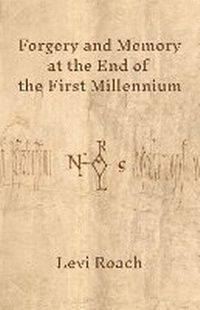
Forgery and Memory at the End of the First Millennium
Will be published approx. on 9. February 2021
Book
Hardback
360 pages
978-0-691-18166-0 (ISBN)
Description
An in-depth exploration of documentary forgery at the turn of the first millennium
Forgery and Memory at the End of the First Millennium takes a fresh look at documentary forgery and historical memory in the Middle Ages. In the tenth and eleventh centuries, religious houses across Europe began falsifying texts to improve local documentary records on an unprecedented scale. As Levi Roach illustrates, the resulting wave of forgery signaled major shifts in society and political culture, shifts which would lay the foundations for the European ancien regime.
Spanning documentary traditions across France, England, Germany and northern Italy, Roach examines five sets of falsified texts to demonstrate how forged records produced in this period gave voice to new collective identities within and beyond the Church. Above all, he indicates how this fad for falsification points to new attitudes toward past and present-a developing fascination with the signs of antiquity. These conclusions revise traditional master narratives about the development of antiquarianism in the modern era, showing that medieval forgers were every bit as sophisticated as their Renaissance successors. Medieval forgers were simply interested in different subjects-the history of the Church and their local realms, rather than the literary world of classical antiquity.
A comparative history of falsified records at a crucial turning point in the Middle Ages, Forgery and Memory at the End of the First Millennium offers valuable insights into how institutions and individuals rewrote and reimagined the past.
Forgery and Memory at the End of the First Millennium takes a fresh look at documentary forgery and historical memory in the Middle Ages. In the tenth and eleventh centuries, religious houses across Europe began falsifying texts to improve local documentary records on an unprecedented scale. As Levi Roach illustrates, the resulting wave of forgery signaled major shifts in society and political culture, shifts which would lay the foundations for the European ancien regime.
Spanning documentary traditions across France, England, Germany and northern Italy, Roach examines five sets of falsified texts to demonstrate how forged records produced in this period gave voice to new collective identities within and beyond the Church. Above all, he indicates how this fad for falsification points to new attitudes toward past and present-a developing fascination with the signs of antiquity. These conclusions revise traditional master narratives about the development of antiquarianism in the modern era, showing that medieval forgers were every bit as sophisticated as their Renaissance successors. Medieval forgers were simply interested in different subjects-the history of the Church and their local realms, rather than the literary world of classical antiquity.
A comparative history of falsified records at a crucial turning point in the Middle Ages, Forgery and Memory at the End of the First Millennium offers valuable insights into how institutions and individuals rewrote and reimagined the past.
Reviews / Votes
"There are few scholars who can match Roach's range and the result is impressive, based on deep familiarity both with primary materials and previous scholarship."---Kathryn A. Lowe, History Today "[A] clever book. . . . This study is a major achievement and has made visible a richvein of possibilities for further work.
"---Hans Hummer, Modern Philology "Levi Roach's unfailingly interesting close contextual study . . . is a valuable contribution to the very substantial scholarly literature on history, memory and literacy in the early middle ages and is bound to stimulate further debate."---Rosamond McKitterck, Medieval Encounters "Levi Roach's book is convincing and impressive on many levels, both in the case studies and in the overarching narrative. . . .It is - contrary to what one might expect of a study that discusses charter studies - a joy to read."---Thomas Kohl, Early Medieval Europe
More details
Language
English
Place of publication
New Jersey
United States
Product notice
Trade binding
Illustrations
52 b/w illus. 4 tables. 3 maps.
Dimensions
Height: 235 mm
Width: 155 mm
ISBN-13
978-0-691-18166-0 (9780691181660)
Copyright in bibliographic data and cover images is held by Nielsen Book Services Limited or by the publishers or by their respective licensors: all rights reserved.
Schweitzer Classification
Other editions
Additional editions
E-Book
04/2021
1st Edition
Princeton University Press
€36.49
Available for download
Person
Levi Roach is associate professor of medieval history at the University of Exeter. He is the author of Kingship and Consent in Anglo-Saxon England and AEthelred the Unready. Twitter @DrLRoach