

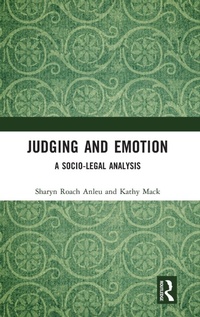
Judging and Emotion
A Socio-Legal Analysis
1st Edition
Published on 4. February 2021
Book
Hardback
214 pages
978-1-138-89302-3 (ISBN)
Description
Judging and Emotion investigates how judicial officers understand, experience, display, manage and deploy emotions in their everyday work, in light of their fundamental commitment to impartiality.
Judging and Emotion challenges the conventional assumption that emotion is inherently unpredictable, stressful or a personal quality inconsistent with impartiality. Extensive empirical research with Australian judicial officers demonstrates the ways emotion, emotional capacities and emotion work are integral to judicial practice. Judging and Emotion articulates a broader conception of emotion, as a social practice emerging from interaction, and demonstrates how judicial officers undertake emotion work and use emotion as a resource to achieve impartiality. A key insight is that institutional requirements, including conceptions of impartiality as dispassion, do not completely determine the emotion dimensions of judicial work. Through their everyday work, judicial officers construct and maintain the boundaries of an impartial judicial role which necessarily incorporates emotion and emotion work.
Building on a growing interest in emotion in law and social sciences, this book will be of considerable importance to socio-legal scholars, sociologists, the judiciary, legal practitioners and all users of the courts.
Judging and Emotion challenges the conventional assumption that emotion is inherently unpredictable, stressful or a personal quality inconsistent with impartiality. Extensive empirical research with Australian judicial officers demonstrates the ways emotion, emotional capacities and emotion work are integral to judicial practice. Judging and Emotion articulates a broader conception of emotion, as a social practice emerging from interaction, and demonstrates how judicial officers undertake emotion work and use emotion as a resource to achieve impartiality. A key insight is that institutional requirements, including conceptions of impartiality as dispassion, do not completely determine the emotion dimensions of judicial work. Through their everyday work, judicial officers construct and maintain the boundaries of an impartial judicial role which necessarily incorporates emotion and emotion work.
Building on a growing interest in emotion in law and social sciences, this book will be of considerable importance to socio-legal scholars, sociologists, the judiciary, legal practitioners and all users of the courts.
Reviews / Votes
"Judging and Emotion is a milestone in research that examines emotion in the practices of the judiciary ... It is a fitting testament to the pioneering research into the judiciary that Roach Anleu and Mack have undertaken over many years. It is a must-read for anyone interested in the interconnection between law, justice, the judiciary and emotions. It is an invaluable study of the skills and knowledge a good judge needs to have and to put to work in the courtroom." Leslie J. Moran, Birkbeck College, University of London, UK; from a review in Emotions and Society, 2022"... Roach Anleu and Mack show how impartiality, as a process rather than a state, involves continuous emotion work to balance emotions..." Stina Bergman Blix, Uppsala University, Sweden; from a review in Journal of Law and Society (2021, vol. 48)
"Judging and Emotion: A Socio-Legal Analysis is not only a stunning empirical exploration of the everyday emotional landscape of the judiciary in the lower courts in Australia, but it is also a masterclass in doing empirical Socio-Legal research." Leslie J. Moran, School of Law, Birkbeck College University of London in Frontiers of Socio-Legal Studies.
"Drawing on research with Australian judicial officers, Roach Anleu and Mack investigate how judicial officers understand, experience, display, manage, and deploy emotions in their everyday work, and they challenge the conventional assumption that emotion is inherently unpredictable, stressful, or inconsistent with impartiality. They articulate a broader conception of emotion as a social practice emerging from interaction and argue that judicial officers undertake emotion work and use emotion as a resource to achieve impartiality." Law & Social Enquiry
More details
Language
English
Place of publication
London
United Kingdom
Publishing group
Taylor & Francis Ltd
Target group
College/higher education
Illustrations
2 s/w Abbildungen, 2 s/w Zeichnungen, 1 s/w Tabelle
1 Tables, black and white; 2 Line drawings, black and white; 2 Illustrations, black and white
Dimensions
Height: 240 mm
Width: 161 mm
Thickness: 17 mm
Weight
514 gr
ISBN-13
978-1-138-89302-3 (9781138893023)
Copyright in bibliographic data and cover images is held by Nielsen Book Services Limited or by the publishers or by their respective licensors: all rights reserved.
Schweitzer Classification
Other editions
Additional editions
Book
01/2022
1st Edition
Routledge
€63.20
Shipment within 15-20 days
E-Book
02/2021
1st Edition
Routledge
€55.49
Available for download
E-Book
02/2021
1st Edition
Routledge
€55.49
Available for download
Persons
Sharyn Roach Anleu is Matthew Flinders Distinguished Professor, Judicial Research Project, College of Humanities, Arts and Social Sciences at Flinders University, Adelaide, Australia
Kathy Mack is Emerita Professor of Law, Judicial Research Project, College of Business, Government and Law at Flinders University, Adelaide, Australia
Kathy Mack is Emerita Professor of Law, Judicial Research Project, College of Business, Government and Law at Flinders University, Adelaide, Australia
Content
Chapter 1. Introduction
Chapter 2. Emotion and everyday judicial work: The context
Chapter 3. Judicial impartiality, emotion and empathy
Chapter 4. Judicial emotion: Experience, display and management
Chapter 5: Judicial emotion work: Others' emotions
Chapter 6. Professional regulation of judicial emotion
Chapter 7. Conclusion
Chapter 2. Emotion and everyday judicial work: The context
Chapter 3. Judicial impartiality, emotion and empathy
Chapter 4. Judicial emotion: Experience, display and management
Chapter 5: Judicial emotion work: Others' emotions
Chapter 6. Professional regulation of judicial emotion
Chapter 7. Conclusion