

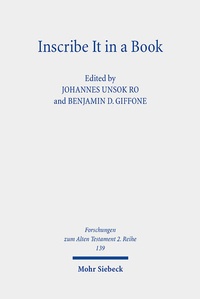
Inscribe It in a Book
Scribal Practice, Cultural Memory, and the Making of the Hebrew Scriptures
1st Edition
Published on 20. March 2023
Book
Paperback/Softback
352 pages
978-3-16-161524-5 (ISBN)
Description
Die Teilbereiche der Mündlichkeit und Schriftkultur innerhalb der Forschung zur Hebräischen Bibel führt zu allmählichen Verschiebungen auf diesem Gebiet. Die theoretischen und empirischen Beiträge in diesem Band tragen zur laufenden Diskussion innerhalb der Bibelwissenschaft und angrenzender Gebiete über die Schreibprozesse bei, die biblische Texte hervorgebracht haben.
More details
Other editions
Additional editions
Johannes Unsok Ro | Benjamin D. Giffone
Inscribe It in a Book
Scribal Practice, Cultural Memory, and the Making of the Hebrew Scriptures
E-Book
03/2023
1st Edition
Mohr Siebeck
€104.00
Available for download
Persons
Editor
Born 1971; 1998 MA in Theological Studies; 2002 Dr. theol. in Old Testament; 2007 MDiv; Professor of Old Testament Studies and Director of the Comparative Culture of Graduate School at International Christian University, Japan.
Born 1984; 2009 MS in Biblical Studies; 2012 MTh; 2014 PhD in Old Testament; research associate, Universiteit van Stellenbosch; Associate Professor of Biblical Studies at LCC International University, Klaipeda, Lithuania.
Content
Johannes Unsok Ro and Benjamin D. Giffone: Introduction
Part I: Comparative Studies
Daniel Bodi: A New Proposal for the Origin of the Term for 'Letter': Sumerian inim.gar, i5-gar-ra; Akkadian egirtu; Aramaic ?iggerâ, ?iggartâ, Hebrew ?iggeret - William R. Stewart: The Death of the Prophet? A Comparative Study of Prophetic Signs in the Royal Archives of Mari, Syria (ARM 26/1.206) and the Hebrew Bible (Jeremiah 19:1-13) - JiSeong James Kwon: Scribal Intertexts in the Book of Job: Foreign Counterparts of Job - Sungwoo Park/Johannes Unsok Ro: Collective Identity through Scribalism: Interpreting Plato's Menexenus and the Book of Chronicles
Part II: Writing about Writing in the Hebrew Bible
Benjamin Kilchör: "Then Moses Wrote This Torah" (Deut 31:9): The Relationship of Oral and Written Torah in Deuteronomy - Lisbeth S. Fried/Edward J. Mills III: Ezra the Scribe - Johanna Erzberger: Israel's Salvation and the Survival of Baruch the Scribe - Peter Altmann: Tracing Divine Law: Written Divine Law in Chronicles
Part III: Case Studies
Jin H. Han: Did the Deuteronomist Detest Dreams? - Benjamin D. Giffone: Regathering Too Many Stones? Scribal Constraints, Community Memory, and the 'Problem' of Elijah's Sacrifice for Deuteronomism in Kings - Woo Min Lee: The "Remnant" in the Deuteronomistic Cultural Memory: A Case Study on 2 Kings 19:30-31 - Roger S. Nam: Nehemiah 5:1-13 as Innerbiblical Interpretation of Pentateuchal Slavery Laws - Kristin Weingart: Chronography in the Book of Kings: An Inquiry into an Israelite Manifestation of an Ancient Near Eastern Genre - Benjamin Ziemer: Radical Versus Conservative? How Scribes Conventionally Used Books While Writing Books
Part I: Comparative Studies
Daniel Bodi: A New Proposal for the Origin of the Term for 'Letter': Sumerian inim.gar, i5-gar-ra; Akkadian egirtu; Aramaic ?iggerâ, ?iggartâ, Hebrew ?iggeret - William R. Stewart: The Death of the Prophet? A Comparative Study of Prophetic Signs in the Royal Archives of Mari, Syria (ARM 26/1.206) and the Hebrew Bible (Jeremiah 19:1-13) - JiSeong James Kwon: Scribal Intertexts in the Book of Job: Foreign Counterparts of Job - Sungwoo Park/Johannes Unsok Ro: Collective Identity through Scribalism: Interpreting Plato's Menexenus and the Book of Chronicles
Part II: Writing about Writing in the Hebrew Bible
Benjamin Kilchör: "Then Moses Wrote This Torah" (Deut 31:9): The Relationship of Oral and Written Torah in Deuteronomy - Lisbeth S. Fried/Edward J. Mills III: Ezra the Scribe - Johanna Erzberger: Israel's Salvation and the Survival of Baruch the Scribe - Peter Altmann: Tracing Divine Law: Written Divine Law in Chronicles
Part III: Case Studies
Jin H. Han: Did the Deuteronomist Detest Dreams? - Benjamin D. Giffone: Regathering Too Many Stones? Scribal Constraints, Community Memory, and the 'Problem' of Elijah's Sacrifice for Deuteronomism in Kings - Woo Min Lee: The "Remnant" in the Deuteronomistic Cultural Memory: A Case Study on 2 Kings 19:30-31 - Roger S. Nam: Nehemiah 5:1-13 as Innerbiblical Interpretation of Pentateuchal Slavery Laws - Kristin Weingart: Chronography in the Book of Kings: An Inquiry into an Israelite Manifestation of an Ancient Near Eastern Genre - Benjamin Ziemer: Radical Versus Conservative? How Scribes Conventionally Used Books While Writing Books