

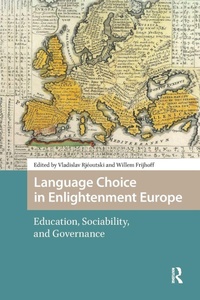
Language Choice in Enlightenment Europe
Education, Sociability, and Governance
1st Edition
Will be published approx. on 1. December 2025
Book
Paperback/Softback
232 pages
978-1-041-18196-5 (ISBN)
Description
This multinational collection of essays challenges the traditional image of a monolingual Ancient Regime in Enlightenment Europe, both East and West. Its archival research explores the important role played by selective language use in social life and in the educational provisions in the early constitution of modern society. A broad range of case studies show how language was viewed and used symbolically by social groups - ranging from the nobility to the peasantry - to develop, express, and mark their identities.
More details
Series
Language
English
Place of publication
London
United Kingdom
Publishing group
Taylor & Francis Ltd
Target group
Professional and scholarly
Academic
Dimensions
Height: 234 mm
Width: 156 mm
Thickness: 13 mm
Weight
363 gr
ISBN-13
978-1-041-18196-5 (9781041181965)
Copyright in bibliographic data and cover images is held by Nielsen Book Services Limited or by the publishers or by their respective licensors: all rights reserved.
Schweitzer Classification
Other editions
Additional editions
Vladislav Rjeoutski | Willem Frijhoff
Language Choice in Enlightenment Europe
Education, Sociability, and Governance
E-Book
10/2025
Routledge
€60.99
Available for download
Vladislav Rjeoutski | Willem Frijhoff
Language Choice in Enlightenment Europe
Education, Sociability, and Governance
E-Book
10/2025
Routledge
€60.99
Available for download
Vladislav Rjeoutski | Willem Frijhoff
Language Choice in Enlightenment Europe
Education, Sociability, and Governance
Book
03/2018
Amsterdam University Press
€149.70
Shipment within 10-20 days
Persons
Dr. Vladislav Rjeoutski, research fellow at the German Historical Institute in Moscow. Co-director of the DFG-funded research project on the languages of diplomacy in the eighteenth-century Russia, co-author (with Derek Offord and Gesine Argent) of: The French Language in Russia. A Social, Political, Cultural, and Literary History (Amsterdam: AUP, 2018).
Willem Frijhoff is Emeritus Professor of Modern History at VU University, Amsterdam, and is now G.Ph. Verhagen Professor of Cultural History at Erasmus University, Rotterdam. His scholarly work focuses on cultural, linguistic and religious identities in early modern France, the Netherlands and North America.
Willem Frijhoff is Emeritus Professor of Modern History at VU University, Amsterdam, and is now G.Ph. Verhagen Professor of Cultural History at Erasmus University, Rotterdam. His scholarly work focuses on cultural, linguistic and religious identities in early modern France, the Netherlands and North America.
Content
Introduction, Vladislav Rjeoutski & Willem Frijhoff Learning Vernaculars, Learning in Vernaculars. The Role of Modern Languages in Nicolas Le Gras' Noble Academy and in Teaching Practices for the Nobility (France, 1640 - about 1750) Andrea Bruschi Dutch Foreign Language Use and Education after 1750: Routines and Innovations Willem Frijhoff Practice and Functions of French as a Second Language in a Dutch Patrician Family: The Van Hogendorp Family (Eighteenth - Early Nineteenth Centuries) Madeleine Van Strien-Chardonneau Multilingualism Versus Proficiency in the German Language among Administrative Elites of the Kingdom of Hungary in the Eighteenth Century Olga Khavanova Introducing the Teaching of Foreign Languages in Grammar Schools. A Comparison Between the Holy Roman Empire and the Governorate of Estland (Estonia) Michael Rocher Voices in a Country Divided: Linguistic Choices in Early Modern Croatia Ivana Horbec & Maja Matasovi? Latin in the Education of Nobility in Russia: The History of a Defeat Vladislav Rjeoutski Latin as the Language of the Orthodox Clergy in Eighteenth-Century Russia Ekaterina Kislova, Index.