

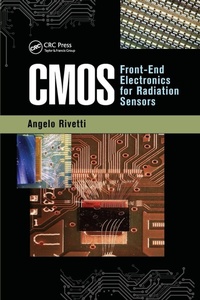
CMOS
Front-End Electronics for Radiation Sensors
1st Edition
Published on 26. July 2017
Book
Paperback/Softback
728 pages
978-1-138-82738-7 (ISBN)
Description
CMOS: Front-End Electronics for Radiation Sensors offers a comprehensive introduction to integrated front-end electronics for radiation detectors, focusing on devices that capture individual particles or photons and are used in nuclear and high energy physics, space instrumentation, medical physics, homeland security, and related fields.
Emphasizing practical design and implementation, this book:
Covers the fundamental principles of signal processing for radiation detectors
Discusses the relevant analog building blocks used in the front-end electronics
Employs systematically weak and moderate inversion regimes in circuit analysis
Makes complex topics such as noise and circuit-weighting functions more accessible
Includes numerical examples where appropriate
CMOS: Front-End Electronics for Radiation Sensors provides specialized knowledge previously obtained only through the study of multiple technical and scientific papers. It is an ideal text for students of physics and electronics engineering, as well as a useful reference for experienced practitioners.
Emphasizing practical design and implementation, this book:
Covers the fundamental principles of signal processing for radiation detectors
Discusses the relevant analog building blocks used in the front-end electronics
Employs systematically weak and moderate inversion regimes in circuit analysis
Makes complex topics such as noise and circuit-weighting functions more accessible
Includes numerical examples where appropriate
CMOS: Front-End Electronics for Radiation Sensors provides specialized knowledge previously obtained only through the study of multiple technical and scientific papers. It is an ideal text for students of physics and electronics engineering, as well as a useful reference for experienced practitioners.
Reviews / Votes
"... an essential resource for whoever is involved with radiation sensors from the circuit design perspective. It nicely covers all topics of practical interest, gradually leading from general concepts to specific aspects and bringing several interesting examples. The author was able to effectively transfer his wide knowledge and experience, both as a researcher and as an educator, into this amazing piece of work. The book can lead newcomers to rapidly learn how to address the analysis and design of front-end circuits, but it is also suitable for experts to refresh some important concepts without the need to go through many scientific papers."-Gian-Franco Dalla Betta, University of Trento, Italy
"... a well-organized, clear, and comprehensive guide to the design of low-noise front-end electronics for sensors. An ideal introduction for beginners and students, and a valuable reference for experienced designers."
-Gianluigi De Geronimo, Brookhaven National Laboratory, Upton, New York, USA and Stony Brook University, New York, USA
"Reflecting the author's extensive experience, the book covers the design and implementation of the front-end electronics optimized for the amplification, conditioning, and digitization of signals in radiation sensors. This body of knowledge, developed along many decades within the high energy and nuclear physics communities, was dispersed in many specialized articles. Now it is collected, summarized, and enriched in an impressive book of about 700 pages, which covers both the theoretical background and many implementation practical aspects. This is the book that many people in the field were waiting for."
-Joao Varela, Laboratory of Instrumentation and Experimental Particles Physics, Lisbon, Portugal and Instituto Superior Tecnico, University of Lisbon, Portugal
More details
Series
Language
English
Place of publication
London
United Kingdom
Publishing group
Taylor & Francis Ltd
Target group
College/higher education
Engineers, physicists, researchers, and senior undergraduate and graduate students in radiation physics, electronics, materials science, medical physics, industrial electronics, and microelectronics.
Dimensions
Height: 234 mm
Width: 156 mm
Weight
453 gr
ISBN-13
978-1-138-82738-7 (9781138827387)
Copyright in bibliographic data and cover images is held by Nielsen Book Services Limited or by the publishers or by their respective licensors: all rights reserved.
Schweitzer Classification
Other editions
Additional editions
E-Book
09/2018
CRC Press
€138.99
Available for download
E-Book
09/2018
1st Edition
CRC Press
€138.99
Available for download
Book
06/2015
1st Edition
CRC Press
€374.50
Shipment within 15-20 days
Person
Angelo Rivetti received a degree in physics from the University of Torino, Italy, and a Ph.D in electrical engineering from the Politecnico di Torino, Italy. From 1998 to 2000, he worked at the Conseil Europeen pour la Recherche Nucleaire (CERN), Meyrin, Switzerland on the implementation of radiation tolerant integrated circuits in commercial deep submicron complementary metal-oxide-semiconductor (CMOS) technologies. From 2000 to 2001, he was an assistant professor with the faculty of physics at the University of Torino. In December 2001, he joined the Istituto Nazionale di Fisica Nucleare (INFN), Torino, Italy, where he developed very-large-scale integration (VLSI) front-end circuits now in use in the A Large Ion Collider Experiment (ALICE) and Common Muon and Proton Apparatus for Structure and Spectroscopy (COMPASS) experiments at CERN. He is currently a senior member of the research and technology staff at INFN. His research interests are in the design of mixed signal front-end electronics for hybrid and monolithic radiation detectors employed in high energy physics, medical imaging, and industrial applications.
Content
Front-End Specifications and Architecture Overview. MOS Transistor Properties. Input Stages. Input Stages in the Frequency Domain. Noise. Time Invariant Shapers. Time Variant Shapers. Transistor-Level Front-End Design. Discriminators. Data Converters. Appendix: Differential and Operational Amplifiers. Appendix: Practical Aspects in Front-End Design.