

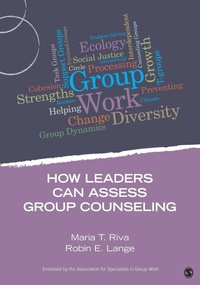
How Leaders Can Assess Group Counseling
1st Edition
Published on 27. November 2013
Book
Paperback/Softback
80 pages
978-1-4833-3225-3 (ISBN)
Description
A practical guide to evaluating group process and outcomes
Ample evidence demonstrates that well-planned and delivered group work can benefit members. Equally important is the continual improvement of group work practice, achieved through the evaluation of each individual group experience. How to Evaluate Groups provides practical guidance on how you can establish-or collaborate with researchers to accomplish-research designs aimed at evaluating group process and outcomes. This accessible book:
Covers group work measures, including both quantitative and qualitative approaches
Includes tips on implementing research designs
Draws from an up-to-date scholarly base that includes the latest research on group work
How to Evaluate Groups is part of the Group Work Practice Kit: Improving the Everyday Practice of Group Work, a collection of nine books each authored by scholars in the specific field of group work. To promote a consistent reading experience, the books in the collection conform to editor Robert K. Conyne's outline. Designed to provide practitioners, instructors, students, and trainees with concrete direction for improving group work, the series provides thorough coverage of the entire span of group work practice.
This book is endorsed by the Association for Specialists in Group Work.
Ample evidence demonstrates that well-planned and delivered group work can benefit members. Equally important is the continual improvement of group work practice, achieved through the evaluation of each individual group experience. How to Evaluate Groups provides practical guidance on how you can establish-or collaborate with researchers to accomplish-research designs aimed at evaluating group process and outcomes. This accessible book:
Covers group work measures, including both quantitative and qualitative approaches
Includes tips on implementing research designs
Draws from an up-to-date scholarly base that includes the latest research on group work
How to Evaluate Groups is part of the Group Work Practice Kit: Improving the Everyday Practice of Group Work, a collection of nine books each authored by scholars in the specific field of group work. To promote a consistent reading experience, the books in the collection conform to editor Robert K. Conyne's outline. Designed to provide practitioners, instructors, students, and trainees with concrete direction for improving group work, the series provides thorough coverage of the entire span of group work practice.
This book is endorsed by the Association for Specialists in Group Work.
More details
Series
Edition
First Edition
Language
English
Place of publication
Thousand Oaks
United States
Target group
Professional and scholarly
Dimensions
Height: 254 mm
Width: 178 mm
Thickness: 5 mm
Weight
173 gr
ISBN-13
978-1-4833-3225-3 (9781483332253)
Copyright in bibliographic data and cover images is held by Nielsen Book Services Limited or by the publishers or by their respective licensors: all rights reserved.
Schweitzer Classification
Persons
Maria T. Riva is a Professor in Counseling Psychology and Chair of the Department of School and Counseling Psychology at the University of Denver. She received her B.A. in psychology from Illinois Wesleyan University in 1976, her M.S. in behavior modification from Southern Illinois University in 1979, and her Ph.D. from the University of Pittsburgh in counseling psychology in 1990. Dr. Riva is currently the President of the APA Division 49, Group Psychology and Group Psychotherapy. She is a past president of the American Counseling Association Division of the Association for Specialists in Group Work (ASGW), a Fellow of ASGW, and a past Associate Editor of the Journal for Specialists in Gorup Work. She has written articles on supervision and teaching of group counseling, and group superivison, along with co-editing the Handbook of Group Counseling and Psychotherapy (with DeLucia-Waack, Gerrity, and Kalodner) and authoring the book Assessing Groups with Robin Lange. She teaches group counseling courses and courses in supervision. Her research interests are in group dynamics, group leadership, and ethical group supervision.
Content
Chapter 1: On Becoming an Evidenced-based Group Practitioner: The Why of Assessment
Chapter 2: With so Many Options, What Should We Assess?
Chapter 3: Optimal Times to Assess Your Groups: the When of Assessment
Chapter 4: Assessment Measures for Group Leaders: The Which Ones to Choose Dilemma
Chapter 5: Putting the Parts Together and Tying Up Loose Ends: The How of Assessment
Putting the Parts Together and Tying Up Loose Ends: The How of Assessment
Chapter 2: With so Many Options, What Should We Assess?
Chapter 3: Optimal Times to Assess Your Groups: the When of Assessment
Chapter 4: Assessment Measures for Group Leaders: The Which Ones to Choose Dilemma
Chapter 5: Putting the Parts Together and Tying Up Loose Ends: The How of Assessment
Putting the Parts Together and Tying Up Loose Ends: The How of Assessment