

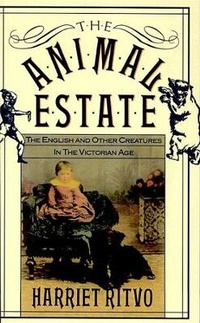
The Animal Estate
The English and Other Creatures in Victorian England
Published on 1. January 1989
Book
Paperback/Softback
368 pages
978-0-674-03707-6 (ISBN)
Description
When we think about the Victorian age, we usually envision people together with animals: the Queen and her pugs, the sportsman with horses and hounds, the big game hunter with his wild kill, the gentleman farmer with a prize bull. Harriet Ritvo here gives us a vivid picture of how animals figured in English thinking during the nineteenth century and, by extension, how they served as metaphors for human psychological needs and sociopolitical aspirations.
Victorian England was a period of burgeoning scientific cattle breeding and newly fashionable dog shows; an age of Empire and big game hunting; an era of reform and reformers that saw the birth of the Royal SPCA. Ritvo examines Victorian thinking about animals in the context of other lines of thought: evolution, class structure, popular science and natural history, imperial domination. The papers and publications of people and organizations concerned with agricultural breeding, veterinary medicine, the world of pets, vivisection and other humane causes, zoos, hunting at home and abroad, all reveal underlying assumptions and deeply held convictions-for example, about Britain's imperial enterprise, social discipline, and the hierarchy of orders, in nature and in human society.
Thus this book contributes a new new topic of inquiry to Victorian studies; its combination of rhetorical analysis with more conventional methods of historical research offers a novel perspective on Victorian culture. And because nineteenth-century attitudes and practices were often the ancestors of contemporary ones, this perspective can also inform modern debates about human-animal interactions.
Victorian England was a period of burgeoning scientific cattle breeding and newly fashionable dog shows; an age of Empire and big game hunting; an era of reform and reformers that saw the birth of the Royal SPCA. Ritvo examines Victorian thinking about animals in the context of other lines of thought: evolution, class structure, popular science and natural history, imperial domination. The papers and publications of people and organizations concerned with agricultural breeding, veterinary medicine, the world of pets, vivisection and other humane causes, zoos, hunting at home and abroad, all reveal underlying assumptions and deeply held convictions-for example, about Britain's imperial enterprise, social discipline, and the hierarchy of orders, in nature and in human society.
Thus this book contributes a new new topic of inquiry to Victorian studies; its combination of rhetorical analysis with more conventional methods of historical research offers a novel perspective on Victorian culture. And because nineteenth-century attitudes and practices were often the ancestors of contemporary ones, this perspective can also inform modern debates about human-animal interactions.
Reviews / Votes
The brilliance of Ritvo's book, my favorite for 1987...[lies] in the particular examples that she has chosen to illustrate the institutional bonds of humans with other animals... She tells so many wonderful stories. -- Stephen Jay Gould * New York Review of Books * This is both an amusing and a valuable book... Harriet Ritvo is concerned primarily with the discussion, use, and display of animals as part of a rhetoric of human and class ascendancy. But the material presented here with impressive lucidity and control should interest virtually any reader. And the book is intriguingly and lavishly illustrated, mostly with engravings and woodcuts from sources ranging from Punch to natural histories, stockbreeders' publications, newspapers and paintings... An important book for anyone with an interest in the sociology of animals, and in the more general social history that emerges from its beautifully presented wealth of detail. -- Vicki Hearne * New York Times Book Review * The Animal Estate is about power. It offers an invigorating new interpretation of an era often characterized as sentimental in its attachment to animals by showing how the work of people and organizations concerned with animals invariably came to portray them as property... This interesting book definitely has a bite. * Times Higher Education Supplement * An unusual social history of Victorian England... Deftly written and generously illustrated, The Animal Estate details the spectrum of Victorian animal concerns: the antivivisection movement, the popularity of zoology, the hunt, the rabies panic (not unlike today's pit bull hysteria), and more. The reader will come out with a fuller understanding of the Victorian people and the development of our bonds with animals. * Animals * This is a remarkable book about how, in a uniquely exploitative age, animals became surrogates for human aspirations. Ritvo is not content with theoretical interpretation of human-animal interaction; she examines the attitudes of the people who actually had animals in their charge: pet owners, farmers, sportsmen, zoologists. It is a book of extraordinary timeliness. -- Coral Lansbury, Rutgers UniversityMore details
Language
English
Place of publication
Cambridge, Mass
United States
Target group
College/higher education
Professional and scholarly
Illustrations
illustrations
Dimensions
Height: 235 mm
Width: 156 mm
Thickness: 25 mm
Weight
562 gr
ISBN-13
978-0-674-03707-6 (9780674037076)
Copyright in bibliographic data and cover images is held by Nielsen Book Services Limited or by the publishers or by their respective licensors: all rights reserved.
Schweitzer Classification
Other editions
Additional editions
E-Book
01/1989
1st Edition
Harvard University Press
€91.99
Available for download
Person
Harriet Ritvo is Arthur J. Conner Professor of History at the Massachusetts Institute of Technology.
Content
Introduction: The Nature of the Beast Part I. Prestige and Pedigree 1. Barons of Beef 2. Prize Pets Part II. Dangerous Classes 3. A Measure of Compassion 4. Cave Canem Part III. Animals and Empire 5. Exotic Captives 6. The Thrill of the Chase Notes Illustration Credits Index