

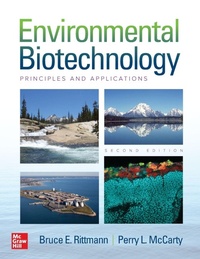
Environmental Biotechnology: Principles and Applications, Second Edition
Principles and Applications, Second Edition
2nd Edition
Published on 12. May 2020
Book
Hardback
656 pages
978-1-260-44160-4 (ISBN)
Description
The classic environmental biotechnology textbook-fully updated for the latest advances
This thoroughly revised educational resource presents the biological principles that underlie modern microbiological treatment technologies. Written by two of the field's foremost researchers, Environmental Biotechnology: Principles and Applications, Second Edition, clearly explains the new technologies that have evolved over the past 20 years, including direct anaerobic treatments, membrane-based processes, and granular processes. The first half of the book focuses on theory and tools; the second half offers practical applications that are clearly illustrated through real-world examples.
Coverage includes:
* Moving toward sustainability
* Basics of microbiology
* Biochemistry, metabolism, genetics, and information flow
* Microbial ecology
* Stoichiometry and energetics
* Microbial kinetics and products
* Biofilm kinetics
* Reactor characteristics and kinetics
* Methanogenesis
* Aerobic suspended-growth processes
* Aerobic biofilm processes
* Nitrogen transformation and recovery
* Phosphorus removal and recovery
* Biological treatment of drinking water
This thoroughly revised educational resource presents the biological principles that underlie modern microbiological treatment technologies. Written by two of the field's foremost researchers, Environmental Biotechnology: Principles and Applications, Second Edition, clearly explains the new technologies that have evolved over the past 20 years, including direct anaerobic treatments, membrane-based processes, and granular processes. The first half of the book focuses on theory and tools; the second half offers practical applications that are clearly illustrated through real-world examples.
Coverage includes:
* Moving toward sustainability
* Basics of microbiology
* Biochemistry, metabolism, genetics, and information flow
* Microbial ecology
* Stoichiometry and energetics
* Microbial kinetics and products
* Biofilm kinetics
* Reactor characteristics and kinetics
* Methanogenesis
* Aerobic suspended-growth processes
* Aerobic biofilm processes
* Nitrogen transformation and recovery
* Phosphorus removal and recovery
* Biological treatment of drinking water
More details
Edition
2nd edition
Language
English
Place of publication
OH
United States
Target group
College/higher education
Illustrations
200 Illustrations
Dimensions
Height: 241 mm
Width: 196 mm
Thickness: 39 mm
Weight
1399 gr
ISBN-13
978-1-260-44160-4 (9781260441604)
Copyright in bibliographic data and cover images is held by Nielsen Book Services Limited or by the publishers or by their respective licensors: all rights reserved.
Schweitzer Classification
Persons
Bruce E. Rittmann is Regents' Professor of Environmental Engineering and Director of the Biodesign Swette Center for Environmental Biotechnology at Arizona State University. He is the recipient of the 2018 Stockholm Water Prize and along with Dr. McCarty he was the winner of the Clarke Prize for Outstanding Achievement in Water Technology.
Perry L. McCarty is the Silas H. Palmer Professor Emeritus of Civil and Environmental Engineering at Stanford University. He received a B.S. Degree in Civil Engineering from Wayne State University and S.M. and Sc.D. Degrees in Sanitary Engineering from the Massachusetts Institute of Technology, where he taught for four years. In 1962 he joined the faculty at Stanford University. His research has been directed towards the application of biological processes for the solution of environmental problems. He is an honorary member of the American Water Works Association and the Water Environment Federation, and Fellow in the American Academy of Arts and Sciences, the American Association for the Advancement of Science, and the American Academy of Microbiology. He was elected to the National Academy of Engineering in 1977. He received the Tyler Prize for environmental achievement in 1992 and the Clark Prize for outstanding achievement in water science and technology in 1997.
Perry L. McCarty is the Silas H. Palmer Professor Emeritus of Civil and Environmental Engineering at Stanford University. He received a B.S. Degree in Civil Engineering from Wayne State University and S.M. and Sc.D. Degrees in Sanitary Engineering from the Massachusetts Institute of Technology, where he taught for four years. In 1962 he joined the faculty at Stanford University. His research has been directed towards the application of biological processes for the solution of environmental problems. He is an honorary member of the American Water Works Association and the Water Environment Federation, and Fellow in the American Academy of Arts and Sciences, the American Association for the Advancement of Science, and the American Academy of Microbiology. He was elected to the National Academy of Engineering in 1977. He received the Tyler Prize for environmental achievement in 1992 and the Clark Prize for outstanding achievement in water science and technology in 1997.
Content
Preface
1. Moving Toward Sustainability
2. Basics of Microbiology
3. Biochemistry, Metabolism, Genetics, and Information Flow
4. Microbial Ecology
5. Stoichiometry and Energetics
6. Microbial Kinetics
7. Biofilm Kinetics
8. Microbial Products
9. Reactor Characteristics and Kinetics
10. Methanogenesis
11. Aerobic Suspended-Growth Processes
12. Aerobic Biofilm Processes
13. Nitrogen Transformation and Recovery
14. Phosphorus Removal and Recovery
15. Biological Treatment of Drinking Water
A. Free Energies of Formation for Various Chemical Species, 25 degreesC
Index
Electronic bonus chapters:
B1. Lagoons and Wetlands
B2. Microbiological Detoxification
B3. Microbial Electrochemical Cells
B4. Photosynthetic Biofactories
B5. Complex Systems
1. Moving Toward Sustainability
2. Basics of Microbiology
3. Biochemistry, Metabolism, Genetics, and Information Flow
4. Microbial Ecology
5. Stoichiometry and Energetics
6. Microbial Kinetics
7. Biofilm Kinetics
8. Microbial Products
9. Reactor Characteristics and Kinetics
10. Methanogenesis
11. Aerobic Suspended-Growth Processes
12. Aerobic Biofilm Processes
13. Nitrogen Transformation and Recovery
14. Phosphorus Removal and Recovery
15. Biological Treatment of Drinking Water
A. Free Energies of Formation for Various Chemical Species, 25 degreesC
Index
Electronic bonus chapters:
B1. Lagoons and Wetlands
B2. Microbiological Detoxification
B3. Microbial Electrochemical Cells
B4. Photosynthetic Biofactories
B5. Complex Systems