

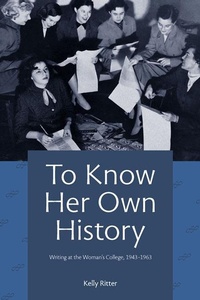
To Know Her Own History
Writing at the Woman's College, 1943-1963
Published on 15. February 2012
Book
Paperback/Softback
264 pages
978-0-8229-6186-4 (ISBN)
Description
To Know Her Own History chronicles the evolution of writing programs at a landmark Southern womenAEs college during the postwar period. Kelly Ritter finds that despite its conservative Southern culture and vocational roots, the WomanAEs College of the University of North Carolina was a unique setting where advanced writing programs and creativity flourished long before these trends emerged nationally.
Ritter profiles the history of the WomanAEs College, first as a normal school, where women trained as teachers with an emphasis on composition and analytical writing, then as a liberal arts college. She compares the burgeoning writing program here to those of the Seven Sisters (Wellesley, Smith, Radcliffe, Barnard, Vassar, Bryn Mawr, and Mount Holyoke) and to elite all-male universities, to show the singular progressivism of the WomanAEs College. Ritter presents lively student writing samples from the early postwar period to reveal a blurring of the boundaries between \u201ccreative\u201d and \u201cexpository\u201d styles.
By midcentury, a quantum shift toward creative writing changed administratorsAE valuation of composition courses and staff at the WomanAEs College. An intensive process of curricular revisions, modeled after HarvardAEs \u201cRedbook\u201d plan, was proposed and rejected in 1951, as the college stood by its unique curricula and singular values. Ritter follows the plight of individual instructors of creative writing and composition, showing how their compensation and standing were made disproportionate by the shifting position of expository writing in relation to creative writing. Despite this unsettled period, the WomanAEs College continued to gain in stature, and by 1964 it became a prize acquisition of the University of North Carolina system.
RitterAEs study demonstrates the value of local histories to uncover undocumented advancements in writing education, offering insights into the political, cultural, and social conditions that influenced learning and methodologies at \u201cmarginalized\u201d schools such as the WomanAEs College.
Ritter profiles the history of the WomanAEs College, first as a normal school, where women trained as teachers with an emphasis on composition and analytical writing, then as a liberal arts college. She compares the burgeoning writing program here to those of the Seven Sisters (Wellesley, Smith, Radcliffe, Barnard, Vassar, Bryn Mawr, and Mount Holyoke) and to elite all-male universities, to show the singular progressivism of the WomanAEs College. Ritter presents lively student writing samples from the early postwar period to reveal a blurring of the boundaries between \u201ccreative\u201d and \u201cexpository\u201d styles.
By midcentury, a quantum shift toward creative writing changed administratorsAE valuation of composition courses and staff at the WomanAEs College. An intensive process of curricular revisions, modeled after HarvardAEs \u201cRedbook\u201d plan, was proposed and rejected in 1951, as the college stood by its unique curricula and singular values. Ritter follows the plight of individual instructors of creative writing and composition, showing how their compensation and standing were made disproportionate by the shifting position of expository writing in relation to creative writing. Despite this unsettled period, the WomanAEs College continued to gain in stature, and by 1964 it became a prize acquisition of the University of North Carolina system.
RitterAEs study demonstrates the value of local histories to uncover undocumented advancements in writing education, offering insights into the political, cultural, and social conditions that influenced learning and methodologies at \u201cmarginalized\u201d schools such as the WomanAEs College.
Reviews / Votes
"To Know Her Own History gives new texture to composition and rhetoric's history in documenting the processes of curricular reform in a state-supported normal school for women post-World War II. This study enriches our understanding of women's rhetorical education within a rich multigenre writing curriculum and shows the effects of feminization of writing program administration as the women's normal school model was abandoned in the unique political and social context of the South." * Joy S. Ritchie, University of Nebraska-Lincoln * Ritter's judicious combination of archival, library, and naturalistic research results in an illuminating study of writing at the Woman's College. In this scholarly narrative, Ritter focuses on literacy education in a first-rate Southern women's college and on the personal and professional achievements of many of the graduates. She also recognizes, however, the sociohistorical context in which these women were educated, a context that includes conditions of gendered and raced labor as well as ongoing tensions between the creative writing and composition programs. * Cheryl Glenn, Pennsylvania State University * A fascinating and instructive reminder that there is no history of composition: there are histories of composition, conflicted and filled with politically and culturally constructed understandings of gender, race, class, ethnicity, and-as this book in particular makes clear-geographical region and disciplinary identity. This thoroughly researched local history adds a needed layer of complexity to the historical frameworks that have informed archives-based scholarship in composition studies. * Wendy Sharer, East Carolina University * [An] engaging and timely volume . . . meticulously researched . . . Ritter is a scholar of the first rank. * <i>Rhetoric Review</i> * A welcome addition to our knowledge of women's education and of women's writing. Chapter Four ("The Double-Helix of Creative/Composition") alone should be required reading for all students in rhetoric and composition, for it illuminates the history of composition in remarkably insightful ways. * <i>Peitho Journal</i> *More details
Series
Language
English
Place of publication
Pittsburgh PA
United States
Target group
Professional and scholarly
Product notice
Paperback (trade)
Dimensions
Height: 234 mm
Width: 155 mm
Thickness: 18 mm
Weight
408 gr
ISBN-13
978-0-8229-6186-4 (9780822961864)
Copyright in bibliographic data and cover images is held by Nielsen Book Services Limited or by the publishers or by their respective licensors: all rights reserved.
Schweitzer Classification
Other editions
Additional editions
E-Book
02/2012
Penguin Random House South Africa
€54.49
Available for download
Person
Kelly Ritter is associate professor of English and director of composition at the University of North Carolina at Greensboro. She is the author of Before Shaughnessy: Basic Writing at Yale and Harvard, 1920?1960 and Who Owns School? Authority, Students, and Online Discourse. Ritter also is editor of the journal College English.