

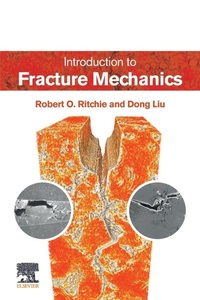
Introduction to Fracture Mechanics
Published on 23. June 2021
Book
Paperback/Softback
168 pages
978-0-323-89822-5 (ISBN)
Description
Introduction to Fracture Mechanics presents an introduction to the origins, formulation and application of fracture mechanics for the design, safe operation and life prediction in structural materials and components. The book introduces and informs the reader on how fracture mechanics works and how it is so different from other forms of analysis that are used to characterize mechanical properties. Chapters cover foundational topics and the use of linear-elastic fracture mechanics, involving both K-based characterizing parameter and G-based energy approaches, and how to characterize the fracture toughness of materials under plane-strain and non plane-strain conditions using the notion of crack-resistance or R-curves.
Other sections cover far more complex nonlinear-elastic fracture mechanics based on the use of the J-integral and the crack-tip opening displacement. These topics largely involve continuum mechanics descriptions of crack initiation, slow crack growth, eventual instability by overload fracture, and subcritical cracking.
Other sections cover far more complex nonlinear-elastic fracture mechanics based on the use of the J-integral and the crack-tip opening displacement. These topics largely involve continuum mechanics descriptions of crack initiation, slow crack growth, eventual instability by overload fracture, and subcritical cracking.
More details
Language
English
Place of publication
Philadelphia
United States
Target group
College/higher education
Materials Scientists and Engineers in power generation, nuclear, aerospace, oil and gas, and related industries, as well as graduate and post-docs.
Product notice
Paperback (trade)
Dimensions
Height: 225 mm
Width: 149 mm
Thickness: 10 mm
Weight
286 gr
ISBN-13
978-0-323-89822-5 (9780323898225)
Copyright in bibliographic data and cover images is held by Nielsen Book Services Limited or by the publishers or by their respective licensors: all rights reserved.
Schweitzer Classification
Other editions
Additional editions
Robert O. Ritchie | Dong Liu
Introduction to Fracture Mechanics
E-Book
05/2021
Elsevier
€86.95
Available for download
Persons
Prof. Robert O. Ritchie is the H.T. & Jessie Chua Distinguished Professor of Engineering in the Departments of Materials Science & Engineering and Mechanical Engineering at the University of California in Berkeley; he is also Senior Materials Scientist at the Lawrence Berkeley National Laboratory. He received M.A., Ph.D. and Sc.D. degrees in materials science all from Cambridge University. He is known for his research into the mechanics and mechanisms of fracture and fatigue of a broad range of engineering and biological materials. He is a foreign member of the Royal Society and a fellow of the Royal Academy of Engineering, a member of the U.S. National Academy of Engineering, and a foreign member of the Russian Academy of Sciences and the Royal Swedish Academy of Engineering Sciences. Dr. Dong Liu is a Lecturer at the University of Bristol and she is the head of Experimental Mechanics of Advanced Materials (EMAM) Group. Her expertise lies in the multiple length-scale damage and fracture of nuclear and aerospace materials, not only in laboratory environments but also in their actual service conditions. Dr. Liu joined the University of Bristol as Lecturer in July 2018 from Oxford University (2015-2018) where she held an independent 1851 Exhibition Royal Commission Fellowship (Brunel) and an EPSRC postdoctoral research fellowship. Dr. Liu was also awarded a Junior Research Fellowship at Mansfield College (2016-2018) while at the University of Oxford.
Content
1. Introduction2. Foundation of Fracture Mechanics3. Linear-Elastic Fracture Mechanics (LEFM)4. Nonlinear-Elastic Fracture Mechanics (NLEFM)5. Crack-Tip Opening Displacement (CTOD)6. Micro-Mechanics Modeling of Fracture7. Application to Subcritical Crack Growth8. Practical Examples