

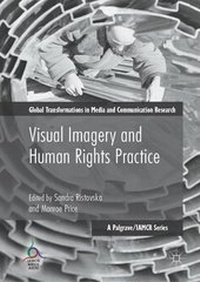
Visual Imagery and Human Rights Practice
Published on 13. December 2019
Book
Paperback/Softback
XVII, 320 pages
978-3-030-40428-4 (ISBN)
Description
Visual Imagery and Human Rights Practice examines the interplay between images and human rights, addressing how, when, and to what ends visuals are becoming a more central means through which human rights claims receive recognition and restitution. The collection argues that accounting for how images work on their own terms is an ever more important epistemological project for fostering the imaginative scope of human rights and its purchase on reality. Interdisciplinary in nature, this timely volume brings together voices of scholars and practitioners from around the world, making a valuable contribution to the study of media and human rights while tackling the growing role of visuals across cultural, social, political and legal structures.
More details
Edition
1st ed. 2018
Language
English
Place of publication
Cham
Switzerland
Publishing group
Springer International Publishing
Target group
Professional and scholarly
Illustrations
7
8 farbige Abbildungen, 7 s/w Abbildungen
8 Illustrations, color; 7 Illustrations, black and white; XVII, 320 p. 15 illus., 8 illus. in color.
Dimensions
Height: 23.5 cm
Width: 15.5 cm
ISBN-13
978-3-030-40428-4 (9783030404284)
DOI
10.1007/978-3-319-75987-6
Schweitzer Classification
Other editions
Additional editions
Sandra Ristovska | Monroe Price
Visual Imagery and Human Rights Practice
Book
11/2018
Palgrave Macmillan
€117.69
Shipment within 10-15 days
Persons
Sandra Ristovska is Assistant Professor in Media Studies at the College of Media, Communication and Information at the University of Colorado Boulder, USA.
Monroe Price is Professor at the Annenberg School for Communication at the University of Pennsylvania, USA, and was director of its Center for Global Communication Studies.
Content
Images and Human Rights.-
Part 1: Technologies.-
50 Years of Documentation: A Brief History of the Audio-Visual Documentation of the
Israeli Occupation.-
Drones, Camera Innovations and Conceptions of Human Rights.-
A Convergence of Visuals: Geospatial and Open Source Analysis in Human Rights.-
The Rise of GEOINT: Technology, Intelligence and Human Rights.-
Technology's Continuum: Body Cameras, Data Collection and Constitutional Searches.-
Part 2: Platforms.-
Simon Srebnik: Narratives of a Holocaust Survivor.-
Re-archiving Mass Atrocity Records by Involving Affected Communities in Postwar Bosnia and Herzegovina.-
Communicating Justice in Film: The Limitations of an Unlimited Field.-
Photography as a Platform for Transitional Justice: Peru's Case.-
Sexual Violence in the Field of Vision.-
Art and Human Rights in the Constitutional Court of South Africa.-
Part 3: Agents.-
A Change of Perspective: Aerial Photography and "the Right to the City" in a
Palestinian Refugee Camp.-
Contested Visualities: Courage and Fear in the Portrayal of Rio de Janeiro's Favelas.-
Ubiquitous Witnessing in Human Rights Activism.-
Answering the Smartphones: Citizen Witness Activism and Police Public Relations.-
How Newsrooms Use Eyewitness Media.