

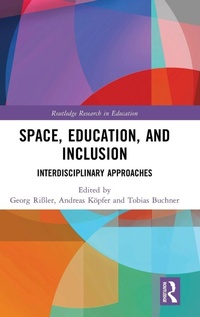
Space, Education, and Inclusion
Interdisciplinary Approaches
1st Edition
Published on 1. December 2023
Book
Hardback
202 pages
978-1-032-32133-2 (ISBN)
Description
This timely, edited volume brings together interdisciplinary perspectives on space and spatiality in inclusive education discourses.
With research from an international range of scholars, the book explores the intersections, boundaries, and intermediary spaces of inclusion and exclusion within educational contexts. It advances thinking in inclusive education research and links discourses of the spatial turn in inclusive education with a call for thinking spatially. Instead of defining one spatial approach as the overarching framework for analysis, it considers the potential of combining spatial approaches from diverse disciplines, including social sciences, educational science, and geography. The book systematically identifies and links the relations between a diversity of spatial theoretical perspectives and phenomena of inclusion/exclusion.
This volume provides invaluable, transdisciplinary readings and reflections on space and spatiality in inclusive education, and will be highly relevant for academics, researchers and postgraduate students in the fields of inclusive education, educational theory and the sociology of education.
The Open Access version of this book, available at http://www.taylorfrancis.com, has been made available under a Creative Commons Attribution-Non Commercial-No Derivatives (CC-BY-NC-ND) 4.0 license.
With research from an international range of scholars, the book explores the intersections, boundaries, and intermediary spaces of inclusion and exclusion within educational contexts. It advances thinking in inclusive education research and links discourses of the spatial turn in inclusive education with a call for thinking spatially. Instead of defining one spatial approach as the overarching framework for analysis, it considers the potential of combining spatial approaches from diverse disciplines, including social sciences, educational science, and geography. The book systematically identifies and links the relations between a diversity of spatial theoretical perspectives and phenomena of inclusion/exclusion.
This volume provides invaluable, transdisciplinary readings and reflections on space and spatiality in inclusive education, and will be highly relevant for academics, researchers and postgraduate students in the fields of inclusive education, educational theory and the sociology of education.
The Open Access version of this book, available at http://www.taylorfrancis.com, has been made available under a Creative Commons Attribution-Non Commercial-No Derivatives (CC-BY-NC-ND) 4.0 license.
More details
Series
Language
English
Place of publication
London
United Kingdom
Publishing group
Taylor & Francis Ltd
Target group
College/higher education
Postgraduate
Illustrations
12 s/w Abbildungen, 12 s/w Photographien bzw. Rasterbilder
12 Halftones, black and white; 12 Illustrations, black and white
Dimensions
Height: 240 mm
Width: 161 mm
Thickness: 16 mm
Weight
490 gr
ISBN-13
978-1-032-32133-2 (9781032321332)
Copyright in bibliographic data and cover images is held by Nielsen Book Services Limited or by the publishers or by their respective licensors: all rights reserved.
Schweitzer Classification
Other editions
Additional editions
Georg Rissler | Andreas Koepfer | Tobias Buchner
Space, Education, and Inclusion
Interdisciplinary Approaches
Book
05/2025
1st Edition
Routledge
€65.10
Shipment within 10-20 days
Georg Rissler | Andreas Koepfer | Tobias Buchner
Space, Education, and Inclusion
Interdisciplinary Approaches
E-Book
12/2023
Taylor & Francis
€42.99
Available for download
Georg Rissler | Andreas Koepfer | Tobias Buchner
Space, Education, and Inclusion
Interdisciplinary Approaches
E-Book
12/2023
Taylor & Francis
€42.99
Available for download
Persons
Georg Rissler is affiliated with the Centre for Childhood in Education and Society at the University of Teacher Education in Zurich. His research focuses on practice theory, space and spatiality, inequality, common worlds and ethnography.
Andreas Koepfer is Professor for Research in Inclusive Education at the University of Education Freiburg, Germany. His research focuses on international comparative perspectives in inclusive education, and social and spatial theories regarding dis-abilities and disadvantages.
Tobias Buchner is a Professor at the Department of Inclusive Education at the University Teacher College, Upper Austria. His research focuses on Inclusive Education, Education and Space, Dis/ability Studies in Education, and Ableism in the Educational System.
Andreas Koepfer is Professor for Research in Inclusive Education at the University of Education Freiburg, Germany. His research focuses on international comparative perspectives in inclusive education, and social and spatial theories regarding dis-abilities and disadvantages.
Tobias Buchner is a Professor at the Department of Inclusive Education at the University Teacher College, Upper Austria. His research focuses on Inclusive Education, Education and Space, Dis/ability Studies in Education, and Ableism in the Educational System.
Content
1. Space, Education, and Inclusion: An Introduction to the Volume 2. Exploring Dimensions of Access Within Restrictive Spaces of Schooling 3. From Excluding Schools to Excluding Spaces: Spatial and Postcolonial Reflections on Inclusive Education in Africa 4. Evaluating Education Policies Through a Spatial Lens: Uncovering the Ability-Space-Regimes of Austrian New Middle Schools 5. Inclusive Research, In-/Exclusion and Ethics: After the Spatial Turn(s) 6. Inclusion, Exclusion, and the Spaces of Practices 7. The Education MarketSpace 8. Revisiting Kracauer's Perspectives on Space and Inclusion/Exclusion 9. Digital Learning: Navigating Inclusive/Exclusive Spaces Through Open Educational Practice 10. Inclusion and Exclusion in Classroom Practices: Empirical Analyses of Conjunctive Spaces of Experience in Secondary Schools 11. Learning Spaces at the Intersections of Families and Preschools. 12. Teaching When Students Are Absent: A Study on the Relationship Between Space and Inclusion Based on the Covid Crisis. Afterword