

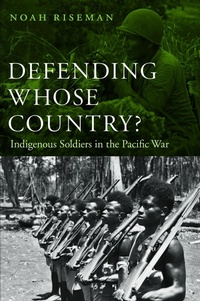
Defending Whose Country?
Indigenous Soldiers in the Pacific War
Published on 1. December 2012
Book
Hardback
336 pages
978-0-8032-3793-3 (ISBN)
Description
In the campaign against Japan in the Pacific during the Second World War, the armed forces of the United States, Australia, and the Australian colonies of Papua and New Guinea made use of indigenous peoples in new capacities. The United States had long used American Indians as soldiers and scouts in frontier conflicts and in wars with other nations. With the advent of the Navajo Code Talkers in the Pacific theater, Native servicemen were now being employed for contributions that were unique to their Native cultures. In contrast, Australia, Papua, and New Guinea had long attempted to keep indigenous peoples out of the armed forces altogether. With the threat of Japanese invasion, however, they began to bring indigenous peoples into the military as guerilla patrollers, coastwatchers, and regular soldiers.
Defending Whose Country? is a comparative study of the military participation of Papua New Guineans, Yolngu, and Navajos in the Pacific theater. In examining the decisions of state and military leaders to bring indigenous peoples into military service, as well as the decisions of indigenous individuals to serve in the armed forces, Noah Riseman reconsiders the impact of the largely forgotten contributions of indigenous soldiers in the Second World War.
Defending Whose Country? is a comparative study of the military participation of Papua New Guineans, Yolngu, and Navajos in the Pacific theater. In examining the decisions of state and military leaders to bring indigenous peoples into military service, as well as the decisions of indigenous individuals to serve in the armed forces, Noah Riseman reconsiders the impact of the largely forgotten contributions of indigenous soldiers in the Second World War.
Reviews / Votes
"A worthy contribution to comparative military history."-Alison R. Bernstein, Journal of American History "Defending Whose Country? is a welcome contribution to the existing body of literature and posits some interest questions in this understudied area of military history.""-Alexios Alecou, Army History "A fascinating study."-Jatinder Mann, Journal of New Zealand and Pacific StudiesMore details
Language
English
Place of publication
Lincoln
United States
Target group
Professional and scholarly
College/higher education
Product notice
Cloth over boards
Illustrations
24 photographs, 3 maps
Dimensions
Height: 229 mm
Width: 152 mm
Thickness: 33 mm
Weight
640 gr
ISBN-13
978-0-8032-3793-3 (9780803237933)
Copyright in bibliographic data and cover images is held by Nielsen Book Services Limited or by the publishers or by their respective licensors: all rights reserved.
Schweitzer Classification
Other editions
Additional editions
E-Book
12/2012
University of Nebraska Press
€108.99
Available for download
Person
Noah Riseman is a senior lecturer in history at Australian Catholic University in Melbourne. This book is based on his dissertation, which won the 2009 C. E. W. Bean Prize for Military History.
Content
List of Illustrations
Preface
List of Abbreviations
Introduction: Reading Colonialism and Indigenous Involvement in the Second World War
1. An Exception in the Equation? Donald Thomson and the NTSRU
2. Allies at War: De Facto Yolngu Soldiers
3. Black Skins, Black Work: Papuan and New Guinean Labor
4. Guerillas for the White Men: Formal Papuan and New Guinean Fighters
5. The Navajo Code Talkers: Warriors for the Settler Nation
6. When the War Was Over: Forgetting and (Re)membering the Code Talkers
Conclusion: The Soldier-Warrior in Modern War
Source Acknowledgments
Notes
Bibliography
Index
Preface
List of Abbreviations
Introduction: Reading Colonialism and Indigenous Involvement in the Second World War
1. An Exception in the Equation? Donald Thomson and the NTSRU
2. Allies at War: De Facto Yolngu Soldiers
3. Black Skins, Black Work: Papuan and New Guinean Labor
4. Guerillas for the White Men: Formal Papuan and New Guinean Fighters
5. The Navajo Code Talkers: Warriors for the Settler Nation
6. When the War Was Over: Forgetting and (Re)membering the Code Talkers
Conclusion: The Soldier-Warrior in Modern War
Source Acknowledgments
Notes
Bibliography
Index