

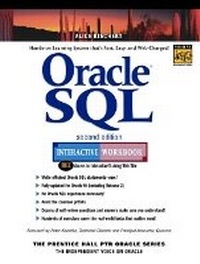
Oracle SQL Interactive Workbook
2nd Edition
Published on 8. January 2003
Book
Paperback/Softback
851 pages
978-0-13-100277-7 (ISBN)
Description
Appropriate for beginning to intermediate courses in Oracle SQL.
Fully updated and expanded for Oracle 9i, this integrated book-and-Web learning solution is designed to help students master SQL on Oracle Systems as quickly as possible. Its unique workbook-based pedagogy incorporates hands-on, real-world labs, exercises, and projects, as well as an outstanding Web-based training site containing "Test Your Thinking" project solutions and detailed explanations, an Author's Corner that connects students with the book's expert author; additional self-review exercises with instant feedback and explanations; and an exclusive Virtual Study Lounge where students can interact with each other. The book's coverage includes every fundamental SQL concept, skill, and technique, including entity-relationship diagrams, SQL*Plus, SELECT and other statements, Boolean operations, functions, pseudocolumns, joins, complex joins, subqueries, relational operators, DML, DQL, DDL, and the Oracle Data Dictionary.
Fully updated and expanded for Oracle 9i, this integrated book-and-Web learning solution is designed to help students master SQL on Oracle Systems as quickly as possible. Its unique workbook-based pedagogy incorporates hands-on, real-world labs, exercises, and projects, as well as an outstanding Web-based training site containing "Test Your Thinking" project solutions and detailed explanations, an Author's Corner that connects students with the book's expert author; additional self-review exercises with instant feedback and explanations; and an exclusive Virtual Study Lounge where students can interact with each other. The book's coverage includes every fundamental SQL concept, skill, and technique, including entity-relationship diagrams, SQL*Plus, SELECT and other statements, Boolean operations, functions, pseudocolumns, joins, complex joins, subqueries, relational operators, DML, DQL, DDL, and the Oracle Data Dictionary.
More details
Edition
2nd edition
Language
English
Place of publication
Upper Saddle River
United States
Publishing group
Pearson Education (US)
Target group
College/higher education
Dimensions
Height: 231 mm
Width: 235 mm
Thickness: 31 mm
Weight
1202 gr
ISBN-13
978-0-13-100277-7 (9780131002777)
Copyright in bibliographic data and cover images is held by Nielsen Book Services Limited or by the publishers or by their respective licensors: all rights reserved.
Schweitzer Classification
Other editions
New editions
Alice Rischert
Oracle SQL by Example
Book
07/2004
3rd Edition
Prentice Hall
€54.46
Article exhausted; check for reprint
Previous edition
Alex Morrison | Alice Rischert
Oracle SQL Interactive Workbook
Book
05/2000
Prentice Hall
€39.60
Article exhausted; check for reprint
Person
ALICE RISCHERT chairs the Database Application Development and Design track at the Computer Technology and Application Program at Columbia University. She has taught Oracle SQL to hundreds of students and has presented at Oracle conferences. Rischert has worked with Oracle for over 10 years and currently consults on large Oracle data warehouse and system integration projects.
Foreword by Peter Koletze
Foreword by Peter Koletze
Content
(NOTE: All chapters conclude with Test Your Thinking.)
Foreword.
Acknowledgments.
About the Author.
Introduction.
1. SQL and Data.
Data, Databases, and the Definition of SQL. Table Relationships. The Student Schema Diagram.
2. SQL: The Basics.
The SQL*Plus Environment. The Anatomy of a SELECT Statement. Editing a SQL Statement. The WHERE Clause: Comparison and Logical Operators. The ORDER BY Clause.
3. Character, Number, and Miscellaneous Functions.
Character Functions. Number Functions. Miscellaneous Single-]Row Functions.
4. Date and Conversion Functions.
Applying Oracle's Date Format Models. Performing Date and Time Math. Using the New Oracle 9i DATETIME Datatypes. Performing Calculations with the INTERVAL Datatype. Converting from One Datatype to Another.
5. Aggregate Functions, Group By, and Having.
Aggregate Functions. The GROUP BY and HAVING Clauses.
6. Equijoins.
The Two-Table Join. Joining Three or More Tables.
7. Subqueries.
Simple Subqueries. Correlated Subqueries. Inline Views, Scalar Subquery Expressions, and the Subquery WITH Clause. ANY, SOME, and ALL Operators in Subqueries.
8. Set Operators.
The Power of UNION and UNION ALL. The MINUS and INTERSECT Set Operators.
9. Complex Joins.
Outer Joins. Self-Joins.
10. Insert, Update, and Delete.
Creating Data and Transaction Control. Updating and Deleting Data.
11. Create, Alter, and Drop Tables.
Creating and Dropping Tables. Altering Tables and Manipulating Constraints.
12. Views, Indexes, and Sequences.
Creating and Modifying Views. Indexes. Sequences.
13. The Data Dictionary and Dynamic SQL Scripts.
The Oracle Data Dictionary Views. Dynamic SQL Scripts.
14. Security.
Users, Privileges, Roles, and Synonyms.
15. Advanced SQL Queries.
Advanced SQL Concepts and Analytical Functions. ROLLUP and CUBE Operators. Hierarchical Queries.
16. SQL Optimization.
The Oracle Optimizer and Writing Effective SQL Statements.
Appendix A. Answers to Self-Review Questions.
Appendix B. SQL Formatting Guide.
Appendix C. SQL*Plus Command Reference.
Appendix D. Student Database Schema.
Appendix E. Table and Column Descriptions.
Appendix F. Additional Example Tables.
Appendix G. Navigating through the Oracle Documentation.
Appendix H. Resources.
Index.
Foreword.
Acknowledgments.
About the Author.
Introduction.
1. SQL and Data.
Data, Databases, and the Definition of SQL. Table Relationships. The Student Schema Diagram.
2. SQL: The Basics.
The SQL*Plus Environment. The Anatomy of a SELECT Statement. Editing a SQL Statement. The WHERE Clause: Comparison and Logical Operators. The ORDER BY Clause.
3. Character, Number, and Miscellaneous Functions.
Character Functions. Number Functions. Miscellaneous Single-]Row Functions.
4. Date and Conversion Functions.
Applying Oracle's Date Format Models. Performing Date and Time Math. Using the New Oracle 9i DATETIME Datatypes. Performing Calculations with the INTERVAL Datatype. Converting from One Datatype to Another.
5. Aggregate Functions, Group By, and Having.
Aggregate Functions. The GROUP BY and HAVING Clauses.
6. Equijoins.
The Two-Table Join. Joining Three or More Tables.
7. Subqueries.
Simple Subqueries. Correlated Subqueries. Inline Views, Scalar Subquery Expressions, and the Subquery WITH Clause. ANY, SOME, and ALL Operators in Subqueries.
8. Set Operators.
The Power of UNION and UNION ALL. The MINUS and INTERSECT Set Operators.
9. Complex Joins.
Outer Joins. Self-Joins.
10. Insert, Update, and Delete.
Creating Data and Transaction Control. Updating and Deleting Data.
11. Create, Alter, and Drop Tables.
Creating and Dropping Tables. Altering Tables and Manipulating Constraints.
12. Views, Indexes, and Sequences.
Creating and Modifying Views. Indexes. Sequences.
13. The Data Dictionary and Dynamic SQL Scripts.
The Oracle Data Dictionary Views. Dynamic SQL Scripts.
14. Security.
Users, Privileges, Roles, and Synonyms.
15. Advanced SQL Queries.
Advanced SQL Concepts and Analytical Functions. ROLLUP and CUBE Operators. Hierarchical Queries.
16. SQL Optimization.
The Oracle Optimizer and Writing Effective SQL Statements.
Appendix A. Answers to Self-Review Questions.
Appendix B. SQL Formatting Guide.
Appendix C. SQL*Plus Command Reference.
Appendix D. Student Database Schema.
Appendix E. Table and Column Descriptions.
Appendix F. Additional Example Tables.
Appendix G. Navigating through the Oracle Documentation.
Appendix H. Resources.
Index.