


Roman and Medieval Exeter and their Hinterlands
From Isca to Excester
Published on 15. February 2021
Book
Hardback
416 pages
978-1-78925-615-4 (ISBN)
Description
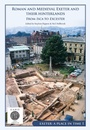
This first volume, presenting research carried out through the Exeter: A Place in Time project, provides a synthesis of the development of Exeter within its local, regional, national and international hinterlands. Exeter began life in c. AD 55 as one of the most important legionary bases within early Roman Britain, and for two brief periods in the early and late 60s AD, Exeter was a critical centre of Roman power within the new province. When the legion moved to Wales the fortress was converted into the civitas capital for the Dumnonii. Its development as a town was, however, relatively slow, reflecting the gradual pace at which the region as a whole adapted to being part of the Roman world. The only evidence we have for occupation within Exeter between the 5th and 8th centuries is for a church in what was later to become the Cathedral Close. In the late 9th century, however, Exeter became a defended burh, and this was followed by the revival of urban life. Exeter's wealth was in part derived from its central role in the south-west's tin industry, and by the late 10th century Exeter was the fifth most productive mint in England. Exeter's importance continued to grow as it became an episcopal and royal centre, and excavations within Exeter have revealed important material culture assemblages that reflect its role as an international port.
Reviews / Votes
Anyone interested in the history and archaeology of Exeter and the south-west of England will want to have these two substantial volumes on their shelves. * Medieval Archaeology *More details
Series
Language
English
Place of publication
Oxford
United Kingdom
Target group
Professional and scholarly
Illustrations
Colour
Dimensions
Height: 297 mm
Width: 210 mm
ISBN-13
978-1-78925-615-4 (9781789256154)
Copyright in bibliographic data is held by Nielsen Book Services Limited or its licensors: all rights reserved.
Schweitzer Classification
Other editions
Additional editions
Rippon Stephen Rippon | Holbrook Neil Holbrook
Roman and Medieval Exeter and their Hinterlands
From Isca to Escanceaster: Exeter, A Place in Time Volume I
E-Book
03/2021
Oxbow Books
€25.49
Available for download
Persons
Stephen Rippon is Professor of Landscape Archaeology at the University of Exeter, and President of the Society for Medieval Archaeology. His main research interests cover the Romano-British and medieval landscapes of Britain, and the origins of today's countryside. Neil Holbrook is Chief Executive of Cotswold Archaeology, and earlier in his career he worked for the Exeter Museums Archaeological Field Unit between 1986 and 1989. He was co-director of the Roman Rural Settlement Project with Michael Fulford and joint series editor of the three monographs in the New Visions of the Countryside of Roman Britain series (2016-18).
Content
List of Figures
List of Tables
List of Appendices
List of Abbreviations
List of Contributors
Preface
Acknowledgments
Summary
Foreign Language Summaries
1. Introduction: Roman and Medieval Exeter and their Hinterlands - From Isca to Excester
Stephen Rippon and Neil Holbrook
2. Exeter's Local and Regional Hinterlands: The Landscape of South-West Britain
Stephen Rippon and David Gould
3. Regional Identities in the Roman Period: Dumnonia and the Wider South-West of Britain
Stephen Rippon and David Gould, with a contribution by Gundula Mueldner and Delphine Fremondeau
4. 'Richer in its bowels than in the face thereof': The Hinterland of Exeter during the Medieval Period
Stephen Rippon and David Gould, with a contribution by Gundula Mueldner and Delphine Fremondeau
5. The Legionary Fortress and its Landscape Context
Paul Bidwell, with a contribution by Mark Maltby
6. The Civitas Capital
Neil Holbrook, with contributions by Paul Bidwell and Mark Maltby
7. The Early Medieval Period c. 410-900 and Urban Revival c. 900-1200
John Allan, with contributions by Robert Higham, Mark Maltby and Stephen Rippon
8. The Medieval City, 1200-1550
John Allan, with a contribution by Mark Maltby
9. Conclusions: Exeter - A Changing Place in Time
Stephen Rippon, John Allan, Paul Bidwell, David Gould and Neil Holbrook
Bibliography
Index
List of Tables
List of Appendices
List of Abbreviations
List of Contributors
Preface
Acknowledgments
Summary
Foreign Language Summaries
1. Introduction: Roman and Medieval Exeter and their Hinterlands - From Isca to Excester
Stephen Rippon and Neil Holbrook
2. Exeter's Local and Regional Hinterlands: The Landscape of South-West Britain
Stephen Rippon and David Gould
3. Regional Identities in the Roman Period: Dumnonia and the Wider South-West of Britain
Stephen Rippon and David Gould, with a contribution by Gundula Mueldner and Delphine Fremondeau
4. 'Richer in its bowels than in the face thereof': The Hinterland of Exeter during the Medieval Period
Stephen Rippon and David Gould, with a contribution by Gundula Mueldner and Delphine Fremondeau
5. The Legionary Fortress and its Landscape Context
Paul Bidwell, with a contribution by Mark Maltby
6. The Civitas Capital
Neil Holbrook, with contributions by Paul Bidwell and Mark Maltby
7. The Early Medieval Period c. 410-900 and Urban Revival c. 900-1200
John Allan, with contributions by Robert Higham, Mark Maltby and Stephen Rippon
8. The Medieval City, 1200-1550
John Allan, with a contribution by Mark Maltby
9. Conclusions: Exeter - A Changing Place in Time
Stephen Rippon, John Allan, Paul Bidwell, David Gould and Neil Holbrook
Bibliography
Index