

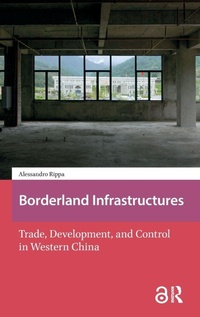
Borderland Infrastructures
Trade, Development, and Control in Western China
Published on 11. September 2020
Book
Hardback
282 pages
978-94-6372-560-6 (ISBN)
Description
Across the Chinese borderlands, investments in large-scale transnational infrastructure such as roads and special economic zones have increased exponentially over the past two decades. Based on long-term ethnographic research, Borderland Infrastructures addresses a major contradiction at the heart of this fast-paced development: small-scale traders have lost their historic strategic advantages under the growth of massive Chinese state investment and are now struggling to keep their businesses afloat. Concurrently, local ethnic minorities have become the target of radical resettlement projects, securitization, and tourism initiatives, and have in many cases grown increasingly dependent on state subsidies. At the juncture of anthropological explorations of the state, border studies, and research on transnational trade and infrastructure development, Borderland Infrastructures provides new analytical tools to understand how state power is experienced, mediated, and enacted in Xinjiang and Yunnan. In the process, Rippa offers a rich and nuanced ethnography of life across China's peripheries.
Reviews / Votes
Winner of the Political Geography Research Group (PolGRG) Book Award (2021-2022)"Carefully contextualized in the literature on Inner Asian borderlands and masterfully weaving in vivid ethnographic evidence, Rippa's book provides a compelling account of how the BRI is worked "on the ground" by traders and state officials, by local histories of exchange, and by grand narratives of frictionless connectivity. It surely will become an inspiring source of information for scholars of western China's borders, historians, social anthropologists, and human geographers alike."
- Henryk Alff, Journal of Borderlands Studies (2022)
"Borderland Infrastructures is a tour de force, and it should be required reading not only for researchers of contemporary China or the BRI, but also for anyone interested in the anthropology and geography of infrastructure, development, heritage, borders, and mobility"
- Emily T. Yeh, The Journal of Asian Studies, Volume 80, Issue 4, November 2021
"Rippa's analysis is a refreshing view from the ground, starkly positing the imageries of infrastructure development and social, cultural, political and ecological control used by the state with local worldviews about their transboundary connections spread over time, space and memory."
- Mirza Zulfiqur Rahman, Asian Studies Review, August 2021
"Borderland Infrastructures is essential reading for anyone interested in BRI, infrastructure. [...] Ethnographically rich and theoretically engaging, the book will be particularly useful to anthropologists, geographers, and other social scientists invested in better understanding the uneven contours of China's contemporary regional ambitions."
- Geoffrey Aung, Eurasian Geography and Economics, April 2021
"Providing a rich and original conceptual framework for understanding the relationship between development processes and state power in China, Borderland Infrastructures is a highly recommended read for students and scholars across disciplines, including political and economic anthropology, borderland studies, development studies and Asian studies."
-Henrik Kloppenborg Moller, The Copenhagen Journal of Asian Studies, 41(1), 2023
More details
Series
Language
English
Place of publication
Amsterdam
Netherlands
Target group
Professional and scholarly
Academic
Illustrations
22 s/w Abbildungen
Dimensions
Height: 240 mm
Width: 161 mm
Thickness: 20 mm
Weight
593 gr
ISBN-13
978-94-6372-560-6 (9789463725606)
Copyright in bibliographic data and cover images is held by Nielsen Book Services Limited or by the publishers or by their respective licensors: all rights reserved.
Schweitzer Classification
Other editions
Additional editions
Book
approx. 12/2025
1st Edition
Routledge
€73.22
Not yet published
E-Book
10/2025
Routledge
€0.00
Available for download
E-Book
10/2025
Routledge
€0.00
Available for download
Person
Alessandro Rippa is Associate Professor of Chinese Studies at Tallinn University and freigeist Fellow (2020-2025) at the Rachel Carson Center for Environment and Society, LMU Munich.|Willem van Schendel, Professor of History, University of Amsterdam and International Institute of Social History, the Netherlands. He works with the history, anthropology and sociology of Asia. Recent works include A History of Bangladesh (2020), Embedding Agricultural Commodities (2017, ed.), The Camera as Witness (2015, with J. L. K. Pachuau). See uva.academia.edu/WillemVanSchendel.
Content
Introduction, Part I - PROXIMITY, Chapter 1: Connections, Interlude, Chapter 2: Bridgehead, Coda, Part II - CURATION, Chapter 3: Dependency, Interlude, Chapter 4: Heritage, Coda, Part III - CORRIDOR, Chapter 5: Control, Interlude, Chapter 6: (Il)licitness, Coda, Conclusion, Bibliography, Index