

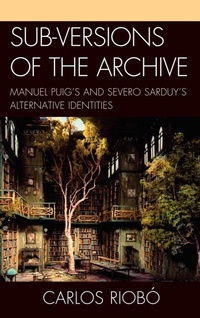
Sub-versions of the Archive
Manuel Puig's and Severo Sarduy's Alternative Identities
Published on 29. December 2010
Book
Hardback
236 pages
978-1-61148-036-8 (ISBN)
Description
Sub-Versions of the Archive: Manuel Puig's and Severo Sarduy's Alternative Identities analyzes recent theories of the archive to examine how Manuel Puig and Severo Sarduy reformulate the Latin American literary tradition. This study focuses on eclectic theories of the archive as both repository and danger, drawing from an array of sources both within and outside the Hispanic literary tradition: from Borges, Foucault, Arrom, Derrida, Gonzalez Echevarria, and Guillory to digital media and biotechnology. This book also applies theories of cultural contamination (Maria Lugones) and symbolic capital (Pierre Bourdieu) to the novels of Puig and Sarduy to explore the representation of marginal cultures within a body of literature that previously altered or elided these subaltern cultures from the tradition.
Through close readings and critical theoretical applications, this book demonstrates how archival fiction continues to be one of the most popular strategies among Latin American novelists and, most importantly, how they have successfully managed to find new ways to inscribe their alternative fictions within this tradition. Puig's and Sarduy's novels reproduce discourses-popular culture and the mass media-that lack prestige within the traditional archive. These discourses mirror realities of marginal groups-gay people, children, the poor, the illiterate, women, and racial minorities. Their cultural variants, sub-versions of hegemonic masterstories, are endowed with truth-bearing power for them, but were previously left out of the archive as legitimate novelistic models.
To date, this is the only study of contemporary Latin American fiction that puts current theories of the archive-especially that of Roberto Gonzalez Echevarria-to practice in such a systematic way. Riobo's analysis of how Puig and Sarduy reformulate the Latin American canon is both a necessary complement of Gonzalez Echevarria's work and an intelligent answer to the first of his projected masterstories. Riobo's multidisciplinary approach
Through close readings and critical theoretical applications, this book demonstrates how archival fiction continues to be one of the most popular strategies among Latin American novelists and, most importantly, how they have successfully managed to find new ways to inscribe their alternative fictions within this tradition. Puig's and Sarduy's novels reproduce discourses-popular culture and the mass media-that lack prestige within the traditional archive. These discourses mirror realities of marginal groups-gay people, children, the poor, the illiterate, women, and racial minorities. Their cultural variants, sub-versions of hegemonic masterstories, are endowed with truth-bearing power for them, but were previously left out of the archive as legitimate novelistic models.
To date, this is the only study of contemporary Latin American fiction that puts current theories of the archive-especially that of Roberto Gonzalez Echevarria-to practice in such a systematic way. Riobo's analysis of how Puig and Sarduy reformulate the Latin American canon is both a necessary complement of Gonzalez Echevarria's work and an intelligent answer to the first of his projected masterstories. Riobo's multidisciplinary approach
More details
Language
English
Place of publication
Cranbury
United States
Publishing group
Associated University Presses
Target group
College/higher education
Dimensions
Height: 235 mm
Width: 157 mm
Thickness: 18 mm
Weight
533 gr
ISBN-13
978-1-61148-036-8 (9781611480368)
Copyright in bibliographic data and cover images is held by Nielsen Book Services Limited or by the publishers or by their respective licensors: all rights reserved.
Schweitzer Classification
Other editions
Additional editions
E-Book
12/2010
1st Edition
Bucknell University Press,U.S.
€94.99
Available for download
E-Book
12/2010
1st Edition
Bucknell University Press,U.S.
€94.99
Available for download
Person
Carlos Riobo is assistant professor of Latin American Literature and Cultures at the City College of New York/City University of New York and Cuba Project Fellow of the Bildner Center for Western Hemisphere Studies at CUNY's Graduate Center.
Content
Chapter 1. Introduction: Alternative Identities and Aberrant Archives
Chapter 2. Raiding the Archive: An Analysis of an Archival Tradition and Its New Configurations
Chapter 3. Manuel Puig: El "doble irrisorio de un subgenero: Entering the Archive through Boquitas pintadas and The Buenos Aires Affair
Chapter 4. Manuel Puig: The Patriarch Betrayed: The Archive's Alternative Voices in La traicion de Rita Hayworth and El beso de la mujer arana
Chapter 5. Severo Sarduy:Monstrorum Artifex: Cultural Compendia as Alternative Archives in De donde son los cantantes and Cobra
Chapter 6. Severo Sarduy: Raiding Archives and Reformulating Narrative Traditions:Maitreya andColibri
Chapter 2. Raiding the Archive: An Analysis of an Archival Tradition and Its New Configurations
Chapter 3. Manuel Puig: El "doble irrisorio de un subgenero: Entering the Archive through Boquitas pintadas and The Buenos Aires Affair
Chapter 4. Manuel Puig: The Patriarch Betrayed: The Archive's Alternative Voices in La traicion de Rita Hayworth and El beso de la mujer arana
Chapter 5. Severo Sarduy:Monstrorum Artifex: Cultural Compendia as Alternative Archives in De donde son los cantantes and Cobra
Chapter 6. Severo Sarduy: Raiding Archives and Reformulating Narrative Traditions:Maitreya andColibri