

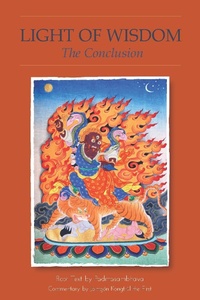
Light of Wisdom, The Conclusion
The Conclusion
Will be published approx. on 31. October 2013
Book
Paperback/Softback
252 pages
978-962-7341-84-0 (ISBN)
Description
The Light of Wisdom, the Conclusion, presents detailed explanations of the activities of a Vajra Master and Buddhist practices to clear away hindrances on the path and enhance realization. The book is a combination of three texts:
The root text, The Gradual Path of the Wisdom Essence is oral instructions of Padmasambhava, recorded by his chief female disciple, Yeshe Tsogyal. Padmasambhava established the Buddhist doctrine in Tibet during the eight century. He concealed teachings in the form of hidden treasures, to be revealed at an appropriate time in the future. The Light of Wisdom by Jamgön Kongtrül, one of the most prominent Buddhist masters of nineteenth-century Tibet, is an extensive commentary on this sacred scripture. Entering the Path of Wisdom consists of annotations on the commentary by Jamyang Drakpa, a student of Jamgön Kongtrül, dictated to Jokyab Rinpoche.
The root text of Lamrim Yeshe Nyingpo, a terma revealed by the great treasure-finder Chokgyur Lingpa, and its commentary by Kongtrül Rinpoche, the great translator in person, form together a complete scripture that embodies all the tantras, statements and instructions of the Nyingma School of the early translations, which is most rare to find in the past, present, or future. …I find it important that all Dharma practitioners study and reflect upon this book.
? Kyabje Dilgo Khyentse Rinpoche
It is correct that it will be quite difficult to practice the entire Gradual Path of the Wisdom Essence, so you should use what is directly appropriate for your training. It is never said that you should practice an entire root text as Light of Wisdom contains the complete path for different kinds of individuals, both of Hinayana, Mahayana and Vajrayana. But since its title is the Wisdom Essence, it means that its ultimate practice is Dzogchen.
? Kyabje Tulku Urgyen Rinpoche
The root text, The Gradual Path of the Wisdom Essence is oral instructions of Padmasambhava, recorded by his chief female disciple, Yeshe Tsogyal. Padmasambhava established the Buddhist doctrine in Tibet during the eight century. He concealed teachings in the form of hidden treasures, to be revealed at an appropriate time in the future. The Light of Wisdom by Jamgön Kongtrül, one of the most prominent Buddhist masters of nineteenth-century Tibet, is an extensive commentary on this sacred scripture. Entering the Path of Wisdom consists of annotations on the commentary by Jamyang Drakpa, a student of Jamgön Kongtrül, dictated to Jokyab Rinpoche.
The root text of Lamrim Yeshe Nyingpo, a terma revealed by the great treasure-finder Chokgyur Lingpa, and its commentary by Kongtrül Rinpoche, the great translator in person, form together a complete scripture that embodies all the tantras, statements and instructions of the Nyingma School of the early translations, which is most rare to find in the past, present, or future. …I find it important that all Dharma practitioners study and reflect upon this book.
? Kyabje Dilgo Khyentse Rinpoche
It is correct that it will be quite difficult to practice the entire Gradual Path of the Wisdom Essence, so you should use what is directly appropriate for your training. It is never said that you should practice an entire root text as Light of Wisdom contains the complete path for different kinds of individuals, both of Hinayana, Mahayana and Vajrayana. But since its title is the Wisdom Essence, it means that its ultimate practice is Dzogchen.
? Kyabje Tulku Urgyen Rinpoche
More details
Language
English
Place of publication
Hong Kong
Hong Kong
Product notice
Paperback (trade)
Illustrations
Black and White Line Drawings
Dimensions
Height: 228 mm
Width: 151 mm
Thickness: 22 mm
Weight
387 gr
ISBN-13
978-962-7341-84-0 (9789627341840)
Copyright in bibliographic data and cover images is held by Nielsen Book Services Limited or by the publishers or by their respective licensors: all rights reserved.
Schweitzer Classification
Persons
PADMASAMBHAVA was the legendary tantric master who, at the invitation of King Trisong Deutsen, established Vajrayana Buddhism in Tibet in the ninth century. He hid innumerable Dharma treasures throughout Tibet, Nepal, and Bhutan to be revealed by destined disciples in the centuries to come. CHOKGYUR LINGPA (1829-70) is regarded as one of the major tertons in Tibetan history, and his termas are widely practiced by both the Kagyu and Nyingma schools. JAMGON KONGTRUL (1813-99) was a leader at the forefront of the nonsectarian rimey movement in the nineteenth century. Renowned as an accomplished master, scholar, and writer, he authored more than 188 volumes of scripture. JAMYANG KHYENTSE WANGPO (1820-92), the last of the five great tertons, was the master and teacher of all the Buddhist schools of Tibet and the founder of the nonsectarian rimey movement.