

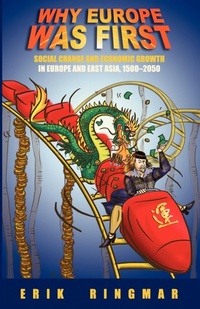
Why Europe Was First
Social Change and Economic Growth in Europe and East Asia 1500-2050
Published on 7. March 2007
Book
Paperback/Softback
428 pages
978-1-84331-241-3 (ISBN)
Description
For most of its history Europe was a thoroughly average part of the world: poor, uncouth, technologically and culturally backward. By contrast, China was always far richer, more sophisticated and advanced. Yet it was Europe that first became modern, and by the nineteenth century China was struggling to catch up. This book explains why. Why did Europe succeed and why was China left behind? The answer, as we will see, does not only solve a long-standing historical puzzle, it also provides an explanation of the contemporary success of East Asia, and it shows what is wrong with current theories of development and modernization.
More details
Series
Language
English
Place of publication
London
United Kingdom
Target group
Professional and scholarly
Dimensions
Height: 216 mm
Width: 140 mm
Thickness: 25 mm
Weight
601 gr
ISBN-13
978-1-84331-241-3 (9781843312413)
Copyright in bibliographic data and cover images is held by Nielsen Book Services Limited or by the publishers or by their respective licensors: all rights reserved.
Schweitzer Classification
Other editions
Additional editions
Erik Ringmar
Why Europe Was First
Social Change and Economic Growth in Europe and East Asia 1500-2050
E-Book
03/2007
Anthem Press
€22.49
Available for download
Person
Erik Ringmar is a Professor at the National Chiao Tung Unviersity, Hsinchu, Taiwan.
Content
The Nature & Origin of Modern Society; The Failure & Success of East Asia; The Self-Transforming Machine; The Discovery of Distance; The Face in the Mirror; Institutions that Reflect; Origins of the Entrepreneurial Outlook; The Age of the Demiurge; Institutions that Get Things Done; A World in Pieces; The Polite Alternative; Institutions that Deal with Conflicts; Institutions & Revolutions; Reflection; Entrepreneurship; Pluralism; Europe & China Compared; Foreign Challenges, Japanese Responses; Japan & China in a Modern World; The New Politics of Modernization; Notes; Bibliography; Index