

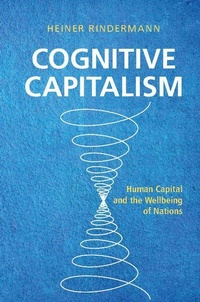
Cognitive Capitalism
Human Capital and the Wellbeing of Nations
Will be published approx. on 15. February 2018
Book
Hardback
592 pages
978-1-107-05016-7 (ISBN)
Description
Nations can vary greatly in their wealth, democratic rights and the wellbeing of their citizens. These gaps are often obvious, and by studying the flow of immigration one can easily predict people's wants and needs. But why are there also large differences in the level of education indicating disparities in cognitive ability? How are they related to a country's economic, political and cultural development? Researchers in the paradigms of economics, psychology, sociology, evolution and cultural studies have tried to find answers for these hotly debated issues. In this book, Heiner Rindermann establishes a new model: the emergence of a burgher-civic world, supported by long-term background factors, furthered education and thinking. The burgher-civic world initiated a reciprocal development changing society and culture, resulting in past and present cognitive capital and wealth differences. This is an important text for graduate students and researchers in a wide range of fields, including economics, psychology, sociology and political science, and those working on economic growth, human capital formation and cognitive development.
Reviews / Votes
'In an era where most intelligent people are poorly informed about intelligence, Heiner Rindermann's book is especially welcome. The title of the book effectively summarizes what is most crucial for the economic well-being of a people: Cognitive Capitalism. The author, who grew up in East Germany at a time when the Berlin Wall still stood, is the best-qualified person to integrate intelligence research with the literature on the determinants of economic growth.' Gregory Christainsen, Professor Emeritus, California State University, East Bay 'Cognitive Capitalism is a tour de force of the science of country level differences in cognitive ability. It raises important questions about the role of cognitive ability for culture, health, economics, education, technology, immigration and government. The theory of cognitive capitalism promises to inform our understanding of country level differences just as Darwin's theory informed our understanding of individual differences.' Thomas R. Coyle, University of Texas, San AntonioMore details
Language
English
Place of publication
Cambridge
United Kingdom
Target group
Professional and scholarly
Product notice
Laminated cover
Illustrations
47 Tables, black and white; 32 Halftones, black and white; 25 Line drawings, black and white
Dimensions
Height: 235 mm
Width: 157 mm
Thickness: 36 mm
Weight
999 gr
ISBN-13
978-1-107-05016-7 (9781107050167)
Copyright in bibliographic data and cover images is held by Nielsen Book Services Limited or by the publishers or by their respective licensors: all rights reserved.
Schweitzer Classification
Other editions
Additional editions
E-Book
02/2018
Cambridge University Press
€34.49
Available for download
Book
02/2018
Cambridge University Press
€61.50
Shipment within 15-20 days
E-Book
01/2018
Cambridge University Press
€41.49
Available for download
Person
Heiner Rindermann is Professor of Educational and Developmental Psychology at Technische Universitaet Chemnitz, Germany. He has published about 150 articles and books, and is Fellow of the Association for Psychological Science (APS). His research focuses on cognitive human capital from an interdisciplinary perspective, bringing together ideas on cognitive competence, cognitive development, productivity, politics and culture on individual and national levels.
Content
1. Large wealth differences across time and nations; 2. The wellbeing of nations; 3. Human capital, cognitive ability and intelligence; 4. International ability differences and their development; 5. Why some are richer, freer and more democratic; 6. History, culture and the burgher-civic world; 7. Why cognitive factors are important - a theory of cognitive capitalism; 8. The impact of cognitive-intellectual classes; 9. Methodological research problems and solutions; 10. Causes for national and historical differences in cognitive ability - and reciprocal effects; 11. Global models for education, cognitive capital, production, wealth and wellbeing; 12. Challenges of future development and first predictions; 13. Models for cognitive and wealth development in twenty-first century; 14. Summary, comparisons and suggestions; References.