

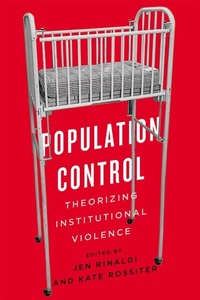
Population Control
Theorizing Institutional Violence
Published on 15. November 2023
Book
Paperback/Softback
344 pages
978-0-2280-1930-5 (ISBN)
Description
Violence is an inescapable through-line across the experiences of institutional residents regardless of facility type, historical period, regional location, government or staff in power, or type of population.
Population Control explores the relational conditions that give rise to institutional violence - whether in residential schools, internment camps, or correctional or psychiatric facilities. This violence is not dependent on any particular space, but on underlying patterns of institutionalization that can spill over into community settings even as Canada closes many of its large-scale facilities. Contributors to the collection argue that there is a logic across community settings that claim to provide care for unruly populations: a logic of institutional violence, which involves a deep entanglement of both loathing and care. This loathing signals a devaluation of the institutionalized and leaves certain populations vulnerable to state intervention under the guise of care. When that offer of care is polluted by loathing, however, there comes along with it an unavoidable and socially prescribed violence.
Offering a series of case studies in the Canadian context - from historical asylums and laundries for "fallen women" to contemporary prisons, group homes, and emergency shelters - Population Control understands institutional violence as a unique and predictable social phenomenon, and makes inroads toward preventing its reoccurrence.
Population Control explores the relational conditions that give rise to institutional violence - whether in residential schools, internment camps, or correctional or psychiatric facilities. This violence is not dependent on any particular space, but on underlying patterns of institutionalization that can spill over into community settings even as Canada closes many of its large-scale facilities. Contributors to the collection argue that there is a logic across community settings that claim to provide care for unruly populations: a logic of institutional violence, which involves a deep entanglement of both loathing and care. This loathing signals a devaluation of the institutionalized and leaves certain populations vulnerable to state intervention under the guise of care. When that offer of care is polluted by loathing, however, there comes along with it an unavoidable and socially prescribed violence.
Offering a series of case studies in the Canadian context - from historical asylums and laundries for "fallen women" to contemporary prisons, group homes, and emergency shelters - Population Control understands institutional violence as a unique and predictable social phenomenon, and makes inroads toward preventing its reoccurrence.
Reviews / Votes
"In bringing together diversely situated experts on institutional violence from across Canada, Population Control offers a serious advance in state-of-the-art research relating to endemic institutional violence in Canada. This collection significantly helps us recognize how care and loathing function across different spatial and temporal locations to structure our social and political responses to unruly populations, not only to advance scholarly knowledge but also to support the afterlives of those who have been institutionalized and provide urgently needed evidence against insidious forms of trans-institutional violence that persists beyond the closure of total institutions." Kelly Fritsch, Carleton University and co-editor of Disability Injustice: Confronting Criminalization in Canada"[Population Control] ... has a wide methodological scope, ethnographic and ethical density, and a palpable sense of care for its institutionalized subjects, providing widely applicable lessons on how to research, articulate and challenge institutional violence. These stories need to be heard." Medicine, Conflict, Survival
More details
Language
English
Place of publication
Montreal
Canada
Target group
Professional and scholarly
Product notice
Paperback (trade)
Unsewn / adhesive bound
Dimensions
Height: 226 mm
Width: 147 mm
Thickness: 25 mm
Weight
522 gr
ISBN-13
978-0-2280-1930-5 (9780228019305)
Copyright in bibliographic data and cover images is held by Nielsen Book Services Limited or by the publishers or by their respective licensors: all rights reserved.
Schweitzer Classification
Other editions
Additional editions

E-Book
11/2023
1st Edition
McGill-Queen's University Press
€36.99
Available for download

E-Book
11/2023
1st Edition
McGill-Queen's University Press
€36.99
Available for download
Persons
Jen Rinaldi is associate professor in legal studies at Ontario Tech University.
Kate Rossiter is associate professor in health studies at Wilfrid Laurier University.
Kate Rossiter is associate professor in health studies at Wilfrid Laurier University.