

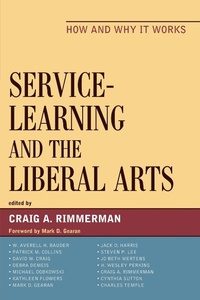
Service-Learning and the Liberal Arts
How and Why It Works
Published on 30. June 2011
Book
Paperback/Softback
228 pages
978-0-7391-2122-1 (ISBN)
Description
What are the connections between service-learning and a liberal arts education? That is the central question of this volume and scholars from a variety disciplines-Chemistry, Economics, Education, Philosophy, Political Science, Psychology, Public Policy, Religious Studies, and Sociology-answer it here. The scholars collected by Craig A. Rimmerman ground their essays in the positive assumption about the importance of service-learning in contributing to students' moral, ethical, and social development within the broader context of a liberal arts education.
The contributors engage in the critique of service and then respond to that critique within the context of their individual chapters. Readers will have a better understanding of what does and does not work in and out of the classroom and why. The practical appeal of this volume lies in the fact that other teachers and students who are interested in both developing their own service-learning courses and connecting those courses to broader issues of citizenship, democracy, and theories of justice, ethics, and morality can find advice and applications of successful service-learning endeavors within it.
The contributors engage in the critique of service and then respond to that critique within the context of their individual chapters. Readers will have a better understanding of what does and does not work in and out of the classroom and why. The practical appeal of this volume lies in the fact that other teachers and students who are interested in both developing their own service-learning courses and connecting those courses to broader issues of citizenship, democracy, and theories of justice, ethics, and morality can find advice and applications of successful service-learning endeavors within it.
Reviews / Votes
This is a refreshing book that provides readers with opportunities to think about how to effectively use service-learning in their courses. As one who has used service-learning scores of times, I completed this book with a new understanding of its value to the liberal arts, new ideas for how I can deepen my own use of the pedagogy, and a renewed enthusiasm for service-learning as a method to better educate my students. -- Joseph Cammarano, Providence CollegeMore details
Language
English
Place of publication
United States
Publishing group
Bloomsbury Publishing Plc
Target group
Professional and scholarly
College/higher education
Product notice
Paperback (trade)
Dimensions
Height: 229 mm
Width: 152 mm
Thickness: 14 mm
Weight
377 gr
ISBN-13
978-0-7391-2122-1 (9780739121221)
Copyright in bibliographic data and cover images is held by Nielsen Book Services Limited or by the publishers or by their respective licensors: all rights reserved.
Schweitzer Classification
Other editions
Additional editions
Service-Learning and the Liberal Arts
How and Why it Works
E-Book
12/2008
1st Edition
Lexington Books
€65.09
Available for download
Service-Learning and the Liberal Arts
How and Why it Works
E-Book
12/2008
1st Edition
Lexington Books
€48.49
Available for download
Persons
Craig A. Rimmerman is professor of public policy studies and political science at Hobart and William Smith Colleges.
Content
1 Table of Contents
2 Dedication
Chapter 3 Preface
Chapter 4 Acknowledgments
Chapter 5 Introduction
Chapter 6 1. Service-Learning in an Ethics Course
Chapter 7 2. Service-Learning: Process and Participation
Chapter 8 3. Too Much of a Good Thing: When Service Interferes with Learning
Chapter 9 4. Teaching the Unteachable: Service-Learning and Engagement in theTeaching of Genocide and the Holocaust
Chapter 10 5. Service-Learning and Public Policy
Chapter 11 6. Does Skill Count? A Reflection on the America Reads Experience
Chapter 12 7. Incorporating Service-Learning in Quantitative Methods Economics Courses
Chapter 13 8. Service-Learning in a Bidisciplinary Course: A Chronological and Conceptual Journey, 1995-2006
Chapter 14 9. Learning about and Helping to Prevent Alcohol and Other Drug Abuse through Service-Learning Initiatives
Chapter 15 10. The Role of the Public Service Office in Service-Learning at Hobart and William Smith Colleges
Chapter 16 11. Service-Learning Lessons
2 Dedication
Chapter 3 Preface
Chapter 4 Acknowledgments
Chapter 5 Introduction
Chapter 6 1. Service-Learning in an Ethics Course
Chapter 7 2. Service-Learning: Process and Participation
Chapter 8 3. Too Much of a Good Thing: When Service Interferes with Learning
Chapter 9 4. Teaching the Unteachable: Service-Learning and Engagement in theTeaching of Genocide and the Holocaust
Chapter 10 5. Service-Learning and Public Policy
Chapter 11 6. Does Skill Count? A Reflection on the America Reads Experience
Chapter 12 7. Incorporating Service-Learning in Quantitative Methods Economics Courses
Chapter 13 8. Service-Learning in a Bidisciplinary Course: A Chronological and Conceptual Journey, 1995-2006
Chapter 14 9. Learning about and Helping to Prevent Alcohol and Other Drug Abuse through Service-Learning Initiatives
Chapter 15 10. The Role of the Public Service Office in Service-Learning at Hobart and William Smith Colleges
Chapter 16 11. Service-Learning Lessons