

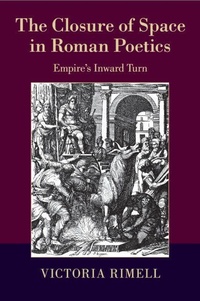
The Closure of Space in Roman Poetics
Empire's Inward Turn
Published on 15. November 2018
Book
Paperback/Softback
372 pages
978-1-107-43748-7 (ISBN)
Description
This ambitious book investigates a major yet underexplored nexus of themes in Roman cultural history: the evolving tropes of enclosure, retreat and compressed space within an expanding, potentially borderless empire. In Roman writers' exploration of real and symbolic enclosures - caves, corners, villas, bathhouses, the 'prison' of the human body itself - we see the aesthetic, philosophical and political intersecting in fascinating ways, as the machine of empire is recast in tighter and tighter shapes. Victoria Rimell brings ideas and methods from literary theory, cultural studies and philosophy to bear on an extraordinary range of ancient texts rarely studied in juxtaposition, from Horace's Odes, Virgil's Aeneid and Ovid's Ibis, to Seneca's Letters, Statius' Achilleid and Tacitus' Annals. A series of epilogues puts these texts in conceptual dialogue with our own contemporary art world, and emphasizes the role Rome's imagination has played in the history of Western thinking about space, security and dwelling.
More details
Series
Language
English
Place of publication
Cambridge
United Kingdom
Target group
Professional and scholarly
Product notice
Paperback (trade)
Illustrations
4 Halftones, unspecified; 4 Halftones, black and white
Dimensions
Height: 229 mm
Width: 152 mm
Thickness: 21 mm
Weight
538 gr
ISBN-13
978-1-107-43748-7 (9781107437487)
Copyright in bibliographic data and cover images is held by Nielsen Book Services Limited or by the publishers or by their respective licensors: all rights reserved.
Schweitzer Classification
Other editions
Additional editions
Book
06/2015
Cambridge University Press
€103.60
Shipment within 15-20 days
Person
Victoria Rimell is Associate Professor of Latin Language and Literature at Sapienza Universit... di Roma. The author of three previous books with Cambridge University Press - Petronius and the Anatomy of Fiction (2002), Ovid's Lovers: Desire, Difference and the Poetic Imagination (2006) and Martial's Rome: Empire and the Ideology of Epigram (2008) - she has published many articles on Latin literature and Roman culture.
Content
Introduction: interior designs; 1. Empire without end: opening, expansion, enclosure; 2. All four corners of the world: Horace's enclaves; 3. Roman philosophy and the house of being: Seneca's Letters; 4. Blood, sweat and fears in the Roman baths; 5. Imperial enclosure, epic spectacle; 6. The homeless problem: exile, entrapment, desire.