

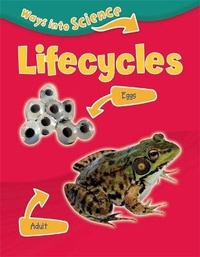
Ways Into Science: Lifecycles
Published on 10. March 2016
Book
Paperback/Softback
32 pages
978-1-4451-3483-3 (ISBN)
Description
A first science series that introduces young readers to basic science principles in a friendly and accessible way. Early scientific skills are taught through a combination of experiments, activities and key questions, designed to get young scientists thinking!
Ways into Science: Lifecycles explores how everything around us - from plants to birds - begins, grows and changes over time.
Ways into Science: Lifecycles explores how everything around us - from plants to birds - begins, grows and changes over time.
Reviews / Votes
A good addition to KS1 and KS2 resources for classroom or library * School Librarian * Lifecycles are part of the KS1 curriculum so this exploration of how everything around us -- including plants, animals and people -- begins, grows and changes over time will be a valuable resource ... Early scientific skills are taught through a combination of experiments, activities and key questions, designed to get young scientists thinking * Parents In Touch *More details
Series
Edition
Illustrated edition
Language
English
Place of publication
London
United Kingdom
Publishing group
Hachette Children's Group
Target group
Children/juvenile
Primary & secondary/elementary & high school
Interest Age: From 5 to 7 years
Edition type
Illustrated edition
Dimensions
Height: 263 mm
Width: 189 mm
Thickness: 5 mm
Weight
152 gr
ISBN-13
978-1-4451-3483-3 (9781445134833)
Copyright in bibliographic data and cover images is held by Nielsen Book Services Limited or by the publishers or by their respective licensors: all rights reserved.
Schweitzer Classification
Person
Peter Riley was a science teacher for 25 years, 17 of them as Head of Science. His first book was published in 1981, and he has been a full-time author since 1996, with over 200 books published for children, students and teachers. He is the winner of the prestigious Schoolbook Award for Science in 2000, as well as being shortlisted for the Aventis Science Prize 2004 and nominated for the Educational Resources Award in 2009.
Content
1: What is a lifecycle?
1: What is a lifecycle?
2: The lifecycle of plants
3: Flowers and seeds
4: The lifecycle of insects
5: Butterflies
6: The lifecycle of amphibians
7: Frogs
8: The lifecycle of reptiles
9: The lifecycle of birds
10: The lifecycle of mammals
11: The lifecycle of farm animals
12: What stage?
13: Useful words
14: Some answers
15: Index
16: About this book
2: Plants
3: Flowers and seeds
4: Insects
5: A butterfly
6: Amphibians
7: Frogs
8: Reptiles
9: Birds
10: Mammals
11: Humans
12: What stage?
13: Useful words
14: Some answers
15: Conservation note
16: Index
17: About this book
1: What is a lifecycle?
2: The lifecycle of plants
3: Flowers and seeds
4: The lifecycle of insects
5: Butterflies
6: The lifecycle of amphibians
7: Frogs
8: The lifecycle of reptiles
9: The lifecycle of birds
10: The lifecycle of mammals
11: The lifecycle of farm animals
12: What stage?
13: Useful words
14: Some answers
15: Index
16: About this book
2: Plants
3: Flowers and seeds
4: Insects
5: A butterfly
6: Amphibians
7: Frogs
8: Reptiles
9: Birds
10: Mammals
11: Humans
12: What stage?
13: Useful words
14: Some answers
15: Conservation note
16: Index
17: About this book