

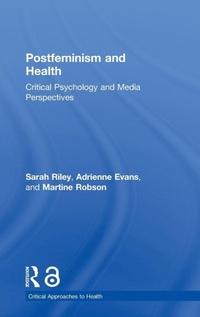
Postfeminism and Health
Critical Psychology and Media Perspectives
1st Edition
Published on 31. July 2018
Book
Hardback
212 pages
978-1-138-12377-9 (ISBN)
Description
Winner of the 2021 BPS Book Award: Academic Text category, this groundbreaking book employs a transdisciplinary and poststructuralist methodology to develop the concept of 'postfeminist healthism,' a twenty-first-century understanding of women's physical and mental health formed at the intersections of postfeminist sensibilities, neoliberal constructs of citizenship and the notion of health as an individual responsibility managed through consumption. Postfeminist healthism is used in this book to explore seven topics where postfeminist sensibility has the most impact on women's health: self-help, weight, surgical technologies, sex, pregnancy, responsibilities for others' health and pro-anorexia communities. The book explores the ways in which the desire to be normal and live a good life is tied to expectations of 'normal-perfection' circulated across interpersonal interactions, media representations and expert discourses. It diagnoses postfeminist healthism as unhealthy for both those women who participate in it and those whom it excludes and considers how more positive directions may emerge.
By exploring the under-researched intersection of postfeminism and health studies, this book will be invaluable to researchers and students in psychology, gender and women's studies, health research, media studies and sociology.
By exploring the under-researched intersection of postfeminism and health studies, this book will be invaluable to researchers and students in psychology, gender and women's studies, health research, media studies and sociology.
Reviews / Votes
"In this brilliant and original book Riley, Evans and Robson introduce the concept of 'postfeminist healthism' - a set of ideas that shape our thinking about everything from weight to sex to pregnancy and pro-Ana. With vivid and up-to-date examples, the authors launch a new research agenda, outline a novel critical perspective, and outline a set of ideas that look set to shape health studies for years to come. This is a must-read for anyone interested in women's mental and physical health today." - Rosalind Gill, City, University of London, UK"Postfeminism is a complicated topic, but one that has emerged as a pressing social and political concern. In this intriguing book, Riley, Evans and Robson explore issues of health and embodiment as they are viewed through the lens of postfeminism. They get to the crux of why embodiment continues to be such a huge focus of contention and controversy globally." - Deborah Lupton, University of Canberra, Australia
"This book offers a series of exciting, critical analyses of contemporary femininities within mediated and mundane health-related contexts. The authors offer a distinctive and coherent theoretical position to help us understand and navigate the complexities and contradictions of doing gender in a postfeminist landscape - an impressive achievement!" - Brendan Gough, Leeds Beckett University, UK
More details
Series
Language
English
Place of publication
London
United Kingdom
Publishing group
Taylor & Francis Ltd
Target group
College/higher education
Dimensions
Height: 240 mm
Width: 161 mm
Thickness: 16 mm
Weight
490 gr
ISBN-13
978-1-138-12377-9 (9781138123779)
Copyright in bibliographic data and cover images is held by Nielsen Book Services Limited or by the publishers or by their respective licensors: all rights reserved.
Schweitzer Classification
Other editions
Additional editions
Sarah Riley | Adrienne Evans | Martine Robson
Postfeminism and Health
Critical Psychology and Media Perspectives
E-Book
07/2018
1st Edition
Routledge
€0.00
Available for download
Sarah Riley | Adrienne Evans | Martine Robson
Postfeminism and Health
Critical Psychology and Media Perspectives
E-Book
07/2018
Routledge
€0.00
Available for download
Sarah Riley | Adrienne Evans | Martine Robson
Postfeminism and Health
Critical Psychology and Media Perspectives
Book
07/2018
1st Edition
Routledge
€69.20
Shipment within 10-20 days
Persons
Sarah Riley is Reader in Critical Psychology at Aberystwyth University, UK. Her work focuses on the psychological impact of neoliberalism. Informed by poststructuralist theory and taking an interdisciplinary approach, her work addresses questions about gender, embodiment, health, youth culture and citizenship. Her co- authored books include Critical Bodies (Palgrave/ MacMillan, 2008), Doing Your Qualitative Research Project (Sage, 2012) and Technologies of Sexiness: Sex, Identity and Consumer Culture (Oxford University Press, 2014).
Adrienne Evans is Reader in Media in the Centre for Postdigital Cultures at Coventry University, UK. Past research explored sexiness; current work develops accounts of postdigital culture, postfeminist masculinity and healthism. Her co- authored books include Technologies of Sexiness: Sex, Identity and Consumer Culture (Oxford University Press, 2014).
Martine Robson is Lecturer in Psychology at Aberystwyth University, UK. Her work focuses on how people in long-term relationships negotiate individualistic, neoliberal lifestyle advice, and uses poststructuralist theory to examine the ways in which people adopt, resist and transform dominant health discourses.
Adrienne Evans is Reader in Media in the Centre for Postdigital Cultures at Coventry University, UK. Past research explored sexiness; current work develops accounts of postdigital culture, postfeminist masculinity and healthism. Her co- authored books include Technologies of Sexiness: Sex, Identity and Consumer Culture (Oxford University Press, 2014).
Martine Robson is Lecturer in Psychology at Aberystwyth University, UK. Her work focuses on how people in long-term relationships negotiate individualistic, neoliberal lifestyle advice, and uses poststructuralist theory to examine the ways in which people adopt, resist and transform dominant health discourses.
Content
Series Editor Preface. Prologue. 1. Self-Help 2. Weight 3. Technologies 4. Sex 5. Pregnancy 6. Intimate Responsibilities 7. Pro-Ana. Epilogue