

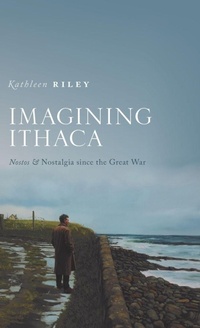
Imagining Ithaca
Nostos and Nostalgia Since the Great War
Published on 1. April 2021
Book
Hardback
352 pages
978-0-19-885297-1 (ISBN)
Description
'Though home is a name, a word, it is a strong one', said Charles Dickens, 'stronger than magician ever spoke, or spirit answered to, in strongest conjuration.' The ancient Greek word nostos, meaning homecoming or return, has a commensurate power and mystique. Irish philosopher-poet John Moriarty described it as 'a teeming word... a haunted word... a word to conjure with'. The most celebrated and culturally enduring nostos is that of Homer's Odysseus who spent ten years returning home after the fall of Troy. His journey back involved many obstacles, temptations, and fantastical adventures and even a katabasis, a rare descent by the living into the realm of the dead. All the while he was sustained and propelled by his memories of Ithaca ('His native home deep imag'd in his soul', as Pope's translation has it). From Virgil's Aeneid to James Joyce's Ulysses, from MGM's The Wizard of Oz to the Coen Brothers' O Brother, Where Art Thou?, and from Derek Walcott's Omeros to Margaret Atwood's Penelopiad, the Odyssean paradigm of nostos and nostalgia has been continually summoned and reimagined by writers and filmmakers. At the same time, 'Ithaca' has proved to be an evocative and versatile abstraction. It is as much about possibility as it is about the past; it is a vision of Arcadia or a haunting, an object of longing, a repository of memory, 'a sleep and a forgetting'. In essence it is about seeking what is absent.
Imagining Ithaca explores the idea of nostos, and its attendant pain (algos), in an excitingly eclectic range of sources: from Rebecca West's The Return of the Soldier and Remarque's All Quiet on the Western Front, through the exilic memoirs of Nabokov and the time-travelling fantasies of Woody Allen, to Seamus Heaney's Virgilian descent into the London Underground and Michael Portillo's Telemachan railway journey to Salamanca. This kaleidoscopic exploration spans the end of the Great War, when the world at large was experiencing the complexities of homecoming, to the era of Brexit and COVID-19 which has put the notion of nostalgia firmly under the microscope.
Imagining Ithaca explores the idea of nostos, and its attendant pain (algos), in an excitingly eclectic range of sources: from Rebecca West's The Return of the Soldier and Remarque's All Quiet on the Western Front, through the exilic memoirs of Nabokov and the time-travelling fantasies of Woody Allen, to Seamus Heaney's Virgilian descent into the London Underground and Michael Portillo's Telemachan railway journey to Salamanca. This kaleidoscopic exploration spans the end of the Great War, when the world at large was experiencing the complexities of homecoming, to the era of Brexit and COVID-19 which has put the notion of nostalgia firmly under the microscope.
Reviews / Votes
Imagining Ithaca opens new prospects for thinking about and with the Odyssey more broadly ... By taking us on a truly odyssean tour of many cities and many minds, she has laid the groundwork for much future research on these materials. * KATERINA STERGIOPOULOU, The Classical Review * In short, Imagining Ithaca is a multifaceted book, dealing with very diverse literary and filmic manifestations through the lens of nostos and nostalgia, a proven fertile field. Homer's poem resonates in all its pages, and it convincingly demonstrates that nostalgia, dangerous though it may be, has always been a powerful creative theme. * Miguel Cisneros Perales Daniel Nisa Caceres, Bryn Mawr Classical Review * compelling * Marina Mackay, James Joyce Quarterly * Riley (an independent scholar with a doctorate in classics) writes poignantly about exile, longing, homesickness, homecomings, and homecomings that never happen ... the entire book is fascinating. * K. B. Hannel, CHOICE * inflected with an awareness of today's social and political issues * Rhiannon Easterbrook, Greece & Rome * Her main arguments make this insightful book thoroughly enjoyable and informative. * Benjamin Jasnow, Rhea Classical Review *More details
Language
English
Place of publication
Oxford
United Kingdom
Target group
Professional and scholarly
Dimensions
Height: 222 mm
Width: 145 mm
Thickness: 22 mm
Weight
570 gr
ISBN-13
978-0-19-885297-1 (9780198852971)
Copyright in bibliographic data and cover images is held by Nielsen Book Services Limited or by the publishers or by their respective licensors: all rights reserved.
Schweitzer Classification
Other editions
Additional editions
E-Book
04/2021
1st Edition
OUP eBook
€18.99
Available for download
E-Book
04/2021
1st Edition
OUP eBook
€18.99
Available for download
Person
Kathleen Riley completed a DPhil in Classics at Corpus Christi College, Oxford where she later held a British Academy Postdoctoral Research Fellowship. Now a full-time writer, she specializes in classical reception, biography, and theatre history. She is the author of Nigel Hawthorne on Stage and The Reception and Performance of Euripides' Herakles: Reasoning Madness. She is also co-editor of Oscar Wilde and Classical Antiquity and, most recently, a contributor to Seamus Heaney and the Classics: Bann Valley Muses. Her book The Astaires: Fred and Adele has been optioned for a feature film currently in development.
Content
Introduction: Home from Homer
Part I: 'Like strangers in those landscapes of our youth': War and impossible nostos
1: Rebecca West's The Return of the Soldier (1918)
2: Erich Maria Remarque's All Quiet on the Western Front (1929)
3: William Wyler's The Best Years of Our Lives (1945)
4: David Malouf's Fly Away Peter (1982)
Part II: 'A deep yearning for a return to the source': Rewriting Homer
5: John Ford's The Long Voyage Home (1940)
6: Njabulo Ndebele's The Cry of Winnie Mandela (2003)
7: Tamar Yellin's 'Return to Zion' (2006)
Part III: 'One is always at home in one's past': The nostalgia of exile
8: Vladimir Nabokov's Speak, Memory (1951)
9: Doris Lessing's Going Home (1957) and Under My Skin (1994)
10: Alan Bennett's The Old Country (1977) and An Englishman Abroad (1983)
Part IV: 'Across a strange country to their homeland': Nostos and the displaced spirit
11: Carson McCullers's, 'Look Homeward, Americans' (1940)
12: Doris Pilkington Garimara's Follow the Rabbit-Proof Fence (1996)
13: Woody Allen's Midnight in Paris (2011)
Part V: 'In the place called Adulthood there's precious few golden afternoons': Returning to the place called Childhood
14: George Orwell's Coming Up for Air (1939)
15: John Van Druten's The Widening Circle (1957)
16: John Logan's Peter and Alice (2013)
Part VI: 'All sons are Telemachus figures': Voyages round the father
17: Michael Portillo's Great Railway Journeys: Granada to Salamanca (1999)
18: Seamus Heaney's Seeing Things (1991), District and Circle (2006), and Human Chain (2010)
19: Daniel Mendelsohn's An Odyssey: A Father, a Son, and an Epic (2017)
Part I: 'Like strangers in those landscapes of our youth': War and impossible nostos
1: Rebecca West's The Return of the Soldier (1918)
2: Erich Maria Remarque's All Quiet on the Western Front (1929)
3: William Wyler's The Best Years of Our Lives (1945)
4: David Malouf's Fly Away Peter (1982)
Part II: 'A deep yearning for a return to the source': Rewriting Homer
5: John Ford's The Long Voyage Home (1940)
6: Njabulo Ndebele's The Cry of Winnie Mandela (2003)
7: Tamar Yellin's 'Return to Zion' (2006)
Part III: 'One is always at home in one's past': The nostalgia of exile
8: Vladimir Nabokov's Speak, Memory (1951)
9: Doris Lessing's Going Home (1957) and Under My Skin (1994)
10: Alan Bennett's The Old Country (1977) and An Englishman Abroad (1983)
Part IV: 'Across a strange country to their homeland': Nostos and the displaced spirit
11: Carson McCullers's, 'Look Homeward, Americans' (1940)
12: Doris Pilkington Garimara's Follow the Rabbit-Proof Fence (1996)
13: Woody Allen's Midnight in Paris (2011)
Part V: 'In the place called Adulthood there's precious few golden afternoons': Returning to the place called Childhood
14: George Orwell's Coming Up for Air (1939)
15: John Van Druten's The Widening Circle (1957)
16: John Logan's Peter and Alice (2013)
Part VI: 'All sons are Telemachus figures': Voyages round the father
17: Michael Portillo's Great Railway Journeys: Granada to Salamanca (1999)
18: Seamus Heaney's Seeing Things (1991), District and Circle (2006), and Human Chain (2010)
19: Daniel Mendelsohn's An Odyssey: A Father, a Son, and an Epic (2017)