

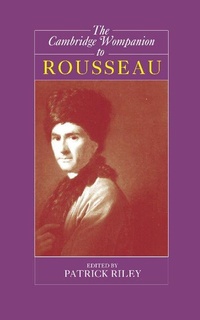
The Cambridge Companion to Rousseau
Published on 27. August 2001
Book
Hardback
468 pages
978-0-521-57265-1 (ISBN)
Description
Universally regarded as the greatest French political theorist and philosopher of education of the Enlightenment, and probably the greatest French social theorist tout court, Rousseau was an important forerunner of the French Revolution, though his thought was too nuanced and subtle ever to serve as mere ideology. This 2001 volume systematically surveys the full range of Rousseau's activities in politics and education, psychology, anthropology, religion, music and theater.
Reviews / Votes
"The Cambridge Companion to Rousseau is an expected and welcome addition to the Cambridge series on philosophers.... It takes good advantage of the possibilities a collection offers to bring diversity to the study of Rousseau. This volume also squarely addresses Rousseau in the context of other historical thinkers." Philosophy in ReviewMore details
Series
Language
English
Place of publication
Cambridge
United Kingdom
Target group
College/higher education
Professional and scholarly
Dimensions
Height: 235 mm
Width: 157 mm
Thickness: 32 mm
Weight
905 gr
ISBN-13
978-0-521-57265-1 (9780521572651)
Copyright in bibliographic data and cover images is held by Nielsen Book Services Limited or by the publishers or by their respective licensors: all rights reserved.
Schweitzer Classification
Other editions
Additional editions
Patrick Riley
The Cambridge Companion to Rousseau
E-Book
07/2006
1st Edition
Cambridge University Press
€32.49
Available for download
Patrick Riley
Cambridge Companion to Rousseau
E-Book
08/2001
Cambridge University Press
€26.99
Available for download
Person
Content
1. Introduction: the life and works of Rousseau Patrick Riley; 2. A general overview George Armstrong Kelly; 3. Rousseau, Voltaire, and the revenge of Pascal Mark Hulliung; 4. Rousseau, Fenelon, and the quarrel between the ancients and the moderns Patrick Riley; 5. Rousseau's political philosophy Christopher Brooke; 6. Rousseau's general will Patrick Riley; 7. Rousseau's images of authority especially in La Nouvelle Heloise Judith Shklar; 8. The religious thought Victor Gourevitch; 9. Emile: learning to be men, women and citizens Geraint Parry; 10. Emile: nature and the education of Sophie Susan Meld Shell; 11. Rousseau's Confessions Christopher Kelly; 12. Music, politics, theater and representation in Rousseau Tracy Strong and C. N. Dugan; 13. The motto Vitam Impendere vero and the question of lying Jean Starobinski; 14. Rousseau's Levite of Ephraim: synthesis within a 'minor' work Thomas Kavanagh; 15. Ancient Postmodernism in the philosophy of Rousseau Robert Wokler; Bibliography.