

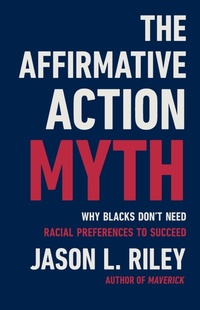
The Affirmative Action Myth
Why Blacks Don't Need Racial Preferences to Succeed
Published on 29. May 2025
Book
Hardback
288 pages
978-1-5416-0455-1 (ISBN)
Description
From Wall Street Journal columnist and Manhattan Institute senior fellow Jason L. Riley, a contrarian argument that racial preferences have done more harm than good for black Americans
After the Supreme Court ruled in 2023 that the use of race in college admissions was unconstitutional, many predicted that the black middle class was doomed. One byproduct of a half century of affirmative action is that it has given people the impression that blacks can't advance without special treatment. In The Affirmative Action Myth, Jason L. Riley details the neglected history of black achievement without government intervention. Using empirical data, Riley shows how black families lifted themselves out of poverty prior to the racial preference policies of the 1960s and 1970s.
Black employment, incomes, homeownership, and educational attainment all were on the rise in the first two-thirds of the twentieth century and began to stagnate only after affirmative action became the law of the land, tainting black achievement with suspicions of unfair advantage. Countering thinkers who blame white supremacy and systemic racism for today's racial gaps, Riley offers a more optimistic story of black success without racial favoritism.
After the Supreme Court ruled in 2023 that the use of race in college admissions was unconstitutional, many predicted that the black middle class was doomed. One byproduct of a half century of affirmative action is that it has given people the impression that blacks can't advance without special treatment. In The Affirmative Action Myth, Jason L. Riley details the neglected history of black achievement without government intervention. Using empirical data, Riley shows how black families lifted themselves out of poverty prior to the racial preference policies of the 1960s and 1970s.
Black employment, incomes, homeownership, and educational attainment all were on the rise in the first two-thirds of the twentieth century and began to stagnate only after affirmative action became the law of the land, tainting black achievement with suspicions of unfair advantage. Countering thinkers who blame white supremacy and systemic racism for today's racial gaps, Riley offers a more optimistic story of black success without racial favoritism.
More details
Language
English
Place of publication
United States
Target group
College/higher education
Professional and scholarly
Product notice
Trade binding
Dimensions
Height: 240 mm
Width: 160 mm
Thickness: 27 mm
Weight
488 gr
ISBN-13
978-1-5416-0455-1 (9781541604551)
Copyright in bibliographic data and cover images is held by Nielsen Book Services Limited or by the publishers or by their respective licensors: all rights reserved.
Schweitzer Classification
Other editions
Additional editions
E-Book
05/2025
Basic Books
€14.99
Available for download
Person
Jason L. Riley is a senior fellow at the Manhattan Institute and a columnist for the Wall Street Journal. He is the author of several previous books, including Maverick: A Biography of Thomas Sowell.