

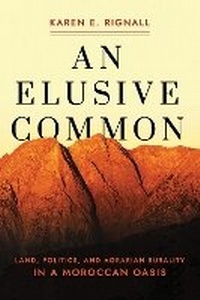
An Elusive Common
Land, Politics, and Agrarian Rurality in a Moroccan Oasis
Published on 15. July 2021
Book
Paperback/Softback
264 pages
978-1-5017-5613-9 (ISBN)
Description
An Elusive Common details the fraught dynamics of rural life in the arid periphery of southeastern Morocco. Karen Rignall considers whether agrarian livelihoods can survive in the context of globalized capitalism and proposes a new way of thinking about agrarian practice, politics, and land in North Africa and the Middle East. Her book questions many of the assumptions underlying movements for land and food sovereignty, theories of the commons, and environmental governance.
Global market forces, government disinvestment, political marginalization, and climate change are putting unprecedented pressures on contemporary rural life. At the same time, rural peoples are defying their exclusion by forging new economic and political possibilities. In southern Morocco, the vibrancy of rural life was sustained by creative and often contested efforts to sustain communal governance, especially of land, as a basis for agrarian livelihoods and a changing wage labor economy.
An Elusive Common follows these diverse strategies ethnographically to show how land became a site for conflicts over community, political authority, and social hierarchy. Rignall makes the provocative argument that land enclosures can be an essential part of communal governance and the fight for autonomy against intrusive state power and historical inequalities.
Global market forces, government disinvestment, political marginalization, and climate change are putting unprecedented pressures on contemporary rural life. At the same time, rural peoples are defying their exclusion by forging new economic and political possibilities. In southern Morocco, the vibrancy of rural life was sustained by creative and often contested efforts to sustain communal governance, especially of land, as a basis for agrarian livelihoods and a changing wage labor economy.
An Elusive Common follows these diverse strategies ethnographically to show how land became a site for conflicts over community, political authority, and social hierarchy. Rignall makes the provocative argument that land enclosures can be an essential part of communal governance and the fight for autonomy against intrusive state power and historical inequalities.
Reviews / Votes
In her extensive, detailed ethnographic study, which includes a number of individual stories, she reveals the contradicting complexities of the transformations in livelihood and agricultural practices that inhabitants have experienced in this corner of North Africa. Her research illustrates the creative, often effective responses people have forged to meet new challenges.(Choice)
More details
Series
Language
English
Place of publication
Ithaca
United States
Target group
College/higher education
Product notice
Paperback (trade)
Illustrations
18 b&w halftones, 5 maps, 1 chart - 18 Halftones, black and white - 5 Maps - 1 Charts
Dimensions
Height: 229 mm
Width: 152 mm
Thickness: 19 mm
Weight
454 gr
ISBN-13
978-1-5017-5613-9 (9781501756139)
Copyright in bibliographic data and cover images is held by Nielsen Book Services Limited or by the publishers or by their respective licensors: all rights reserved.
Schweitzer Classification
Other editions
Additional editions
E-Book
07/2021
Cornell University Press
€22.49
Available for download
Person
Karen E. Rignall is a Community and Leadership Development Professor at the University of Kentucky. Her research has appeared in numerous journals, including, The Journal of Peasant Studies, and Migration and Development.
Content
Introduction
1. Custom and the Ambivalent Romance of Community
2. Political Pluralism, Local Politics, and the State
3. Land and the New Commoning
4. Environmental Politics and the New Rurality
5. Making a Living on and off the Land
Conclusion
1. Custom and the Ambivalent Romance of Community
2. Political Pluralism, Local Politics, and the State
3. Land and the New Commoning
4. Environmental Politics and the New Rurality
5. Making a Living on and off the Land
Conclusion