

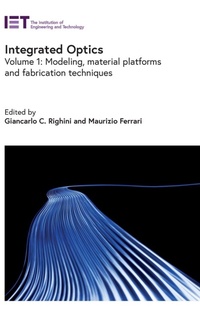
Integrated Optics: Volume 1
Modeling, material platforms and fabrication techniques
Published on 29. January 2021
Book
Hardback
461 pages
978-1-83953-341-9 (ISBN)
Description
Edited by two recognised experts, this book in two volumes provides a comprehensive overview of integrated optics, from modelling to fabrication, materials to integration platforms, and characterization techniques to applications. The technology is explored in detail, and set in a broad context that addresses a range of current and potential future research and development trends.
Volume 1 begins with introductory chapters on the history of integrated optics technology, design tools, and modelling techniques. The next section of the book goes on to discuss the range of materials used for integrated optics, their deposition techniques, and their specific applications, including glasses, plasmonic nanostructures, SOI and SOS, and III-V and II-VI semiconductors.
Volume 2 addresses characterization techniques, integrated optical waveguides and devices. A range of applications are also discussed, including devices for sensing, telecommunications, optical amplifiers and lasers, and quantum computing.
The introductory chapters are intended to be of use to newcomers to the field, but its depth and breadth of coverage means that this book is also appropriate reading for early-career and senior researchers wishing to refresh their knowledge or keep up to date with recent developments in integrated optics.
Volume 1 begins with introductory chapters on the history of integrated optics technology, design tools, and modelling techniques. The next section of the book goes on to discuss the range of materials used for integrated optics, their deposition techniques, and their specific applications, including glasses, plasmonic nanostructures, SOI and SOS, and III-V and II-VI semiconductors.
Volume 2 addresses characterization techniques, integrated optical waveguides and devices. A range of applications are also discussed, including devices for sensing, telecommunications, optical amplifiers and lasers, and quantum computing.
The introductory chapters are intended to be of use to newcomers to the field, but its depth and breadth of coverage means that this book is also appropriate reading for early-career and senior researchers wishing to refresh their knowledge or keep up to date with recent developments in integrated optics.
More details
Series
Language
English
Place of publication
Stevenage
United Kingdom
Target group
College/higher education
Professional and scholarly
Product notice
sewn/stitched
Cloth over boards
Dimensions
Height: 239 mm
Width: 163 mm
Thickness: 28 mm
Weight
907 gr
ISBN-13
978-1-83953-341-9 (9781839533419)
Copyright in bibliographic data and cover images is held by Nielsen Book Services Limited or by the publishers or by their respective licensors: all rights reserved.
Schweitzer Classification
Persons
Giancarlo C. Righini is former director of the Enrico Fermi Center and of the National Department on Materials and Devices, National Research Council of Italy (CNR). He was also research director at the Nello Carrara Institute of Applied Physics, CNR, and vice-president of the International Commission for Optics. His research interests concern fiber and integrated optics, glass materials, and microresonators. He has published over 500 research papers. He is fellow of OSA, SPIE and Italian Physical Society (SIF), and also founding member and fellow of European Optical Society (EOS) and Italian Society of Optics and Photonics (SIOF).
Maurizio Ferrari is the director of research with the Institute for Photonics and Nanotechnologies, CNR, Italy, where he is also head of the CSMFO - Caratterizzazione e Sviluppo di Materiali per la Fotonica e Optoelettronica Lab and the Institute for Photonics and Nanotechnologies (IFN-CNR) Trento unit. He is co-author of more than 400 publications in international journals, of several book chapters, and he is involved in numerous national and international projects concerning glass photonics. He is a OSA and SPIE fellow.
Maurizio Ferrari is the director of research with the Institute for Photonics and Nanotechnologies, CNR, Italy, where he is also head of the CSMFO - Caratterizzazione e Sviluppo di Materiali per la Fotonica e Optoelettronica Lab and the Institute for Photonics and Nanotechnologies (IFN-CNR) Trento unit. He is co-author of more than 400 publications in international journals, of several book chapters, and he is involved in numerous national and international projects concerning glass photonics. He is a OSA and SPIE fellow.
Content
Chapter 1: 1969-2019: 50 years of integrated optics
Part I: Modelling of waveguides and devices
Chapter 2: Numerical tools for integrated optical circuits design
Chapter 3: Analytical modelling of active integrated resonators
Chapter 4: Modelling of nanophotonic non-linear metasurfaces
Part II: Material platforms and fabrication techniques
Chapter 5: Rare-earth-doped glasses and glass ceramics for integrated optics
Chapter 6: Lithium niobate integrated optics
Chapter 7: Thin-film deposition: physical techniques
Chapter 8: Thin-film deposition: chemical techniques
Chapter 9: Photorefractive waveguides
Chapter 10: Integrated optics using liquid crystals
Chapter 11: Silicon nitride integrated optics
Chapter 12: Femtosecond laser writing of integrated optical structures in glasses
Chapter 13: Optical waveguides produced by ion beams
Part I: Modelling of waveguides and devices
Chapter 2: Numerical tools for integrated optical circuits design
Chapter 3: Analytical modelling of active integrated resonators
Chapter 4: Modelling of nanophotonic non-linear metasurfaces
Part II: Material platforms and fabrication techniques
Chapter 5: Rare-earth-doped glasses and glass ceramics for integrated optics
Chapter 6: Lithium niobate integrated optics
Chapter 7: Thin-film deposition: physical techniques
Chapter 8: Thin-film deposition: chemical techniques
Chapter 9: Photorefractive waveguides
Chapter 10: Integrated optics using liquid crystals
Chapter 11: Silicon nitride integrated optics
Chapter 12: Femtosecond laser writing of integrated optical structures in glasses
Chapter 13: Optical waveguides produced by ion beams