

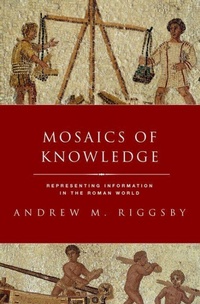
Mosaics of Knowledge
Representing Information in the Roman World
Published on 21. February 2023
Book
Paperback/Softback
272 pages
978-0-19-766062-1 (ISBN)
Description
Today's information technology often seems to take on a life of its own, spreading into every part of our lives. In the Roman world things were different. Technologies were limited to small, scattered social groups.
By examining five technologies-lists, tables, weights and measures, artistic perspective, and mapping-Mosaics of Knowledge demonstrates how the Romans broke up a world we might have imagined them to unite. That is, the recording, storage, and recall of information in physical media might be expected to bind together persons distant in time and space. More often than not, however, Roman instances serve to create or reinforce the isolation of particular groups. Persons in different "locations"- whether those are geographical, social, or occupational-had access to quite different informational resources, and the overall situation is thus not controlled by the needs of any particular class or group. On the one hand, these constraints on use in turn constrain the development and power of individual technologies. Development is slow, scattered, and far from one-directional. On the other, seeming technological weaknesses can turn out to be illusory if we set them in actual use-contexts. Romans deploy no more but also no less "computing" power than needed for very narrowly defined goals.
This study combines detailed readings of a wide variety of evidence (inscriptions, small archeological finds, artworks, literary texts) with theoretical consideration of the social, cognitive, and material contexts for their use to present a unique portrait of Roman IT capabilities, limitations, and habits.
By examining five technologies-lists, tables, weights and measures, artistic perspective, and mapping-Mosaics of Knowledge demonstrates how the Romans broke up a world we might have imagined them to unite. That is, the recording, storage, and recall of information in physical media might be expected to bind together persons distant in time and space. More often than not, however, Roman instances serve to create or reinforce the isolation of particular groups. Persons in different "locations"- whether those are geographical, social, or occupational-had access to quite different informational resources, and the overall situation is thus not controlled by the needs of any particular class or group. On the one hand, these constraints on use in turn constrain the development and power of individual technologies. Development is slow, scattered, and far from one-directional. On the other, seeming technological weaknesses can turn out to be illusory if we set them in actual use-contexts. Romans deploy no more but also no less "computing" power than needed for very narrowly defined goals.
This study combines detailed readings of a wide variety of evidence (inscriptions, small archeological finds, artworks, literary texts) with theoretical consideration of the social, cognitive, and material contexts for their use to present a unique portrait of Roman IT capabilities, limitations, and habits.
Reviews / Votes
Riggsby, professor in classics and of art history at the University of Texas, Austin, conducts a very scholarly guided tour of how the Romans represented information (via concepts such as lists, tables, weights and measures, landscapes, and more) - often for very limited, rather than universal, uses. The best kind of academic work, rendering the commonplace unfamiliar. The landscape examples dazzle. * Harvard Magazine * Throughout this tome [Riggsby] is meticulous in discussing the views of other scholars and in providing evidence for his own theories. It is a work of specialised scholarship, rather than aimed at the general reader. * Marion Gibbs, Classics for All * REVIEW: Jason Koenig, University of St. Andrews, 01/03/2019. Quote loaded: 14/03/2019 REVIEW: Michael Koortbojian, Princeton University, 01/03/2019. Quote loaded: 14/03/2019 REVIEW: Richard J. A. Talbert, University of North Carolina, Chapel Hill, 01/03/2019. Quote loaded: 14/03/2019More details
Series
Language
English
Place of publication
New York
United States
Target group
College/higher education
Product notice
Paperback (trade)
Unsewn / adhesive bound
Illustrations
37 illustrations
Dimensions
Height: 231 mm
Width: 157 mm
Thickness: 22 mm
Weight
355 gr
ISBN-13
978-0-19-766062-1 (9780197660621)
Copyright in bibliographic data and cover images is held by Nielsen Book Services Limited or by the publishers or by their respective licensors: all rights reserved.
Schweitzer Classification
Person
Andrew M. Riggsby is a historian of the Roman world. Educated at Harvard and Berkeley, he is now Lucy Shoe Meritt Professor in Classics at the University of Texas at Austin. He is a Fellow of the American Academy in Rome and was the Stanley Kelley Jr. Visiting Professor for Distinguished Teaching in Classics at Princeton University.
Content
A Brief Orientation
1. Lists Ordered Lists Indexed Lists Tables of Contents Nested Lists 2. Tables Actual Tables Not Tables Outliers Conclusions 3. Weights and Measures How Does Roman Measurement Work? Standards and Standardization Direct Standardization Indirect Standardization Complications Conclusions 4. Representing Three Dimensions Perspective and the Theory of Space The Corpora Space in the Landscapes Two Comprehensive Examples Conclusions 5. Representing Two Dimensions Data Graphics Textual Illustrations Plans What is a "Map"? Maps Maps as Information Technology 6. Conclusion Where Are We Now? Going Forward I: Power and Other Topics Going Forward II: An IT Revolution in Late Antiquity? Bibliography
1. Lists Ordered Lists Indexed Lists Tables of Contents Nested Lists 2. Tables Actual Tables Not Tables Outliers Conclusions 3. Weights and Measures How Does Roman Measurement Work? Standards and Standardization Direct Standardization Indirect Standardization Complications Conclusions 4. Representing Three Dimensions Perspective and the Theory of Space The Corpora Space in the Landscapes Two Comprehensive Examples Conclusions 5. Representing Two Dimensions Data Graphics Textual Illustrations Plans What is a "Map"? Maps Maps as Information Technology 6. Conclusion Where Are We Now? Going Forward I: Power and Other Topics Going Forward II: An IT Revolution in Late Antiquity? Bibliography