

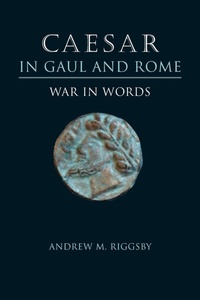
Caesar in Gaul and Rome
War in Words
Published on 1. July 2006
Book
Paperback/Softback
286 pages
978-0-292-72617-8 (ISBN)
Description
Winner, AAP/PSP Award for Excellence, Classics and Ancient History, 2006
Anyone who has even a passing acquaintance with Latin knows "Gallia est omnis divisa in partes tres" ("All Gaul is divided into three parts"), the opening line of De Bello Gallico, Julius Caesar's famous commentary on his campaigns against the Gauls in the 50s BC. But what did Caesar intend to accomplish by writing and publishing his commentaries, how did he go about it, and what potentially unforeseen consequences did his writing have? These are the questions that Andrew Riggsby pursues in this fresh interpretation of one of the masterworks of Latin prose.
Riggsby uses contemporary literary methods to examine the historical impact that the commentaries had on the Roman reading public. In the first part of his study, Riggsby considers how Caesar defined Roman identity and its relationship to non-Roman others. He shows how Caesar opens up a possible vision of the political future in which the distinction between Roman and non-Roman becomes less important because of their joint submission to a Caesar-like leader. In the second part, Riggsby analyzes Caesar's political self-fashioning and the potential effects of his writing and publishing the Gallic War. He reveals how Caesar presents himself as a subtly new kind of Roman general who deserves credit not only for his own virtues, but for those of his soldiers as well. Riggsby uses case studies of key topics (spatial representation, ethnography, virtus and technology, genre, and the just war), augmented by more synthetic discussions that bring in evidence from other Roman and Greek texts, to offer a broad picture of the themes of national identity and Caesar's self-presentation.
Anyone who has even a passing acquaintance with Latin knows "Gallia est omnis divisa in partes tres" ("All Gaul is divided into three parts"), the opening line of De Bello Gallico, Julius Caesar's famous commentary on his campaigns against the Gauls in the 50s BC. But what did Caesar intend to accomplish by writing and publishing his commentaries, how did he go about it, and what potentially unforeseen consequences did his writing have? These are the questions that Andrew Riggsby pursues in this fresh interpretation of one of the masterworks of Latin prose.
Riggsby uses contemporary literary methods to examine the historical impact that the commentaries had on the Roman reading public. In the first part of his study, Riggsby considers how Caesar defined Roman identity and its relationship to non-Roman others. He shows how Caesar opens up a possible vision of the political future in which the distinction between Roman and non-Roman becomes less important because of their joint submission to a Caesar-like leader. In the second part, Riggsby analyzes Caesar's political self-fashioning and the potential effects of his writing and publishing the Gallic War. He reveals how Caesar presents himself as a subtly new kind of Roman general who deserves credit not only for his own virtues, but for those of his soldiers as well. Riggsby uses case studies of key topics (spatial representation, ethnography, virtus and technology, genre, and the just war), augmented by more synthetic discussions that bring in evidence from other Roman and Greek texts, to offer a broad picture of the themes of national identity and Caesar's self-presentation.
More details
Language
English
Place of publication
Austin, TX
United States
Target group
Professional and scholarly
Product notice
Paperback (trade)
Dimensions
Height: 229 mm
Width: 152 mm
Thickness: 17 mm
Weight
465 gr
ISBN-13
978-0-292-72617-8 (9780292726178)
Copyright in bibliographic data and cover images is held by Nielsen Book Services Limited or by the publishers or by their respective licensors: all rights reserved.
Schweitzer Classification
Other editions
Additional editions
E-Book
01/2010
1st Edition
University of Texas Press
from
€32.99
Available for download
Previous edition

Book
07/2006
University of Texas Press
€65.88
Article exhausted; check for reprint
Person
Andrew M. Riggsby is Associate Professor of Classics at the University of Texas at Austin.
Content
Introduction
The Social Life of Texts
The Composition of De Bello Gallico
Reality and Representation
1. Where Was the Gallic War?
Types of Space
Geographic Space in De Bello Gallico
Tactical Space, Surveying, and the Possession of Gaul
2. The "Other" and the Other "Other"
The Ethnographic Tradition
Caesar's Ethnography
3. Technology, Virtue, Victory
Siegecraft in De Bello Gallico
Virtus in De Bello Gallico
The Gallic Assimilation of Virtus
Conclusion
4. Alien Nation
Playing the Cannibal
Rhetorics of Empire
What Is a Roman?
5. Formal Questions
Who and What?
To What End?
Whose Voice?
6. Empire and the "Just War"
The Theory of the Just War
Just War Theory in the Real World
Cicero's Textual Practice
Caesar's Textual Practice
7. New and Improved, Sort Of
Facing the Alternatives
Comparanda
How Does Caesar Compare?
Propaganda
Appendix A: Wars against "Barbarians"
Apppendix B: Generals' Inscriptions
Notes
Bibliography
Index
The Social Life of Texts
The Composition of De Bello Gallico
Reality and Representation
1. Where Was the Gallic War?
Types of Space
Geographic Space in De Bello Gallico
Tactical Space, Surveying, and the Possession of Gaul
2. The "Other" and the Other "Other"
The Ethnographic Tradition
Caesar's Ethnography
3. Technology, Virtue, Victory
Siegecraft in De Bello Gallico
Virtus in De Bello Gallico
The Gallic Assimilation of Virtus
Conclusion
4. Alien Nation
Playing the Cannibal
Rhetorics of Empire
What Is a Roman?
5. Formal Questions
Who and What?
To What End?
Whose Voice?
6. Empire and the "Just War"
The Theory of the Just War
Just War Theory in the Real World
Cicero's Textual Practice
Caesar's Textual Practice
7. New and Improved, Sort Of
Facing the Alternatives
Comparanda
How Does Caesar Compare?
Propaganda
Appendix A: Wars against "Barbarians"
Apppendix B: Generals' Inscriptions
Notes
Bibliography
Index