

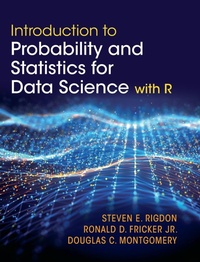
Introduction to Probability and Statistics for Data Science
with R
Published on 14. November 2024
Book
Hardback
828 pages
978-1-107-11304-6 (ISBN)
Description
Introduction to Probability and Statistics for Data Science provides a solid course in the fundamental concepts, methods and theory of statistics for students in statistics, data science, biostatistics, engineering, and physical science programs. It teaches students to understand, use, and build on modern statistical techniques for complex problems. The authors develop the methods from both an intuitive and mathematical angle, illustrating with simple examples how and why the methods work. More complicated examples, many of which incorporate data and code in R, show how the method is used in practice. Through this guidance, students get the big picture about how statistics works and can be applied. This text covers more modern topics such as regression trees, large scale hypothesis testing, bootstrapping, MCMC, time series, and fewer theoretical topics like the Cramer-Rao lower bound and the Rao-Blackwell theorem. It features more than 250 high-quality figures, 180 of which involve actual data. Data and R are code available on our website so that students can reproduce the examples and do hands-on exercises.
Reviews / Votes
'This book serves as an excellent resource for students with diverse backgrounds, offering a thorough exploration of fundamental topics in statistics. The clear explanation of concepts, methods, and theory, coupled with an abundance of practical examples, provides a solid foundation to help students understand statistical principles and bridge the gap between theory and application. This book offers invaluable insights and guidance for anyone seeking to master the principles of statistics. I highly recommend adopting this book for my future statistics class.' Haijun Gong, Saint Louis University 'Professors Rigdon, Fricker and Montgomery have put together an impressive volume that covers not only basic probability and basic statistics, but also includes extensions in a number of directions, all of which have immediate relevance to the work of practitioners in quantitative fields. Suffused with common sense and insights about real data and problems, it is both approachable and precise. I'm excited about the inclusion of material on power and on multiple testing, both of which will help users become smarter about what their analyses can do, and I applaud their omission of too much theory. I also appreciate their use of R and of real data. This would be an excellent text for undergraduate or graduate-level data analysts.' Sam Buttrey, Naval Postgraduate School (NPS) 'This is a comprehensive and rich book that extends foundational concepts in statistics and probability in easily accessible form into data science as an integrated discipline. The reader applies and validates theoretical concepts in R and connects results from R back to the theory across many methods: from descriptive statistics to Bayesian models, time series, generalized linear models and more. Thoroughly enjoyable!' Oliver Schabenberger, Virginia Tech Academy of Data ScienceMore details
Language
English
Place of publication
Cambridge
United Kingdom
Target group
College/higher education
Dimensions
Height: 260 mm
Width: 208 mm
Thickness: 49 mm
Weight
1967 gr
ISBN-13
978-1-107-11304-6 (9781107113046)
Copyright in bibliographic data and cover images is held by Nielsen Book Services Limited or by the publishers or by their respective licensors: all rights reserved.
Schweitzer Classification
Other editions
Additional editions
Steven E. Rigdon | Ronald D. Fricker, Jr | Douglas C. Montgomery
Introduction to Probability and Statistics for Data Science
with R
Book
11/2024
Cambridge University Press
€88.50
Available immediately
Persons
Steven E. Rigdon is Professor of Biostatistics at Saint Louis University. He is a fellow of the American Statistical Association and is the author of Statistical Methods for the Reliability of Repairable Systems Calculus, 8th and 9th editions, Monitoring the Health of Populations by Tracking Disease Outbreaks (2020), and Design of Experiments for Reliability Achievement (2022). He has received the Waldo Vizeau Award for technical contributions to quality, the Soren Bisgaard Award, and the Paul Simon Award for linking teaching and research. He is also Distinguished Research Professor Emeritus at Southern Illinois University Edwardsville. Ronald D. Fricker is Vice Provost for Faculty Affairs at Virginia Tech, where he has served as head of the Department of Statistics, Senior Associate Dean in the College of Science and, subsequently, interim dean of the college. He is the author of Introduction to Statistical Methods for Biosurveillance (2013) and with Steve Rigdon, Monitoring the Health of Populations by Tracking Disease Outbreaks (2020). He is a fellow of the American Statistical Association, a fellow of the American Association for the Advancement of Science, and an elected member of the Virginia Academy of Science, Engineering, and Medicine. Douglas C. Montgomery is Regents Professor and ASU Foundation Professor of Engineering at Arizona State University. He is an Honorary Member of the American Society for Quality, a fellow of the American Statistical Association, a fellow of the Institute of Industrial and Systems Engineering, and a fellow of the Royal Statistical Society. He is the author of fifteen other books including Design and Analysis of Experiments, 10th edition (2013) and Design of Experiments for Reliability Achievement (2022). He has received the Shewhart Medal, the Distinguished Service Medal, and the Brumbaugh Award from the ASQ, the Deming Lecture Award from the ASA, the Greenfield Medal from the Royal Statistical Society, and the George Box Medal from the European Network for Business and Industrial Statistics.
Content
Part I. Descriptive Statistics & Data Science: 1. Introduction; 2. Descriptive statistics; 3. Data visualization; Part II. Probability: 4. Basic probability; 5. Random variables; 6. Discrete distributions; 7. Continuous distribution; Part III. Classical Statistical Inference: 8. About data & data collection; 9. Sampling distributions; 10. Point estimation; 11. Confidence intervals; 12. Hypothesis testing; 13. Hypothesis tests for two or more samples; 14. Hypothesis tests for discrete data; 15. Regression; Part IV. Bayesian and Other Computer Intensive Methods: 16. Bayesian methods; 17. Time series methods; 18. The jackknife and bootstrap; Part V. Advanced Topics in Inference & Data Science: 19. Generalized linear models and regression trees; 20. Cross-validation and estimates of prediction error; 21. Large-scale hypothesis testing and the false discovery rate; Appendix. More About R.