

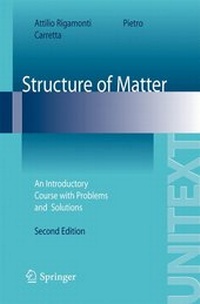
Structure of Matter
An Introductory Course with Problems and Solutions
2nd Edition
Published on 13. January 2009
Book
Paperback/Softback
XVII, 492 pages
978-88-470-1128-1 (ISBN)
Description
Intended Audience, Approach and Presentation This text is intended for a course of about four months for undergraduate students. Itarisesfromtheadaptationandtheamendmentstoatextforafu- yearcourseinStructureofMatter,writtenbyoneoftheauthors(A. R. )about thirty years ago. At that time only a few (if any) textbooks having the suited formforintroductiontothebasicquantumpropertiesofatoms,moleculesand crystalsinacomprehensiveandinterrelatedway,wereavailable. Alongthelast twentyyearsmanyexcellentbookspursuingtheaforementionedaimhavebeen published (some of them are listed at the end of this preface). Still there are reasons,inouropinion,toattemptafurthertextdevotedtothequantumroots of condensed matter properties. A practical aspect in this regard involves the organization of the studies in Physics, after the huge scienti?c outburst of the varioustopicsoffundamentalandtechnologicalcharacterinrecentdecades. In most Universities there is now a ?rst period of three or four years, common to all the students and devoted to elementary aspects, followed by an advanced program in more specialized ?elds of Physics. The di?cult task is to provide a common and formative introduction in the ?rst period suitable as a basis for buildingupmoreadvancedcoursesandtobridgetheareabetweenelementary physics and topics pertaining to the research activities. The present attempt towards a readable book, hopefully presenting those desired characteristics, essentially is based on a mixture of simpli?ed institutional theory with solved problems. The hope, in this way, is to provide physical insights, basic culture and motivation, without deteriorating the possibility of advanced subsequent learning. Organization Structure of Matter is such a wide ?eld involving so many subjects that a ?rst taskisto?ndawaytocon?neanintroductorytext. Thepresentstatusofthat VI Preface discipline represents a key construction of the scienti?c knowledge, possibly equated only by the unitary description of the electromagnetic phenomena.
Reviews / Votes
From the reviews:
"This highly recommended textbook builds bridges between elementary physics and research activities. Its main strength lies in its mixture of simplified theory in the main text and deeper exploration in the solved problems. It addresses key concepts and typical aspects of atoms, molecules and solids. . The numerous graphs and problems with solutions make this book particularly useful for self-studying an extremely wide scope of the structure of matter." (Peter Enders, Optics and Photonics News, February, 2008)
More details
Series
Edition
2nd ed. 2009
Language
English
Place of publication
Milano
Italy
Target group
Professional and scholarly
Graduate
Edition type
Revised edition
Product notice
Paperback (trade)
Illustrations
biography
Dimensions
Height: 0 mm
Width: 0 mm
Thickness: 26 mm
Weight
771 gr
ISBN-13
978-88-470-1128-1 (9788847011281)
DOI
10.1007/978-88-470-1129-8
Schweitzer Classification
Other editions
New editions

Attilio Rigamonti | Pietro Carretta
Structure of Matter
An Introductory Course with Problems and Solutions
Book
06/2015
3rd Edition
Springer
€117.69
Shipment within 10-15 days
Additional editions
Attilio Rigamonti | Pietro Carretta
Structure of Matter
An Introductory Course with Problems and Solutions
E-Book
08/2009
2nd Edition
Springer
€48.14
Available for download
Previous edition
Attilio Rigamonti | Pietro Carretta
Structure of Matter
An Introductory Course with Problems and Solutions
Book
03/2007
Springer
€48.10
Article exhausted; check for reprint
Content
Atoms: general aspects.- Typical atoms.- The shell vectorial model.- Atoms in electric and magnetic fields.- Nuclear moments and hyperfine interactions.- Spin statistics, magnetic resonance, spin motion and echoes.- Molecules: general aspects.- Electronic states in diatomic molecules.- Electronic states in selected polyatomic molecules.- Nuclear motions in molecules and related properties.- Crystal structures.- Electron states in crystals.- Miscellaneous aspects related to the electronic structure.- Vibrational motions of the ions and thermal effects.