

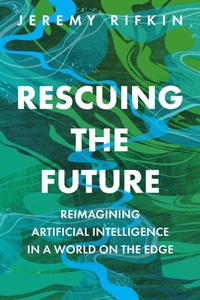
Rescuing the Future
Reimagining Artificial Intelligence in a World on the Edge
1st Edition
Will be published approx. on 16. July 2026
Book
Hardback
240 pages
978-1-5095-6442-2 (ISBN)
Description
AI and the Great Ontological Transformation
How did we get to this horrific moment when life itself may be snuffed out on this once animated planet? For 98 per cent of the time our species has inhabited the Earth, we adapted to the temporal processes, patterns, and flows of an environment alive with agency. Two thousand years ago our ancestors changed course and began to think of our world as made up of inert substances, things, and resources to be extracted, propertized, commodified, marketed, and consumed. We quickened the pace over the past two centuries of the Industrial Age, systematically stripping the planet of agency, and now find ourselves and our fellow creatures on the brink of extinction. Philosophers describe this historical dialectic as process ontology vs. substance ontology.
The existential question we now face is this: can we restore vibrant life on our planet or will we continue to exploit and degrade our Earthly largesse? The answer will depend, in great part, on how we choose to use Artificial Intelligence.
The powers that be in the AI world imagine a geopolitical approach to managing the planet, where a handful of tech giants govern the future and extract the last remains of what was a thriving environment, and where even humanity is bypassed by machine intelligence, giving rise to the "singularity" alongside an AI-framed substance ontology paradigm. By contrast, a powerful alternative AI is quietly scaling with the build-out of a highly distributed AI infrastructure attached to local ecosystems and stewarded by bioregional commons governance, enjoining the collaborative intelligence of both our species and our fellow creatures. The People's AI is pure process ontology and fosters a deep biophilic realignment with the natural world.
The choice we make between holding on to an AI substance ontology or grabbing hold of a nascent AI process ontology will determine whether our planet, once brimming with life, will flourish again or perish.
How did we get to this horrific moment when life itself may be snuffed out on this once animated planet? For 98 per cent of the time our species has inhabited the Earth, we adapted to the temporal processes, patterns, and flows of an environment alive with agency. Two thousand years ago our ancestors changed course and began to think of our world as made up of inert substances, things, and resources to be extracted, propertized, commodified, marketed, and consumed. We quickened the pace over the past two centuries of the Industrial Age, systematically stripping the planet of agency, and now find ourselves and our fellow creatures on the brink of extinction. Philosophers describe this historical dialectic as process ontology vs. substance ontology.
The existential question we now face is this: can we restore vibrant life on our planet or will we continue to exploit and degrade our Earthly largesse? The answer will depend, in great part, on how we choose to use Artificial Intelligence.
The powers that be in the AI world imagine a geopolitical approach to managing the planet, where a handful of tech giants govern the future and extract the last remains of what was a thriving environment, and where even humanity is bypassed by machine intelligence, giving rise to the "singularity" alongside an AI-framed substance ontology paradigm. By contrast, a powerful alternative AI is quietly scaling with the build-out of a highly distributed AI infrastructure attached to local ecosystems and stewarded by bioregional commons governance, enjoining the collaborative intelligence of both our species and our fellow creatures. The People's AI is pure process ontology and fosters a deep biophilic realignment with the natural world.
The choice we make between holding on to an AI substance ontology or grabbing hold of a nascent AI process ontology will determine whether our planet, once brimming with life, will flourish again or perish.
Reviews / Votes
"Rescuing the Future is a sweeping call to rethink how we understand progress, technology, and life itself amidst the rise of artificial intelligence. Drawing on decades of engagement with governments, industries, civil society, and academia, Jeremy Rifkin argues that the ecological crisis we face is not only the result of fossil fuels, but of a deeper worldview that treats nature as a collection of things rather than living systems. Written with intellectual honesty and philosophical ambition, this book meets the urgency of the moment by asking what kind of future we are coding into existence. It challenges readers to see the climate and extinction crises not as technical failures, but as a profound test of how we choose to live on Earth, and whether we are willing to change in time."Ani Dasgupta, President & CEO of World Resources Institute and author of The New Global Possible
More details
Person
Jeremy Rifkin is the bestselling author of twenty-four books translated into over thirty-five languages. He is a principal architect of the European Union's and China's economic plans for transitioning into a Third Industrial Revolution to address climate change, and he served as an economic advisor to Senate Majority Leader Charles Schumer on the U.S. infrastructure plan. He is listed among the top ten most influential economic thinkers in The Huffington Post's global survey of "The World's Most influential Voices."
Content
Introduction
Part 1: Rethinking Existence
Chapter 1. The Sublime: The Dialectic of Substance Ontology vs. Process Ontology
Chapter 2. All We Need to Know: Selfhoods, Verbs and Nouns
Chapter 3. Thermodynamics and Electromagnetic Fields: The Master "On" Switches of the Universe
Part 2: The New Economic Paradigm
Chapter 4. The Economic Transformation from Subtractive Manufacturing to 3D Printing Additive Infofacturing
Chapter 5. Everyone's the Infrastructure in a Distributed World
Part 3: How We Live in the Here and Now and the Afterlife
Chapter 6. Neoanimist Governance: From Nation-states in the Geopolitical Sphere to Bioregional Governance on the Commons in the Biosphere
Chapter 7. Three Ways to Look at the Afterlife: The Great Religions; Automata and the Singularity; and the Laws of Thermodynamics
Part 4: From the Age of Progress to the Age of Resilience
Chapter 8. The Machine Age Gives Way to the Information Age and Patents on Life: The Ultimate Substance Ontology
Chapter 9. The Old Science: Nature as Resources
Chapter 10. Rethinking Nature: The Emergence of Abductive Science and Complex Adaptive Social-Ecological Systems Science (CASES) in the 21st Century
Chapter 11. Why Conventional AI Can't Deliver: Known Knowns, Known Unknowns, and Unknown Unknowns
Chapter 12: Fluid Art and Architecture In A Process-Oriented World
Part 5: Coming Together on a Seamless Planet
Chapter 13. Frontiers vs. Ecotones and Edges: Nestling in Biomes, Ecosystems, and Microbiomes
Chapter 14. The Last Dance: The Wisdom of Crowds and Collective Intelligence
Chapter 15. From Animism to Neoanimism: The Last Chance
Conclusion: The Future is Here
Acknowledgements
Notes
Index
Part 1: Rethinking Existence
Chapter 1. The Sublime: The Dialectic of Substance Ontology vs. Process Ontology
Chapter 2. All We Need to Know: Selfhoods, Verbs and Nouns
Chapter 3. Thermodynamics and Electromagnetic Fields: The Master "On" Switches of the Universe
Part 2: The New Economic Paradigm
Chapter 4. The Economic Transformation from Subtractive Manufacturing to 3D Printing Additive Infofacturing
Chapter 5. Everyone's the Infrastructure in a Distributed World
Part 3: How We Live in the Here and Now and the Afterlife
Chapter 6. Neoanimist Governance: From Nation-states in the Geopolitical Sphere to Bioregional Governance on the Commons in the Biosphere
Chapter 7. Three Ways to Look at the Afterlife: The Great Religions; Automata and the Singularity; and the Laws of Thermodynamics
Part 4: From the Age of Progress to the Age of Resilience
Chapter 8. The Machine Age Gives Way to the Information Age and Patents on Life: The Ultimate Substance Ontology
Chapter 9. The Old Science: Nature as Resources
Chapter 10. Rethinking Nature: The Emergence of Abductive Science and Complex Adaptive Social-Ecological Systems Science (CASES) in the 21st Century
Chapter 11. Why Conventional AI Can't Deliver: Known Knowns, Known Unknowns, and Unknown Unknowns
Chapter 12: Fluid Art and Architecture In A Process-Oriented World
Part 5: Coming Together on a Seamless Planet
Chapter 13. Frontiers vs. Ecotones and Edges: Nestling in Biomes, Ecosystems, and Microbiomes
Chapter 14. The Last Dance: The Wisdom of Crowds and Collective Intelligence
Chapter 15. From Animism to Neoanimism: The Last Chance
Conclusion: The Future is Here
Acknowledgements
Notes
Index