

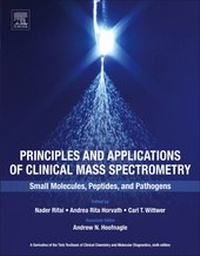
Principles and Applications of Clinical Mass Spectrometry
Small Molecules, Peptides, and Pathogens
Published on 18. June 2018
Book
Paperback/Softback
216 pages
978-0-12-816063-3 (ISBN)
Description
Principles and Applications of Clinical Mass Spectrometry: Small Molecules, Peptides, and Pathogens is a concise resource for quick implementation of mass spectrometry methods in clinical laboratory work. Focusing on the practical use of these techniques, the first half of the book covers principles of chromatographic separations, principles and types of mass spectrometers, and sample preparation for analysis; the second half outlines the main applications of this technology within clinical laboratory settings, including determination of small molecules and peptides, as well as pathogen identification. A thorough yet succinct guide to using mass spectrometry technology in the clinical laboratory, Principles and Applications of Clinical Mass Spectrometry: Small Molecules, Peptides, and Pathogens is an essential resource for chemists, pharmaceutical and biotech researchers, certain government agencies, and standardization groups.
More details
Language
English
Place of publication
United States
Target group
Professional and scholarly
Dimensions
Height: 276 mm
Width: 216 mm
Weight
700 gr
ISBN-13
978-0-12-816063-3 (9780128160633)
Copyright in bibliographic data and cover images is held by Nielsen Book Services Limited or by the publishers or by their respective licensors: all rights reserved.
Schweitzer Classification
Other editions
Additional editions
Nader Rifai | A. Rita Horvath | Carl T. Wittwer
Principles and Applications of Clinical Mass Spectrometry
Small Molecules, Peptides, and Pathogens
E-Book
06/2018
Elsevier
€105.00
Available for download
Persons
Andrea Rita Horvath's key research interests include evidence-based laboratory medicine (EBLM) including evidence-based monitoring, guideline development, and evaluation of new biomarkers and overdiagnosis. She holds advisory roles on test utilization and reimbursement policy at the National Prescribing Service of Australia and Medicare. She has published 160 research papers and 16 book chapters and has been an invited speaker at over 100 international conferences. Her national and international leadership positions include Chair of the IFCC Committee on EBLM (2003-2008); European Communities Confederation of Clinical Chemistry and Laboratory Medicine (EC4) Secretary (2005-2007); President of the Hungarian Society (2005-2008) and the Hungarian College of Laboratory Medicine (2008-2009); President-Elect (2007-2009), President (2009-2011) and Past President (2012-2013) of the European Federation of Clinical Chemistry and Laboratory Medicine (EFLM); chair of the EFLM working group on Test Evaluation (2011-2015) and member of the Board of Directors of the American Association of Clinical Chemistry (2014-2016). Andy Hoofnagle received his undergraduate education at Cornell University. He obtained his medical degree from the University of Colorado Health Sciences and his PhD from the University of Colorado, Boulder as part of the Medical Scientist Training Program. During his residency and chief residency in Clinical Pathology in the Department of Laboratory Medicine at the University of Washington, he did his post-doctoral work in the laboratory of Jay Heinecke, Department of Medicine. He was then promoted to Assistant Professor of Laboratory Medicine and now serves as the Director of Clinical Mass Spectrometry.
Dr. Hoofnagle's laboratory focuses on using proteomic and metabolomic approaches to investigate the intersection of inflammation and lipid metabolism. His laboratory is pioneering the use of immunoaffinity peptide enrichment strategies of analyte-specific peptides from tryptic digests in the clinical analysis of low-abundance serum proteins. The laboratory has developed assays for small molecule analytes, including arginine, arginine metabolites, and vitamin D, which are being used in basic science and large-scale clinical studies. Several mouse models are being used to assess the importance of complement regulatory proteins in insulin sensitivity and lipid metabolism. All of these studies are in collaboration with outstanding investigators from the University of Washington and elsewhere.
Dr. Hoofnagle's laboratory focuses on using proteomic and metabolomic approaches to investigate the intersection of inflammation and lipid metabolism. His laboratory is pioneering the use of immunoaffinity peptide enrichment strategies of analyte-specific peptides from tryptic digests in the clinical analysis of low-abundance serum proteins. The laboratory has developed assays for small molecule analytes, including arginine, arginine metabolites, and vitamin D, which are being used in basic science and large-scale clinical studies. Several mouse models are being used to assess the importance of complement regulatory proteins in insulin sensitivity and lipid metabolism. All of these studies are in collaboration with outstanding investigators from the University of Washington and elsewhere.
Editor
Professor Department of Pathology Harvard Medical School; The Louis Joseph Gay-Lussac Chair in Laboratory Medicine Boston Children's Hospital; Director of Clinical Chemistry Laboratory Medicine Boston Children's Hospital Boston, Massachusetts, USA
Professor, School of Medical Sciences, University of New South Wales, Sydney, Australia
Professor Emeritus,Pathology,University of Utah ,Salt Lake City, Utah
Professor, Department of Laboratory Medicine
Head, Division of Clinical Chemistry, University of Washington
Seattle, WA USA
Head, Division of Clinical Chemistry, University of Washington
Seattle, WA USA
Content
1. Chromatography
2. Mass spectrometry
3. Sample preparation for mass spectrometry applications
4. Mass spectrometry applications in infectious disease and pathogens identification
5. Development and Validation of Small Molecule Analytes By Liquid Chromatography-Tandem Mass Spectrometry
6. Proteomics
2. Mass spectrometry
3. Sample preparation for mass spectrometry applications
4. Mass spectrometry applications in infectious disease and pathogens identification
5. Development and Validation of Small Molecule Analytes By Liquid Chromatography-Tandem Mass Spectrometry
6. Proteomics