

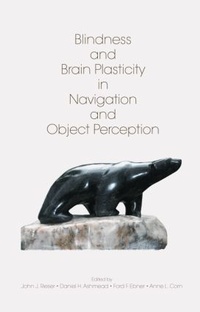
Blindness and Brain Plasticity in Navigation and Object Perception
1st Edition
Published on 10. August 2007
Book
Hardback
436 pages
978-0-8058-5551-7 (ISBN)
Description
Research into the development of sensory structures in the brains of blind or visually-impaired individuals has opened a window into important ways in which the mind works. In these individuals, the part of the brain that is usually devoted to processing visual information is given over to increased processing of the touch and hearing sense. This demonstration of brain plasticity is of great importance to cognitive neuroscientists and cognitive psychologists, and has real implications for rehabilitation and education specialists who work with the visually impaired. This is an interdisciplinary book, featuring chapters from cognitive and developmental psychologists, neurologists and neuroscientists, and rehabilitation specialists and educators. All of these groups do research in this area but generally do not collaborate with one another. This book is an attempt to bring together the disparate threads of research into a single volume, appropriate for all three markets.
More details
Language
English
Place of publication
Philadelphia
United States
Publishing group
Taylor & Francis Inc
Target group
College/higher education
Professional and scholarly
Dimensions
Height: 229 mm
Width: 152 mm
Weight
970 gr
ISBN-13
978-0-8058-5551-7 (9780805855517)
Copyright in bibliographic data and cover images is held by Nielsen Book Services Limited or by the publishers or by their respective licensors: all rights reserved.
Schweitzer Classification
Other editions
Additional editions
John J. Rieser | Daniel H. Ashmead | Ford Ebner
Blindness and Brain Plasticity in Navigation and Object Perception
Book
08/2007
Psychology Press
€59.60
The article will not be published
John J. Rieser | Daniel H. Ashmead | Ford Ebner
Blindness and Brain Plasticity in Navigation and Object Perception
E-Book
08/2007
1st Edition
Psychology Press Ltd
€73.49
Available for download
John J. Rieser | Daniel H. Ashmead | Ford Ebner
Blindness and Brain Plasticity in Navigation and Object Perception
E-Book
08/2007
1st Edition
Psychology Press Ltd
€73.99
Available for download
Persons
John J. Rieser, Daniel H. Ashmead, Ford Ebner, Anne L. Corn
Content
Preface. Introduction. J.J. Rieser, Theory and Issues in Research on Blindness and Brain Plasticity. H.L. Pick, History of Research on Blindness and Brain Plasticity. Part 1. Experience Dependent Recruitment of Visual Cortex for Nonvisual Learning and Development. L.B. Merabet, N.B. Pitskel, A. Amedi, A. Pascual-Leone, The Plastic Human Brain in Blind Individuals: The Cause of Disability and the Opportunity for Rehabilitation. J. Rauschecker, Plasticity of Cortical Maps in Visual Deprivation. A. Vanlierde, L. Renier, A.G. De Volder, Brain Plasticity and Multi-Sensory Experience in Early Blind Individuals. P. Melzer, F. Ebner, Braille, Plasticity, and the Mind. K. Sathian, S. Lacey, Visual Cortical Involvement During Tactile Perception in Blind and Sighted Individuals. I. Fine, The Behavioral and Neurophysiological Effects of Sensory Deprivation. Part 2. Perception, Sensory Substitution, and Cognitive Strategies.J.M. Loomis, R. Klatzky, Functional Equivalence of Spatial Representations From Vision, Touch, and Hearing: Relevance for Sensory Substitution. R. Klatzky, S. Lederman, Object Recognition by Touch. G. Legge, S-H. Cheung, S.T.L. Chung, H-W. Lee, J. Gefroh, MY. Kwon, Training Peripheral Vision to Read. P.A. Cummins, J.J. Rieser, Strategies of Maintaining Dynamic Spatial Orientation When Walking Without Vision. F. Mast, T. Zaehle, Spatial Reference Frames Used in Mental Imagery Tasks. M. Heller, A. Clark, Touch as a "Reality Sense". Part 3. From Use-Oriented Research to Application.P. Ponchillia, Nonvisual Sports and Art: Fertile Substrates for the Growth of Knowledge About Brain Plasticity in People Who Are Blind or Have Low Vision. B.L. Bentzen, Making the Environment Accessible to Pedestrians Who Are Visually Impaired: Policy Research. R. Long, Crossing Streets Without Vision: Access to Information, Strategies for Traveling, and the Impact of Technology, Training, and Environmental Design. D. Guth, Why Does Training Reduce Blind Pedestrians' Veering? R.W. Emerson, D. Ashmead, Visual Experience and the Concept of Compensatory Spatial Hearing Abilities. F. Vital-Duran, Rehabilitation Strategies in Individuals With Age-Related Macular Degeneration.