

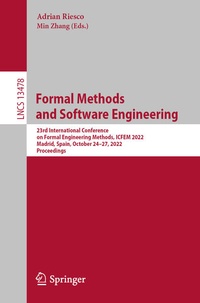
Formal Methods and Software Engineering
23rd International Conference on Formal Engineering Methods, ICFEM 2022, Madrid, Spain, October 24-27, 2022, Proceedings
Published on 10. October 2022
Book
Paperback/Softback
XV, 440 pages
978-3-031-17243-4 (ISBN)
Description
This book constitutes the proceedings of the 23rd International Conference on Formal Engineering Methods, ICFEM 2022, held in Madrid, Spain, in October 2022. The 16 full and 4 short papers presented together with 1 doctoral symposium paper in this volume were carefully reviewed and selected from 41 submissions. The papers cover for research in all areas related to formal engineering methods, such as verification and validation, software engineering, formal specification and modeling, software security, and software reliability.
More details
Series
Edition
1st ed. 2022
Language
English
Place of publication
Cham
Switzerland
Publishing group
Springer International Publishing
Target group
Professional and scholarly
Illustrations
504 s/w Abbildungen, 76 farbige Abbildungen
XV, 440 p. 580 illus., 76 illus. in color.
Dimensions
Height: 235 mm
Width: 155 mm
Thickness: 25 mm
Weight
692 gr
ISBN-13
978-3-031-17243-4 (9783031172434)
DOI
10.1007/978-3-031-17244-1
Schweitzer Classification
Other editions
Additional editions
Adrian Riesco | Min Zhang
Formal Methods and Software Engineering
23rd International Conference on Formal Engineering Methods, ICFEM 2022, Madrid, Spain, October 24-27, 2022, Proceedings
E-Book
10/2022
Springer
€53.49
Available for download
Persons
Content
Model checking quantum Markov chains.- Bridging Formal Methods and Machine Learning with Global Optimisation.- Canonical Narrowing for Variant-based Conditional Rewrite Theories.- Modular Analysis of Tree-Topology Models.- Non-linear optimization methods for learning regular distributions.- Separation of concerning things: a simpler basis for defining and programming with the C\C++ memory model.- Creusot: a Foundry for the Deductive Verification of Rust Programs.- Generation of a Reversible Semantics for Erlang in Maude.- Program slicing techniques with support for unconditional jumps.- Formal verification of the inter-core synchronization of a multi-core RTOS kernel.- SMT-Based Model Checking of Industrial Simulink Models.- PFMC: A Parallel Symbolic Model Checker for Security Protocol Verification.- A Formal Methodology for Verifying Side-channel Vulnerabilities in Cache Architectures.- Refined Modularization for Bounded Model Checking through Precondition Generation.- TTT/ik: Learning Accurate Mealy Automata Efficiently with an Imprecise Symbol Filter.- A Proof System for Cyber-physical Systems with Shared-Variable Concurrency.- Theorem proving for Maude specifications using Lean.- On How to Not Prove Faulty Controllers Safe in Differential Dynamic Logic.- Declassification predicates for controlled information release.- Trace Refinement in B and Event-B.- Model Checking B Models via High-level Code Generation.- On Probabilistic Extension of The Interaction Theory.- Extracting Weighted Finite Automata from Recurrent Neural Networks for Natural Languages.- RoboCert: Property Specification in Robotics.- Formally Verified Animation for RoboChart using Interaction Trees.- Machine-checked executable semantics of Stateflow.