

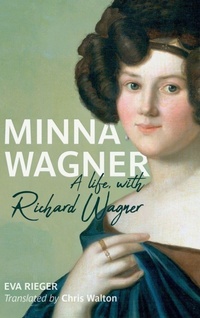
Minna Wagner
A Life, with Richard Wagner
Published on 19. July 2022
Book
Hardback
376 pages
978-1-64825-045-3 (ISBN)
Description
This biography of Minna Planer, Richard Wagner's wife of 30 years, reveals her as a self-assured woman and artist who was vital to her husband's creative life.
When Richard Wagner first met Minna Planer in 1834, he was an unknown conductor, she a popular actress. His hectic pursuit of her affections culminated in marriage in 1836. Minna endured poverty with him, nursed him through chronic illness, followed him across Europe as he fled from creditors and pursued his artistic goals, and sought to provide him with the stable domestic and erotic life that he craved. He played his works to her as he wrote them, up to Tannhaeuser and Lohengrin, and set store by her opinions. But when he went on the run as a wanted revolutionary, Minna only reluctantly followed him into Swiss exile.
Domestic peace tentatively prevailed, but was ultimately destroyed by Wagner's passion for Mathilde Wesendonck. In 1858, he and Minna separated, she returned home to Germany, and subsequent efforts at reconciliation proved ultimately impossible. They remained married, however, until Minna's death in 1866.
Despite having been at Richard's side as he matured into the composer of the Ring and Tristan, Minna has been given short shrift by most Wagner commentators. In Eva Rieger's acclaimed biography, translated into English by Chris Walton, the author reveals Minna as a self-assured woman and artist who played a crucial role in the creative life of her husband.
When Richard Wagner first met Minna Planer in 1834, he was an unknown conductor, she a popular actress. His hectic pursuit of her affections culminated in marriage in 1836. Minna endured poverty with him, nursed him through chronic illness, followed him across Europe as he fled from creditors and pursued his artistic goals, and sought to provide him with the stable domestic and erotic life that he craved. He played his works to her as he wrote them, up to Tannhaeuser and Lohengrin, and set store by her opinions. But when he went on the run as a wanted revolutionary, Minna only reluctantly followed him into Swiss exile.
Domestic peace tentatively prevailed, but was ultimately destroyed by Wagner's passion for Mathilde Wesendonck. In 1858, he and Minna separated, she returned home to Germany, and subsequent efforts at reconciliation proved ultimately impossible. They remained married, however, until Minna's death in 1866.
Despite having been at Richard's side as he matured into the composer of the Ring and Tristan, Minna has been given short shrift by most Wagner commentators. In Eva Rieger's acclaimed biography, translated into English by Chris Walton, the author reveals Minna as a self-assured woman and artist who played a crucial role in the creative life of her husband.
Reviews / Votes
Fascinating, detailed, and absorbing. Chris Walton has done a superb job in creating the illusion that this volume was written in English. Detailed footnotes are included as well as a number of germane photographs. Marvelous to read and completely engrossing. * AMERICAN RECORD GUIDE * Through Rieger's vivid and sometimes humorous presentation of Richard and Minna's daily life together, we discover an attractive and also tragic figure, courageous, highly adaptable and generous to the point of offering her last piece of bread to a hungry friend, even when she didn't know what her own next meal would be. -- Anna Stoll Knecht * The Wagner Journal *More details
Series
Language
English
Place of publication
Rochester
United States
Publishing group
Boydell & Brewer Ltd
Target group
Professional and scholarly
Product notice
Cloth over boards
Illustrations
28 b/w illus.
Dimensions
Height: 235 mm
Width: 157 mm
Thickness: 25 mm
Weight
697 gr
ISBN-13
978-1-64825-045-3 (9781648250453)
Copyright in bibliographic data and cover images is held by Nielsen Book Services Limited or by the publishers or by their respective licensors: all rights reserved.
Schweitzer Classification
Other editions
Additional editions
Book
09/2023
University of Rochester Press
€53.41
Shipment within 3-4 weeks
E-Book
07/2022
1st Edition
Boydell & Brewer
€48.99
Available for download
E-Book
07/2022
1st Edition
De Gruyter
€48.99
Available for download
Persons
EVA RIEGER is professor emeritus in historical musicology at the University of Bremen. CHRIS WALTON teaches music history at the Basel Academy of Music in Switzerland, is an Honorary Professor at Africa Open Institute (Stellenbosch University in South Africa) and runs a research project at the Bern Academy of the Arts for the Swiss National Science Foundation.
Content
Illustrations
Abbreviations
Notes on this translation
Introduction: "He could not breathe without her"
Chapter 1. "I have become her despot": From Love to Marriage
Chapter 2. "Deprived of incipient motherhood": Riga, London, Paris, 1836-1842
Chapter 3. "Home for me is you alone": Dresden 1842-1847
Chapter 4. "My knucklehead of a husband": Revolution and Its Aftermath, 1848-1850
Chapter 5. "This ridiculous, amorous intrigue": The Jessie Laussot Affair, 1850-1851
Chapter 6. "That good, foolish man...": Exile in Zurich, 1852-1854
Chapter 7. "I'm a poor, stupid woman to have let you go...": Zurich and London, 1854-1856
Chapter 8. "Alas, now all our happiness is gone...": The Wesendonck Scandal, 1857-1858
Chapter 9. The Bitter End: 1858-1859
Chapter 10. "In love and fidelity, your Emma": Emma Herwegh
Chapter 11. "...neither wife, housekeeper, nor friend": Dresden, Paris, Biebrich, 1860-1862
Chapter 12. "That weak, blind man...": The end of a marriage, 1863-1866
References
Index
Abbreviations
Notes on this translation
Introduction: "He could not breathe without her"
Chapter 1. "I have become her despot": From Love to Marriage
Chapter 2. "Deprived of incipient motherhood": Riga, London, Paris, 1836-1842
Chapter 3. "Home for me is you alone": Dresden 1842-1847
Chapter 4. "My knucklehead of a husband": Revolution and Its Aftermath, 1848-1850
Chapter 5. "This ridiculous, amorous intrigue": The Jessie Laussot Affair, 1850-1851
Chapter 6. "That good, foolish man...": Exile in Zurich, 1852-1854
Chapter 7. "I'm a poor, stupid woman to have let you go...": Zurich and London, 1854-1856
Chapter 8. "Alas, now all our happiness is gone...": The Wesendonck Scandal, 1857-1858
Chapter 9. The Bitter End: 1858-1859
Chapter 10. "In love and fidelity, your Emma": Emma Herwegh
Chapter 11. "...neither wife, housekeeper, nor friend": Dresden, Paris, Biebrich, 1860-1862
Chapter 12. "That weak, blind man...": The end of a marriage, 1863-1866
References
Index