

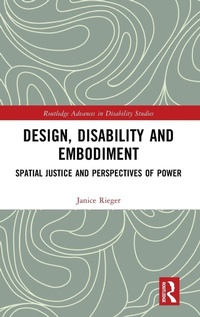
Design, Disability and Embodiment
Spatial Justice and Perspectives of Power
1st Edition
Published on 31. July 2023
Book
Hardback
122 pages
978-1-032-07684-3 (ISBN)
Description
This timely book explores the spatial and social injustices within our streets, malls, schools, and public institutions. Taken-for-granted acts like going for a walk, seeing an exhibition with a friend, and going to school are, for people with disabilities, conditional or precluded acts due to exclusion by design.
This book stimulates debate and discussion about current practice and studies in spatial design in the context of disability and the growing need for inclusive design globally. Case studies of inclusive design in spaces like museums, malls, galleries and universities are presented to challenge and expose the perspectives of power and spatial injustices that still exist within these spaces today. The international case studies presented purposely privilege the voices and perspectives of people with disabilities, to expose the multisensorial perspectives of spatial justice in order to understand inclusion more holistically through embodiment.
If you are an architect, designer, arts educator, curator or museum professional or just want a world where spatial justice is possible, then this book will provide you with a new perspective of spatial design through critical disability studies, allyship and codesign, where tangible approaches and practices for inclusive design are explored.
This book stimulates debate and discussion about current practice and studies in spatial design in the context of disability and the growing need for inclusive design globally. Case studies of inclusive design in spaces like museums, malls, galleries and universities are presented to challenge and expose the perspectives of power and spatial injustices that still exist within these spaces today. The international case studies presented purposely privilege the voices and perspectives of people with disabilities, to expose the multisensorial perspectives of spatial justice in order to understand inclusion more holistically through embodiment.
If you are an architect, designer, arts educator, curator or museum professional or just want a world where spatial justice is possible, then this book will provide you with a new perspective of spatial design through critical disability studies, allyship and codesign, where tangible approaches and practices for inclusive design are explored.
More details
Series
Language
English
Place of publication
London
United Kingdom
Publishing group
Taylor & Francis Ltd
Target group
College/higher education
Academic and Postgraduate
Illustrations
12 s/w Abbildungen, 12 s/w Photographien bzw. Rasterbilder, 2 s/w Tabellen
2 Tables, black and white; 12 Halftones, black and white; 12 Illustrations, black and white
Dimensions
Height: 240 mm
Width: 161 mm
Thickness: 12 mm
Weight
373 gr
ISBN-13
978-1-032-07684-3 (9781032076843)
Copyright in bibliographic data and cover images is held by Nielsen Book Services Limited or by the publishers or by their respective licensors: all rights reserved.
Schweitzer Classification
Other editions
Additional editions
Book
11/2024
1st Edition
Routledge
€64.90
Shipment within 10-20 days
E-Book
07/2023
1st Edition
Routledge
€59.49
Available for download
E-Book
07/2023
1st Edition
Routledge
€59.49
Available for download
Person
Janice Rieger is Associate Professor in the School of Architecture and Built Environment at Queensland University of Technology in Australia, and Australian Research Council Principal Research Fellow. With a background in inclusive design and spatial design, Janice's research focuses on creating cultures of inclusion through codesign and spatial justice. She is a passionate advocate for access, inclusion, and disability research.
Content
Part One - Introduction. 1.Perspectives of Power and Points of Contention. Part Two - Deconstructing Ableism. 2.Embodied Mapping/s (EM): Weaving Lines through Multisensorial Storytelling. 3.Designing Differently through Acoustemology: Sound, Soundscapes and Sonic Environments. 4.Dialoguing while Wandering: Co-creating Inclusion through Short Films. 5.Poetic Plans: Creating Alternate Experiences of the White Cube. Part Three - Constructing Inclusive Experiences. 6.Plans to Intervene: A Critical Access Approach. 7.Spatial Histories and Injustices: Reframing Architectural Education. 8.Inclusive Ecologies: Care-full Codesigning in More than Human Worlds. Part Four - Conclusion. 9.Spatial Justice and New Trajectories through Allyship and Design for All.